Applying AI in archaeological research and early warning of natural disasters in Vietnam
AI is being widely applied in many fields of social science and humanities research, such as archaeological research or in the field of natural disaster forecasting.
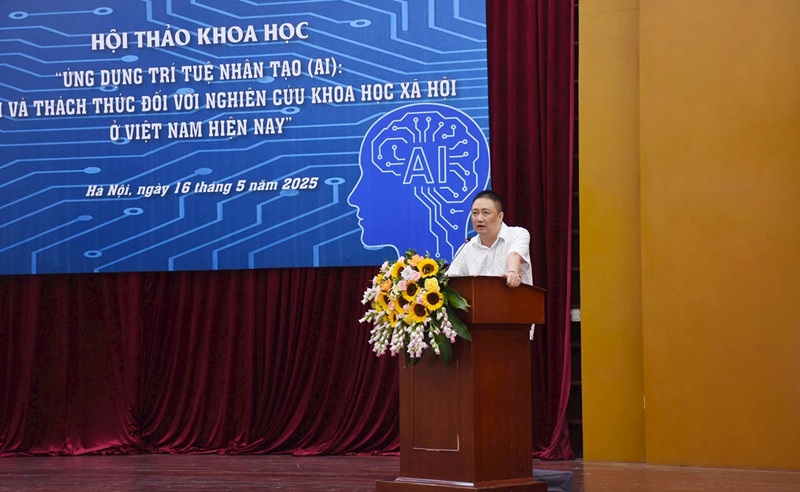
Dr. Ha Van Can: The use of AI in archaeological research has rapidly developed strongly.
Sharing at the scientific conference “Application of artificial intelligence (AI): Opportunities and challenges for social science research in Vietnam today” recently organized by the Vietnam Academy of Social Sciences (VASS), Dr. Ha Van Can, Deputy Director in charge of the Institute of Archaeology, said: Archaeological research - traditionally a field that depends heavily on human knowledge and practical experience to collect and analyze data.
In recent years, AI technology has opened up many breakthrough opportunities for the archaeology industry, helping to improve the ability to excavate, analyze and preserve ancient relics. Thanks to artificial intelligence, archaeologists can process big data, use computer vision to analyze images, detect artifacts and accurately map archaeological sites.
3D scanning technology, digital modeling and virtual reality also help create accurate digital copies, without direct contact, easily comparing cultural layers through periods and simulating damaged artifacts. In particular, modern LiDAR technology helps to explore large areas, detect underground architecture, support terrain analysis and search for archaeological targets in dense areas, such as Co Loa citadel, with clear application results through excavations, from discovering ancient tombs to other ancient works.
In addition to archaeology, AI also plays an important role in the field of conservation and anthropological research in Vietnam. Data analysis software helps build family tree diagrams, identify historical relationships of ancient groups of residents, as well as track the migration and occupation of lands in the past. Thanks to 3D scanning technology, researchers can easily analyze soil structure and stratification in the field without direct contact, thereby simulating and restoring damaged or lost artifacts. AI algorithms also help identify damage, develop restoration plans, and monitor the environment to predict natural risks, in order to better protect cultural heritage from physical impacts, such as changes in temperature, humidity or pollution.
In the field of natural disaster forecasting, AI has become an essential tool for early warning of extreme climate change. Thanks to forecasting models using huge hydrometeorological data, AI helps predict more accurately, shortens decision-making time, thereby improving the community's response capacity. These systems provide timely information about storms and floods, helping to minimize human and property damage, and support the development of long-term plans to adapt to climate change. As a result, long-term forecasting capabilities are increasingly accurate, contributing significantly to natural disaster prevention and community protection.