Operating the Science, Technology & Innovation Fund: Transparent resource allocation, with output results as the central benchmark.
Circular No. 17/2026/TT-BKHCN not only establishes a unified legal framework for Science, Technology and Innovation Development Funds, but also clearly defines a modern governance model: transparency, market linkage, and output-centricity. This is considered an important step to "unlock" capital flows for science and technology to operate flexibly, efficiently, and closer to international standards.
The Ministry of Science and Technology has just issued Circular No. 17/2026/TT-BKHCN, along with a model charter on the organization and operation of the Science, Technology and Innovation Development Fund, to be applied uniformly from the central to local levels, effective from April 16, 2026.
For the first time, a comprehensive legal framework has been established for the entire fund system, creating a foundation for unified governance while ensuring proactiveness and flexibility in accordance with practical realities.
Non-profit, operates according to market mechanisms.
According to regulations, ministries, sectors, and localities shall base their actions on the model charter to issue and finalize the charters governing the organization and operation of funds under their management, while also reviewing and adjusting existing regulations within the prescribed timeframe.
The Fund is defined as a non-profit state-owned financial institution with legal personality, receiving and utilizing resources from the state budget and other legitimate sources. Its overarching goal is to promote science, technology, and innovation as the central driving force of a knowledge-based growth model.

A notable new feature is the inclusion of the term "innovation," ensuring consistency with the 2025 Law on Science, Technology and Innovation, while also establishing a risk management mechanism suitable to the specifics of research. Objective risks, arising unexpectedly but following the correct procedures, may be considered acceptable; stage-by-stage evaluation serves as the basis for deciding whether to continue, adjust, or terminate the project, ensuring flexibility and effectiveness.
Furthermore, the requirement to apply digital platforms in management, monitoring, and evaluation has been consistently emphasized, promoting comprehensive digital transformation in the Fund's operations. New mechanisms such as co-financing between the State and enterprises, receiving non-budgetary resources, and strengthening accountability and oversight have also been designed in a coordinated manner, aiming for modern governance.
In terms of operational objectives, the Fund is positioned to promote science, technology, and innovation as the central driving force of a knowledge-based growth model. Funding, commissioning, and support activities are not spread thinly but focus on solving major problems in specific sectors, fields, and localities; while simultaneously improving productivity, quality, and the competitiveness of the economy. All management activities are output-oriented, closely linked to market needs; contributing to the formation of an effective science, technology, and innovation ecosystem, linking the State - research institutes/universities - businesses.
The Fund's functions include funding and commissioning science, technology, and innovation programs and tasks, as well as providing financial support and interest rate subsidies for technology application, technology transfer, technological innovation, and creative innovation; supporting activities to enhance science and technology capacity; supporting the development of innovation systems and creative startup ecosystems; and promoting a culture of innovation and creative entrepreneurship.
Notably, the entire process of selecting tasks and implementing entities is organized according to the principles of openness, transparency, competition, and non-discrimination. The deep involvement of businesses in advisory and evaluation councils contributes to making "market signals" an important criterion in resource allocation.
The co-financing mechanism is clearly defined, prioritizing state budget allocation for basic and applied research, while the contribution of businesses gradually increases as the technology matures and becomes commercially viable. This approach not only effectively mobilizes social resources but also promotes linkages between research, application, and the market.
Results-based management, accepting controlled risk.
A fundamental change established in the Circular is the shift from "input-based management" to "output-based management". Accordingly, funding is allocated according to evaluation milestones linked to the progress and results of task implementation, instead of being distributed haphazardly, while also allowing for adjustments, continuation, or termination of tasks based on evaluation results.
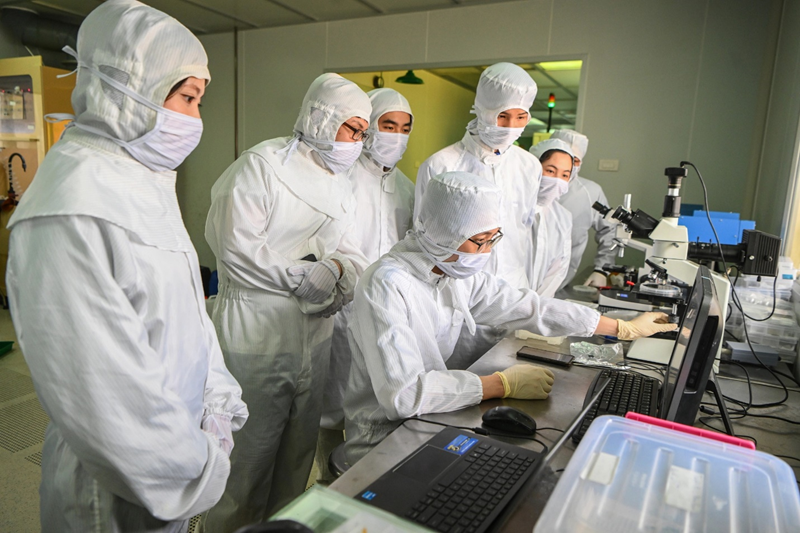
The application of digital technology and artificial intelligence in planning, monitoring, evaluating, and disclosing resources is required to be implemented throughout, aiming for modern, transparent, and real-time governance.
In particular, the organizational structure has been adjusted to clearly define roles: the Management Board focuses on strategic direction and supervision; the Executive Agency proactively implements funding, ordering, support, and other activities of the Fund in accordance with the law and the Charter, ensuring flexibility and timeliness in the implementation process.
The risk management, inspection, monitoring, and accountability mechanisms are designed in a coordinated manner, allowing for controlled risk acceptance in scientific research and innovation; ensuring the Fund operates transparently, efficiently, and in accordance with modern governance practices. Risk assessment is conducted through a scientific council or independent experts, serving as the basis for decisions on continuing, adjusting, or terminating projects.
The circular also emphasizes the need for strong decentralization and delegation of power, avoiding the imposition of rigid models, and creating conditions for ministries, sectors, and localities to proactively choose operating models that suit their practical realities.
With Circular 17/2026/TT-BKHCN, a new institutional framework for Science, Technology & Innovation Funds has been clearly defined: from standardized operations and transparent funding to results-based management and controlled risk acceptance. This not only perfects the financial mechanism for science, technology & innovation, but also provides a significant impetus to promote the development of a truly robust innovation ecosystem, closely linking the State - research institutes/universities - businesses, thereby directly contributing to a growth model based on knowledge, science, technology & innovation.
Center for Science and Technology Communication