Cao Bang: Digital skills popularization focuses on practical needs.
In the national digital transformation process, the popularization of digital knowledge and skills is not just a technical task, but has become a fundamental development requirement, ensuring the inclusiveness of growth. In Cao Bang, a mountainous, border province with many unique geographical and demographic characteristics, the "Digital Literacy Movement" is being implemented in a practical way, focusing on the people, and gradually building the foundation of a digital society from the grassroots.
After more than 5 months of implementation (from August 2025 to early 2026), although still in its initial phase, the movement has recorded noteworthy initial results, showing that the approach is suitable to the local practical conditions.
Timely policy and systematic implementation.
The "Digital Literacy Movement" in Cao Bang was launched in the context of the province having just completed the reorganization of administrative units according to the two-tiered local government model. This is a time when the need to improve the effectiveness and efficiency of serving the people is clearly evident, and at the same time, it demands that digital transformation be substantive, not merely superficial.
Based on that, the Provincial Party Committee issued Plan No. 465-KH/TU dated May 16, 2025; and the Provincial People's Committee issued Plan No. 2554/KH-UBND dated August 14, 2025 to implement the movement throughout the province. A noteworthy point is that these plans not only provide guidance but also concretize objectives and tasks, clearly assigning responsibilities to each agency and unit.
The Department of Science and Technology is assigned as the permanent agency, acting as the specialized focal point to monitor, evaluate, and connect the movement with the tasks related to science, technology, innovation, and digital transformation being implemented in the area.
The dissemination and promotion efforts were organized synchronously with 2,622 conferences, attracting more than 60,000 delegates. In addition, the Fatherland Front system and political and social organizations carried out 1,734 propaganda campaigns, with more than 116,000 participants. Integrating the content of the movement with emulation programs, especially the "Nationwide Emulation in Innovation and Digital Transformation" movement, created a widespread ripple effect.
Notably, the province maintains the annual "National Digital Learning Day" on October 10th, contributing to the formation of a rhythm of digital skills learning within the community.
Bringing digital skills closer to the people through practical actions.
Unlike a broad, scattered approach, Cao Bang chose to implement "Digital Popular Education" focusing on essential skills directly related to the daily needs of its people.
Priority areas include: using electronic identification, submitting online applications for public services, cashless payments, accessing official information, and developing online safety skills. Simultaneously, the province organizes training courses and workshops on the application of artificial intelligence in management and daily life, gradually bringing new technologies into practice.
One of the key highlights is the construction of the "Digital Popular Education Portal" in Cao Bang province, creating an open online learning environment that allows people to access digital knowledge flexibly, anytime, anywhere.
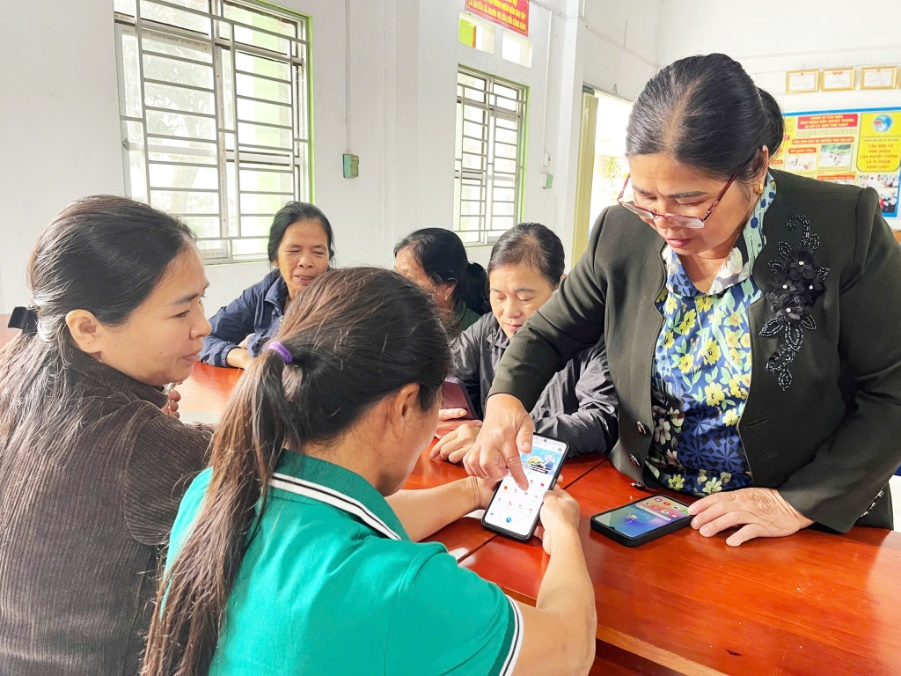
In particular, the hands-on approach at the grassroots level has created a significant transformation. Instead of just disseminating information, community-based digital transformation teams directly guide people in using smartphones, installing applications, and operating on digital platforms, helping people "learn by doing."
Spreading from the community, forming digital habits.
The effectiveness of the movement is most evident at the grassroots level, where activities are implemented in conjunction with community life.
In many localities, digital transformation content is integrated into Party branch meetings and neighborhood gatherings, creating opportunities for people to both exchange ideas and practice. This "slow and steady" approach helps people gradually become confident in using digital tools, moving from initial unfamiliarity to confidence.
In reality, with specific guidance and direct experience, people quickly recognize the benefits of digital transformation. From online application submission and cashless payments to online shopping, digital conveniences are increasingly becoming a part of daily life.
Many people, after receiving guidance, have proactively supported their relatives and neighbors, becoming "key figures" in spreading digital transformation within their communities. This is a crucial factor in ensuring the sustainable development of the movement.
The model of creating motivation for scaling up
In the initial phase of implementation, several exemplary models proved effective, playing a "nucleus" role in driving the movement forward.
In some localities, the "Outstanding Digital Official" and "Outstanding Digital Citizen" models have initially shown effectiveness in mobilizing youth union members to participate in supporting the people. At the same time, the "One-Stop Shop" model at commune-level public administrative service centers helps people directly experience online public services, thereby changing their habits in accessing administrative services.
These models not only deliver practical results but also build trust among the people, contributing to strengthening the understanding that digital transformation is practical, accessible, and directly serves the interests of the people.
Despite initial achievements, Cao Bang still faces numerous challenges, such as the lack of synchronized digital infrastructure in some areas, the continued existence of "dead zones" for mobile phone and electricity coverage; limited access to technology for the people; and uneven levels of education among the population.
However, practical implementation shows that, with the right approach and the involvement of the entire political system, the "Digital Literacy Movement" is gradually creating positive changes and building trust among the people.
In the coming period, the province is determined to continue improving digital infrastructure, strengthening skills training, promoting the role of community-based digital transformation teams, and linking the movement with socio-economic development goals, such as promoting e-commerce and supporting people in consuming products in the digital environment.
It can be affirmed that, from its initial but steady steps, the "Digital Literacy Movement" in Cao Bang is gradually confirming its correct direction: Digital transformation begins with the people, is for the people, and is nurtured by the community itself. This is a crucial foundation for building a sustainable digital society, contributing to the effective achievement of development goals in the new era.
Center for Science and Technology Communication