Successful recycling of Formosa steel slag into aggregate for concrete used in coastal protection projects
Formosa steel slag can be used as aggregate for heavy concrete to improve the performance of breakwater structures in coastal protection projects.
This is the result of nearly 10 years of research on the use of slag (Formosa steel slag) in construction by Formosa Ha Tinh Hung Nghiep Steel Company Limited (FHS), and nearly 30 months of experimental research on Formosa steel slag and concrete using Formosa steel slag as aggregate by a research group from the University of Science, Hue University, which has just been announced.
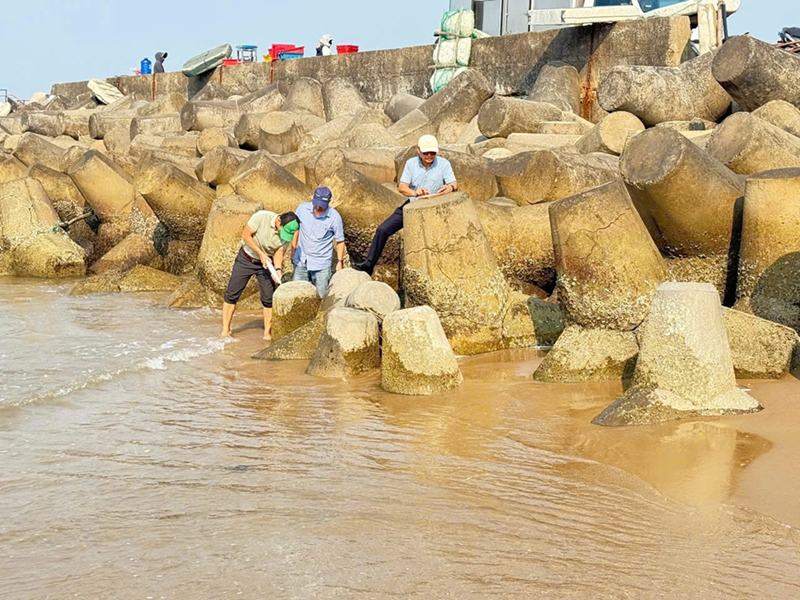
The research team and businesses are conducting experimental deployments of the Tetrapod in the Vung Ang sea area, Ha Tinh province.
The research results were presented at the scientific conference on the topic "Research on the physical, chemical, and environmental properties of Formosa steel slag and pilot use as aggregate in coastal protection projects in Ha Tinh province," with the participation of many experts, scientists, and local management agencies.
Through three sampling rounds involving over 45 tons of Formosa steel slag that were processed at source using pressurized water jet technology (for Des slag), closed thermal technology (for BOF slag), and brittle thermal technology (for CAST slag), the research team analyzed hundreds of samples for chemical and mineral composition and tested the mechanical and technical properties of Formosa steel slag. This aims to guide the rational and safe use of this material in the construction sector in general and as aggregate for concrete in particular.
This research direction contributes to the safer and more valuable use of Formosa steel slag compared to current backfill and embankment materials. Based on this, the project has completed the fabrication and research of six types of concrete using steel slag and three types of traditional concrete, aiming to compare, evaluate, and select the optimal mix design for practical applications.
One of the outstanding results of the project is the pilot implementation of a practical application through the fabrication of 5 Tetrapod wave-breaking units, each weighing approximately 2.3 tons, and the trial application in protecting coastal structures in Ha Tinh province starting in May 2025.
Initial results show that these Tetrapod units have performed well in their protective function, having withstood three major storms that directly affected the area during the 2025 rainy season, while still remaining stable and functioning effectively.
The results of compressive strength tests on concrete used to construct Tetrapod blocks show that it continues to increase rapidly after 85 days and stabilizes over time (to date, more than 400 days) with a strength ranging from 45 MPa to 55 MPa.
According to scientists at the conference, the research on using Formosa steel slag as aggregate for concrete in the construction of wave-breaking structures aims at a dual objective: addressing the issue of fly ash from FSH in particular and domestic steel mills in general, while simultaneously using this material to replace increasingly depleted natural building materials.
In particular, concrete using Formosa steel slag aggregate can meet the requirements for heavy-duty and high-strength concrete, improving the performance of wave-breaking structures.
It is known that many countries around the world are now effectively reusing steel slag, and many countries have established slag associations such as the United States, China, Japan, Australia, etc. These countries have recycled and reused approximately 85-90% of the slag they generate.
Research into Formosa's steel slag will lay the groundwork for creating a new source of materials from steel slag in general, ensuring the achievement of dual objectives in the future.
Thai Son