Cryptocurrency assets and career development opportunities
Blockchain is rapidly expanding into practical financial solutions, particularly through real-world asset tokenization (RWA) models. As this technology enters asset-backed models requiring real-world operations, businesses will not only need purely technical teams but also personnel who understand the product, cash flow, customers, and how a financial model is brought to market.
On April 8, 2026, the Vietnam Blockchain and Digital Asset Association (VBA), in collaboration with the ABAII Institute of Blockchain Technology and Artificial Intelligence, organized the 41st ABAII Unitour for over 100 students from the International School, Vietnam National University, Hanoi (VNU-IS) with the theme "Overview of blockchain, crypto assets and career development opportunities".
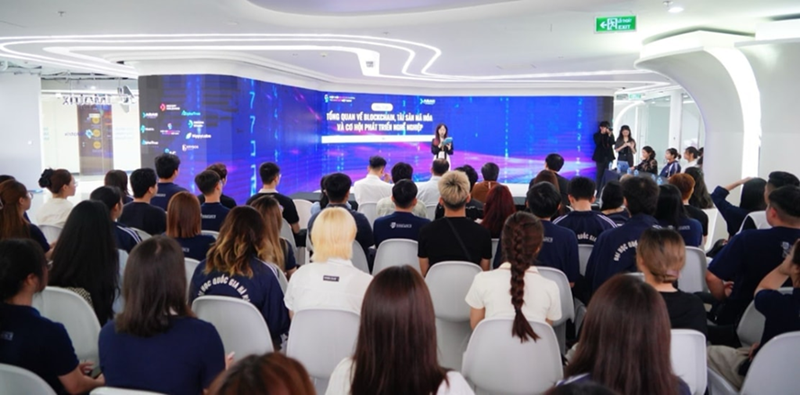
An overview of the program.
The digital asset market is facing many risks.
According to Mr. Nguyen The Bao, Strategy Expert at 1Matrix, the digital asset market is facing numerous risks from sophisticated scams. A series of deceptive schemes such as rug-pull, fake tokens, airdrop scams, Ponzi schemes, phishing attacks, and pig butchering not only threaten users but also create dangerous "traps" for those seeking career opportunities in this field.
According to the Chainalysis 2026 Crime Report, global illicit transactions increased by 162% from $57.2 billion in 2024 to over $154 billion in 2025.
In Vietnam, data from the Cyber Security and High-Tech Crime Prevention Department (A05) of the Ministry of Public Security shows that from December 15, 2019 to May 14, 2024 (approximately 4.5 years), nearly 20,000 fraud cases were detected, involving more than 17,000 individuals, with losses exceeding 12,000 billion VND.
However, in the first 11 months of 2025 alone, the losses from online fraud were equivalent to 50% of the total losses from the previous 4.5 years, estimated at over 6 trillion VND.
Increased risk also means that businesses operating in the blockchain sector are forced to raise their operational, control, and compliance standards. This leads to a significant shift in workforce demand: the market needs not only people who understand the concept, but also people who can do the job and are discerning enough to distinguish between genuine opportunities and problematic models.
Blockchain is gradually shifting from a purely technological field to a practical financial solution.
One notable point is that blockchain is gradually shifting from a purely technological field to practical financial problems, especially with the rise of the real asset tokenization (RWA) model.
During a discussion on career choices in the blockchain field, Piyush Shah, Business Development Director of BIGOD, stated that blockchain is rapidly expanding into practical financial solutions, particularly through the real asset tokenization (RWA) model.
As this technology moves into asset-backed models and requires real-world operational capabilities, businesses will not only need a purely technical team but also personnel who understand the product, cash flow, customers, and how a financial model is brought to market.
The risks for young people entering the blockchain field lie not only in a lack of skills but also in misjudging the work environment. In a rapidly developing field, genuine opportunities and opaque models can coexist, even appearing quite similar on the surface.
Therefore, students should not only look at the technology name, growth rate, or promises about the future, but also carefully observe what the business is doing, whether the product is real, what the business model is like, and how transparent the team is to build trust.
Meanwhile, Nguyen Tuan Minh, a software engineer at 1Matrix, argues that the biggest gap between training and practical requirements lies in applicability. Businesses are now looking not only for personnel who understand fundamental concepts, but also for people who can work practically with layer-1 blockchain, smart contracts, DeFi, or Web3 infrastructure.
As part of the program, VNU-IS students also visited the Blockchain Gallery and the statue of Satoshi Nakamoto, the creator of Bitcoin, an inspiring symbol of innovative thinking, pioneering spirit, and the ability to create technologies with profound impact on the financial system and digital economy. The activity also helped them better understand the working environment and corporate culture at the Vietnam Blockchain and Digital Assets Association and 1Matrix Company – a pioneering enterprise in the Blockchain field.