CAN THO CITY DEPARTMENT OF SCIENCE AND TECHNOLOGY
Vietnamese Enterprises in the Digital Productivity Era
If eliminating waste once helped businesses “do things right,” modern technology is now opening a new frontier: enabling them to “work smarter.” In the midst of rapid digital transformation, data, connectivity, and automation are gradually replacing instinct-driven management in production and operations.

From Optimized Processes to Smart Operations

After streamlining workflows with methods like Lean or Kaizen, many companies face a new challenge: how to sustain efficiency consistently and scale it further. The answer lies in technology. Modern enterprise resource planning (ERP) systems are becoming the “brain” of businesses, integrating data from production, finance, and human resources into a unified platform. When combined with the Internet of Things (IoT) and Artificial Intelligence (AI), these systems go beyond management to provide analysis, forecasting, and decision support.

Research and real-world applications show that integrating IoT into ERP allows companies to collect real-time data from machines and equipment, enhancing resource management and operational efficiency. One of the biggest shifts is the ability to access real-time data across the enterprise.

In warehouse management, IoT sensors can continuously track the location, quantity, and condition of goods. The system automatically alerts managers when inventory runs low or when risks of damage arise. This not only reduces losses but also optimizes production and distribution planning.

Big data further enables businesses to forecast market demand, allowing flexible adjustments in production. Reports indicate that applying big data in supply chains can significantly reduce waste and improve operational performance. The core difference is clear: instead of relying on experience, businesses now rely on data, reducing errors and increasing accuracy across operations.
Technology Beyond “Modernization”

A common misconception is that simply investing in technology will boost productivity. In reality, technology only delivers results when built upon a solid management foundation.

Modern ERP systems in Vietnam now integrate AI and IoT, enabling not just management but also automation of processes from planning to operational control. However, if workflows are not standardized, digitalization merely accelerates existing inefficiencies rather than improving them.

Experts emphasize that digital transformation should follow a roadmap: standardization – digitalization – intelligent automation. Technology is a tool, not the starting point.

One clear benefit of technology adoption is reducing reliance on human labor in repetitive tasks. In manufacturing, IoT systems can monitor equipment health, detect early signs of malfunction, and trigger timely maintenance to avoid production stoppages. In services, AI can analyze customer behavior to personalize experiences and improve service quality. These applications not only raise productivity but also enhance product quality and reduce defects—critical factors for companies competing in global supply chains.

Industry conferences highlight IoT and AI as key technologies helping Vietnam’s supporting industries improve productivity, quality, and cost efficiency.

At Samsung Electronics Vietnam, smart factory models in Bac Ninh and Thai Nguyen employ advanced automation and real-time data connectivity. These systems monitor quality, productivity, and equipment status across entire production lines. Digitalized processes allow tight control of errors and optimized efficiency at scale.

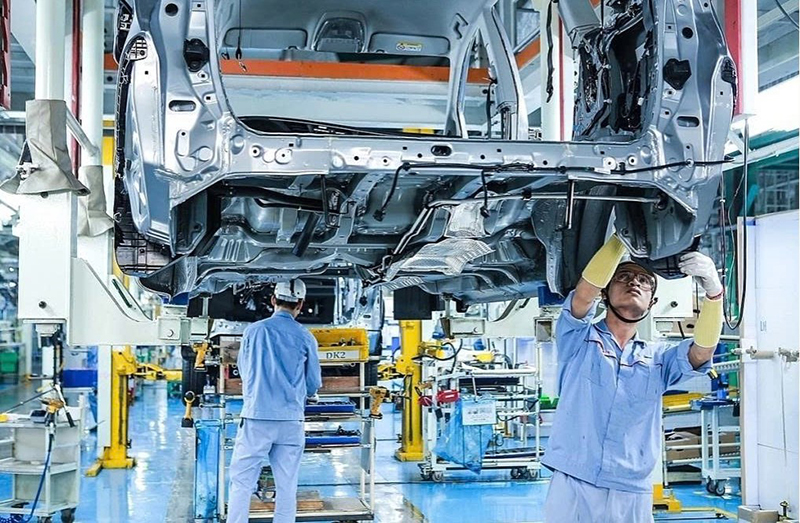
Meanwhile, Toyota Motor Vietnam continues to refine its Toyota Production System (TPS), blending lean management with digital tools. Operational data is used to track quality, optimize assembly, and minimize waste at every stage. The combination of continuous improvement and digital solutions ensures stable, high-performance production.

These cases show that across industries, leading companies share one trait: shifting from experience-based management to data-driven decision-making, with technology as the foundation.

From “Doing Right” to “Working Smart”

Despite the benefits, technology adoption poses challenges, especially for small and medium-sized enterprises. High upfront costs, workforce requirements, and system integration hurdles are common barriers.

Data management—from collection to security and utilization—also determines the success of digital transformation. In practice, successful companies are not those that invest the most, but those that choose the right technologies and implement them effectively.

If the challenge of the past was eliminating waste to optimize processes, today’s challenge is leveraging technology to strengthen operational capacity.

The fusion of lean management and digital tools is creating a new productivity model, where data is central and every decision is supported by intelligent systems. This lays the groundwork for businesses to go further—not only improving internal efficiency but also enhancing competitiveness at industry and national levels, a topic to be explored in the next article of this series.

In the new era, productivity no longer comes from doing more, but from understanding better and making smarter decisions through data and technology.

https://vietq.vn
Most viewed news

Applying technology to improve the quality of the population.

Population quality is key to unlocking the door to sustainable national development. Implementing Resolution No. 21-NQ/TW of the 12th Central Committee of the Communist Party of Vietnam on population work in the new situation, the Military Institute of Clinical Embryology (Military Medical Academy) has been a pioneer in applying modern scientific and technological achievements to help infertile families have children, while also performing screening techniques to eliminate genetic diseases.

Vigorously implement and focus on key areas of semiconductor industry development.

The government has mandated that 2026 should be a year of "Decisive Implementation - Synchronized Coordination - Focused on Key Areas - Creating Substantive Results," thereby promoting Vietnam's deeper participation in the global semiconductor industry.

PTIT aims to become a leading institution in training and strategic technology research.

On March 31, 2026, the Ministry of Science and Technology officially approved the Project "Continuing to develop the Posts and Telecommunications Institute of Technology as an organization specializing in training, in-depth research in science and technology, innovation and digital transformation in the period 2026-2035". This is a crucial turning point, positioning the Institute as a leading institution in the country's strategic technology fields.

By the end of 2026, 100% of staff will be proficient in using digital platforms to support their work

This is one of the tasks outlined in Directive No. 14/CT-TTg dated April 22, 2026, of the Prime Minister on promoting the training and assessment of digital knowledge and skills for officials, civil servants, and public employees, which was recently signed by Deputy Prime Minister Pham Thi Thanh Tra.

Developing Thoi Hung custard apple brand, Co Do district, Can Tho city

Can Tho City Department of Science and Technology organized a Mid-term Evaluation Council for the science and technology task of developing the Thoi Hung Soursop Brand, Co Do District, Can Tho City. The Council was presided by Dr. Ngo Anh Tin - Director of the Department of Science and Technology. The study was carried by Nguyen Khac Phi - Branch of Investip Industrial Property Joint Stock Company (Hanoi City), and Tran Thi Thien Thu - Can Tho City Farmers' Association.

Current status and solutions for developing smart tourism systems to attract tourists to Can Tho city - Strategic direction for tourism industry in the digital age

In the afternoon of June 5, 2025, Can Tho City Department of Science and Technology held a meeting of the City-level Council for the acceptance evaluation of the social science project "Current status and solutions for developing a smart tourism system to attract tourists to Can Tho City". Dr. Ngo Anh Tin - Director of Can Tho City Department of Science and Technology was the Chairman of the Council. The project was carried out by Prof. Dr. Ha Nam Khanh Giao; Vietnam Aviation Academy was an implementing unit.

Conference to discuss the organizational arrangement of the Department of Science and Technology when merging Can Tho City, Soc Trang Province, and Hau Giang Province

In the afternoon of May 29, 2025, leaders of Departments of Science and Technology of Can Tho City and Hau Giang and Soc Trang provinces had a meeting to discuss plans to rearrange and reorganize the apparatus of the Department of Science and Technology after merging and consolidating the areas of these three localities.

Selection of scientific and technological project "Research on microbial preparations to decompose starch or food additives sodium benzoate in wastewater"

In the morning of May 29, 2025, Can Tho City Department of Science and Technology held a meeting of the Council for selecting organizations and individuals to preside over the city-level science and technology project "Research on microbial preparations to decompose starch or food additives sodium benzoate in wastewater.” The study will be carried by Dr. Nguyen Thi Phi Oanh. Can Tho University is an implementing agency.

Evaluation and acceptance of the scientific and technological project "Research on diversifying processed products from jackfruit (Artocarpus heterophyllus LAM)"

In the afternoon of May 27, 2025, Can Tho City Department of Science and Technology held a meeting of the Advisory Council to evaluate and accept the results of the implementation of the scientific and technological project "Research on diversifying processed products from jackfruit (Artocarpus heterophyllus Lam)." The project was carried out by Associate Professor, Dr. Bach Long Giang. Nguyen Tat Thanh University was an implementing agency; Science and Technology Advances Application Center, Vietnam - Korea Industrial Technology Incubator were coordinating units.

Related news
CAN THO CITY DEPARTMENT OF SCIENCE AND TECHNOLOGY

Copyright @ 2021 belongs to the Can Tho City Department of Science and Technology
Address: No. 02, Ly Thuong Kiet, Ninh Kieu Ward, Can Tho City
Phone: 0292.3820674, Fax: 0292.3821471; Email: sokhcn@cantho.gov.vn
Head of the Editorial Board: Mr. Tran Dong Phuong An - Deputy Director of the
Can Tho City Department of Science and Technology

Copyright © 2021 All rights reserved | This template is made by CASTI'1987