Intellectual property creates new growth drivers in the digital age.
This year's World Intellectual Property Day on April 26th carries a message that not only celebrates creativity but also emphasizes the need to transform intellectual property into a genuine resource for development. In the context of digital transformation, technological competition, and deep integration, Vietnam is facing a great opportunity to make intellectual property a new growth engine for the economy.
April 26th each year is designated by the World Intellectual Property Organization as World Intellectual Property Day to raise global awareness of the role of intellectual property rights in innovation and development. For Vietnam, this is not only an opportunity to reflect on the achievements in this field, but also a time to reaffirm the determination to make intellectual property a crucial foundation for national innovation.
Intellectual property is accelerating rapidly.
In recent years, the field of intellectual property in Vietnam has witnessed significant development in both scale and quality of service.
These figures are highly significant. Each application for a patent, trademark, industrial design, or geographical indication reflects the growing need for protection of creative achievements by businesses, research institutes, universities, and individuals.
While intellectual property was previously viewed primarily as a legal procedure, it has now become a competitive tool in the market. A strong brand increases the value of goods. A protected invention gives businesses a technological advantage. An established geographical indication helps Vietnamese agricultural products elevate their position in the international market.
As a state management agency, the Ministry of Science and Technology has recently been actively working to improve the legal framework, reform procedures, and promote digital transformation in intellectual property management.
A significant milestone is the Law amending and supplementing certain articles of the Intellectual Property Law in 2025. The new law is considered a major step forward in management thinking: from simply protecting rights to exploiting intellectual property as a resource for economic development.
Accordingly, the processing time for applications has been significantly shortened. The examination time for patent applications has been reduced from 18 months to 12 months; trademark applications from 9 months to 5 months; and industrial design applications from 7 months to 5 months. This is an important change that helps businesses bring their intellectual property into production and business more quickly.
In addition, the online public service system, data digitization, and internal process reforms have been strengthened, contributing to reducing the backlog of applications and improving the quality of service for citizens and businesses.
Intellectual property must become an asset of the economy.
The most important new development in current thinking is that intellectual property must be commercialized.

This means that inventions are not just research papers; trademarks are not just logos; and copyrights are not just for registration. These intangible assets must be capable of being valued, bought, sold, transferred, contributed as capital, mortgaged, and generating added value for the economy.
This is a particularly important direction for innovative startups, technology companies, and research universities. In many cases, the greatest value of a business lies not in its factory or machinery, but in its core technology, data, software, and brand.
When intellectual property is properly financed, businesses will have more resources to expand investment, enhance competitiveness, and attract capital.
In the context of globalization, intellectual property is increasingly linked to international cooperation. Most recently, during the State visit to Vietnam by President Lee Jae Myung, Vietnam and South Korea signed numerous cooperation documents in the fields of science, technology, innovation, and intellectual property.
Notably, the Vietnamese Ministry of Science and Technology and the Korean Ministry of Intellectual Property agreed to strengthen cooperation to improve the legal framework, promote digital transformation in management, and enhance the effectiveness of intellectual property protection and enforcement.
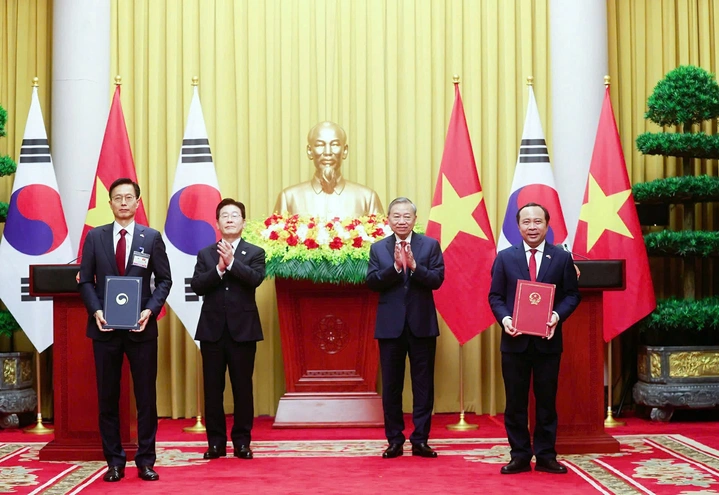
General Secretary and President To Lam and President Lee Jae Myung witnessed the signing of a Memorandum of Understanding on strengthening cooperation in the field of intellectual property between the Minister of Science and Technology of Vietnam, Vu Hai Quan, and the Minister of Intellectual Property of Korea, Kim Yong Sun.
Both sides also aim to expand cooperation in the commercialization of intellectual property, human resource training, and professional exchange.
South Korea has a highly developed intellectual property ecosystem, closely linked to global technology corporations. Strengthening cooperation with South Korea will help Vietnam access modern management practices, effective IP commercialization models, and mechanisms to support innovative businesses.
New challenges in the digital environment
Along with opportunities, intellectual property also faces many new challenges. Counterfeiting, trademark infringement, digital content copying, and copyright violations in the online environment are becoming increasingly complex. AI and deepfake technologies can even be exploited to create fake content, causing damage to businesses and consumers.
This requires faster, more modern enforcement of rights and closer coordination among regulatory agencies, law enforcement forces, and digital platforms.
Vietnam is entering a phase of development that relies more heavily on science, technology, innovation, and digital transformation. In this context, intellectual property serves as a bridge between knowledge and the market, between research and businesses, and between ideas and growth.
When a nation knows how to protect creativity, encourage innovation, and transform intellectual property into tangible wealth, that nation will have a long-term competitive advantage.
World Intellectual Property Day on April 26th is therefore not only an occasion to celebrate new ideas. It is also a strong reminder that Vietnam's future development resources lie not only in capital or natural resources, but also in Vietnamese intelligence.
Center for Science and Technology Communication