Collaboration to develop a smart tutoring application
Founded in 2019, Z.AI is a startup originating from Tsinghua University (China). Z.AI focuses on developing large language models (LLMs) and is considered a formidable competitor in the field of artificial intelligence (AI), often compared to models such as ChatGPT and DeepSeek.
Within the framework of the State visit to China from April 14 to 17, 2026, by General Secretary and President To Lam, Vietnam National University, Hanoi (VNU) and Z.AI are promoting cooperation in developing the AI Tutor project, contributing to realizing the orientation of cooperation in education, science, technology, and innovation between Vietnam and China.
Within the framework of this visit, the Vietnam-China Forum on Higher Education, Science, Technology and Innovation Cooperation, jointly organized by Vietnam National University, Hanoi and Tsinghua University, became a significant highlight, clearly demonstrating the spirit of promoting substantive cooperation, using concrete results as a measure, and aiming for the benefit of the people.
At the same time, the Forum established education, science, technology, innovation, and digital transformation as priority pillars in the cooperative relationship between the two countries.
Smart Tutoring System
At the Forum, scientists from Vietnam National University, Hanoi presented the AI Tutor project, introducing a new approach to applying AI to Vietnamese general education: not replacing teachers, not simply providing answers, but supporting learners in accessing knowledge in a structured, step-by-step manner, more suited to their individual learning needs and self-learning abilities in the new context.
The project is envisioned as an intelligent tutoring system for Vietnamese students, initially focusing on middle school mathematics, particularly grades 6 to 9, and will gradually expand to other subjects in the next phase.
According to the agreed-upon direction, the system does not follow a direct, immediate response approach, but instead focuses on guiding students' thinking, providing step-by-step suggestions, asking open-ended questions, assisting in error detection, and supporting the development of learning competencies. This approach is both pedagogically sound and suitable for the demands of educational reform in the digital age.
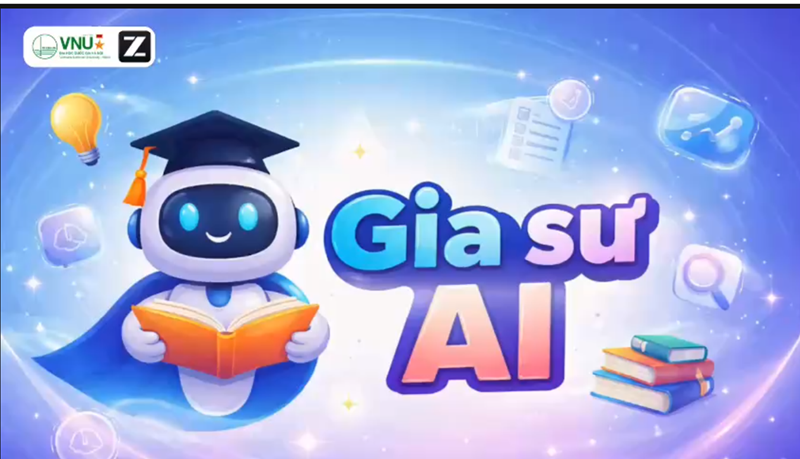
The intelligent tutoring system of Hanoi National University.
The AI Tutoring Project is not just an educational technology product, but also a concrete effort to translate the major directions of Vietnam-China cooperation into applications that can create a clear social impact.
The project aims to provide students nationwide with a more convenient, intelligent, and user-friendly learning tool; and to support parents and teachers with additional means to accompany learners, thereby contributing to building a more joyful, effective, and humane learning environment.
Initial results from the project's Proof of Concept (PoC) show positive signs. According to user feedback data compiled in March 2026, the product achieved an overall average rating of 8.7/10; 87% of participants rated it at 7-9/10; the level of "content comprehension" reached 8.36 and the level of "understanding user intent" reached 8.6.
Notably, users highly value the system's step-by-step guidance and suggestions, rather than providing immediate answers. This demonstrates that the outstanding value of PoC lies in its pedagogical approach, not just in its ability to generate answers.
Continue to improve along the priority axes.
In line with future development plans, VNU and Z.AI will continue to refine the system along priority axes such as increasing stability and response speed, improving Vietnamese language processing capabilities, expanding multimodal support for problems involving images or geometry, organizing learning content by class - topic - chapter, and adding tools to track learning progress for students, parents, and teachers.
The long-term goal is to build a platform that can support Vietnamese students in many subjects, focusing on individualized learning, strengthening self-learning abilities, and enhancing collaboration between schools, families, and technology.
Therefore, AI tutoring goes beyond a single technological experiment. It represents a concrete step demonstrating the academic capacity, international partnership capabilities, and knowledge transfer capacity of Vietnam National University, Hanoi (VNU) in the AI era. This also reflects a new trend of collaboration between universities and leading technology companies, aiming for products that directly serve education, learners, and the future development of high-quality human resources in Vietnam.