Green fuels, sustainable technology, and AI applications in automotive engineering
This was the theme of the scientific conference organized by the School of Mechanical and Automotive Engineering (Hanoi University of Industry) on the afternoon of April 14, 2026. The conference attracted the attention and participation of numerous experts, lecturers, researchers, and students in the field of mechanical and automotive engineering.
At the conference, many valuable papers were presented, focusing on prominent trends such as the development of green fuels, engine performance optimization, greenhouse gas emission reduction, and the application of artificial intelligence (AI) in the design and operation of automobiles.
Experts emphasize that, in the context of climate change and increasingly stringent environmental requirements, the shift from fossil fuels to clean energy sources such as biofuels, hydrogen, and electrochemicals is an inevitable trend.
This not only helps minimize negative impacts on the environment but also opens up opportunities for the development of eco-friendly, energy-efficient vehicles, in line with Vietnam's and the world's sustainable development strategies.
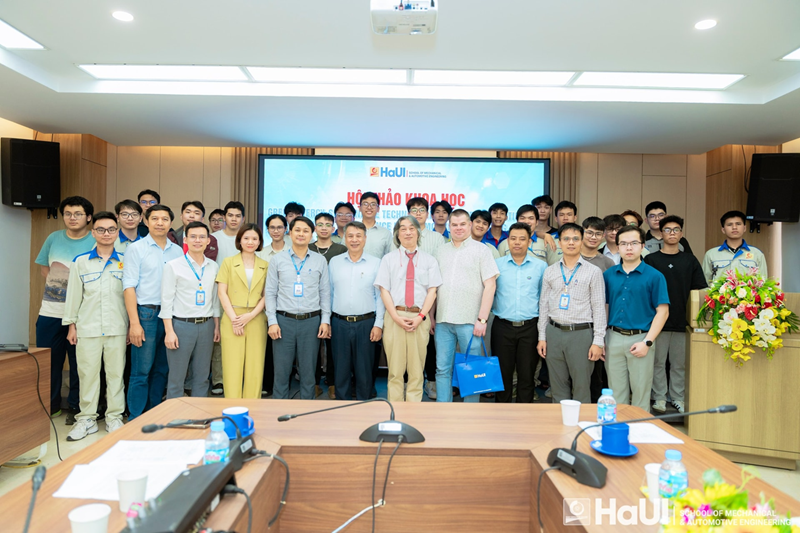
The scientific seminar "Green Fuels, Sustainable Technologies and Artificial Intelligence Applications in Automotive Engineering" was organized by the School of Mechanical and Automotive Engineering. Photo: DC.
In particular, in the context of technological development, AI has become a special focus of scientists. Reports have clarified the role of AI in improving design efficiency, predicting technical failures, optimizing maintenance processes, and supporting the development of autonomous driving systems.
The integration of AI with sensor technologies, big data, and the Internet of Things (IoT) is contributing to the creation of smart vehicles capable of self-learning, adapting to operating conditions, and enhancing user safety. This is considered a crucial foundation for the automotive industry to move towards the era of autonomous vehicles and intelligent transportation.
Speaking at the conference, Dr. Nguyen Anh Ngoc, Vice Rector of the Automotive Engineering School, stated that in the context of development and integration, the school has continuously innovated its training content, promoted scientific research, and strengthened cooperation with experts and businesses both domestically and internationally. This is an important step to improve the quality of highly skilled technical human resources, meeting the development requirements of the automotive industry in the context of deep international integration.
In the coming period, the school will continue to promote research on green fuels, develop environmentally friendly engineering solutions, and strengthen the application of artificial intelligence and digital technologies in teaching and research. Through this, it will contribute to affirming the pioneering role of the School of Mechanical and Automotive Engineering in accompanying the Vietnamese automotive industry on its journey to a green, smart, and sustainable development model in the digital age.