Hanoi University of Industry: Determined to undergo digital transformation and strive to become an innovation-oriented university
This was the message delivered by the School's leadership at the Conference summarizing digital transformation work in 2025 and implementing the digital transformation plan for 2026, held on January 23, 2026 in Hanoi.
In 2025, despite the challenges of limited investment resources and a shortage of high-quality human resources, Hanoi University of Industry will still complete its key tasks as planned.
A highlight of the year was the completion of the integrated payment system with banks, shifting all financial transactions for students to a cashless format.
Network infrastructure continues to be upgraded with the deployment of 5G at facility 1 (298 Cau Dien Street, Tay Tuu Ward, Hanoi) and free Wi-Fi coverage throughout the library and dormitory areas.
In the administrative field, the application of digital signatures has contributed to changing working methods, saving printing costs, and shortening document processing time.
In addition, the training, examination, and finance subsystems have been upgraded, especially the initial application of AI, which has yielded positive results with the virtual admissions assistant helping to answer more than 30,000 questions from candidates.
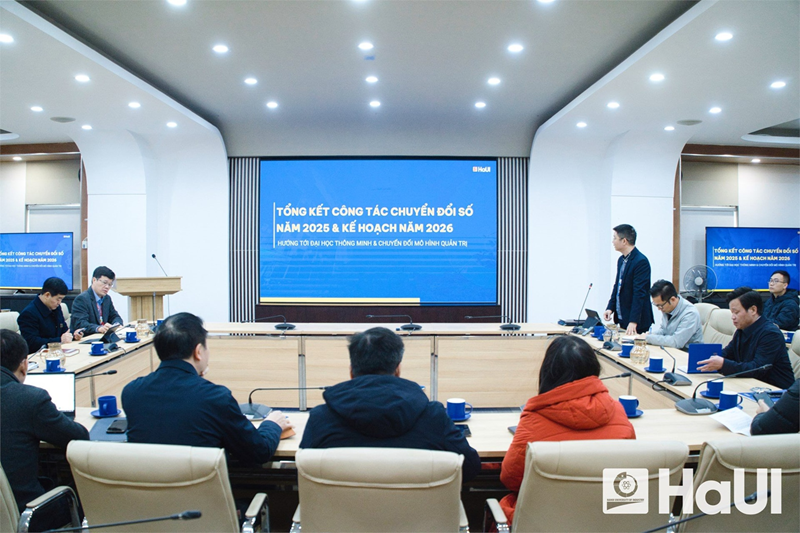
Conference summarizing digital transformation work in 2025 and planning for 2026. Photo: DC.
Entering 2026, Hanoi University of Industry will focus on implementing three key action directions: improving governance, technological breakthroughs, and standardization according to international standards.
One of the key tasks is to build a data integration platform to synchronously connect software subsystems, completely overcoming the problem of scattered data between units.
Regarding infrastructure for training, the school plans to deploy a wifi system in 5 lecture hall buildings with high student density, and simultaneously put into operation 10-15 smart classrooms, meeting the requirements for recording lectures and supporting blended learning.
Associate Professor Dr. Kieu Xuan Thuc, Rector of Hanoi University of Industry, said that to realize the set goals, the University will streamline its digital transformation management system, clearly defining responsibilities between the specialized unit commissioning the project and the technical unit implementing it.
Simultaneously, the university aims to popularize digital skills for over 80% of its staff and faculty to meet international accreditation requirements and effectively operate the smart university model.
With synchronized strategic and infrastructure preparation, the digital transformation at Hanoi University of Industry is expected to create a solid foundation for the University to aim towards becoming an innovation-oriented university, ranking among the top 400 universities in Asia by 2035.