Selecting microalgae strains with nutritional potential from the Can Gio Biosphere Reserve
For the first time, Ho Chi Minh City has successfully built a diverse genetic data set and established a collection of Can Gio microalgae that meets international standards, creating a scientific foundation for the conservation of indigenous genetic resources and the development of nutritional and biotechnology applications in aquaculture and functional foods.
The Can Gio Mangrove Biosphere Reserve (Ho Chi Minh City) is one of the unique and ecologically valuable coastal ecosystems in the southern region, notable for its rich biodiversity.
In this ecosystem structure, microalgae play a fundamental role in the material and energy cycles, contributing to maintaining the biological productivity and ecological balance of the entire region. However, to date, data on the genetic diversity of microalgae in this area remain fragmented, not comprehensively surveyed, and not standardized according to international standards.
In response to the urgent need to conserve indigenous gene resources and rationally exploit their application potential, the science and technology project "Research on genetic diversity, establishment of a collection and selection of microalgae strains with nutritional potential from the Can Gio Mangrove Biosphere Reserve," implemented by the Ho Chi Minh City Department of Science and Technology, aims to clarify the genetic diversity picture of microalgae communities.
Simultaneously, establish a collection of standardized strains and screen for lines with high nutritional value, serving scientific research, biotechnology development, and sustainable bioeconomic development.
The project, led by Assoc. Prof. Dr. Tran Hoang Dung of the HUFI Institute for Applied Research and Technology Transfer ( thuộc Ho Chi Minh City University of Industry and Trade), has completed all its objectives after more than two years of implementation.
The project not only provides foundational scientific data but also establishes an internationally standardized genetic resource infrastructure – a crucial step in the city's marine biotechnology development strategy.
The first "gene map" of the Can Gio microalgae ecosystem
A highlight of the study is the synchronized application of modern analytical tools such as DNA metabarcoding and multi-marker DNA barcoding (18S, ITS2, 23S/UPA, 16S) to reconstruct the spatial and temporal structure of microalgal communities.
DNA metabarcoding is a method of directly analyzing DNA from environmental samples to determine the composition and structure of biological communities without isolating individual species.
Multimarker DNA barcoding is a technique for sequencing multiple standard gene regions such as 18S, ITS2, 23S/UPA, and 16S on isolated strains for accurate identification and phylogenetic analysis. Combining markers with varying levels of conservation and variability increases reliability and resolution at the species or subspecies level.
From 36 environmental samples collected at 26 points representing three types of water bodies—saline, brackish, and freshwater—the research team recorded 1,962 ASVs (different DNA sequence variants), reflecting a very high level of genetic diversity.
The community structure shows a clear differentiation according to changes in salinity. Specifically, Bacillariophyta (diatoms) predominate in saline areas, Chlorophyta (green algae) are dominant in freshwater areas, while brackish water acts as a "convergence point" for both of these major groups.
Seasonal comparisons reveal a relatively stable phylogenetic order, with differences primarily in the richness of characteristics and the breadth of occurrence. Notably, over 70% of ASVs remain unidentified to the species level, indicating the existence of many new lineages, which are important additions to our understanding of microalgal diversity in tropical coastal areas.
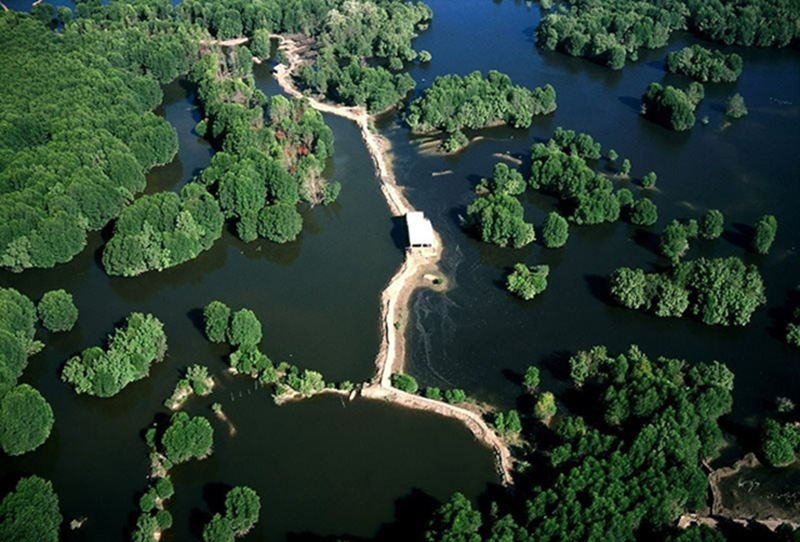
The Can Gio mangrove forest ecosystem boasts rich biodiversity. (Photo: ST)
CCAH - Microalgae genetic resource infrastructure meeting international standards.
Based on genetic data and isolated strains, the research team built the Ho Chi Minh City Microalgae Collection (CCAH), which contains over 100 monoclonal strains with standardized morphological data, metadata, and DNA barcodes. Notably, CCAH has been recognized and assigned the WDCM 1372 code by the World Organisation for the Collection of Microorganisms (WFCC), officially registering it on the international map of microbial collections.
CCAH's database system is built according to the reference standards of international databases such as GBIF, AlgaeBase, and GenBank, allowing for interoperability and transparent retrieval. Participation in international networks not only enhances Ho Chi Minh City's scientific standing but also facilitates the exchange of samples, data, and research collaboration within the framework of sharing the benefits of genetic resources.
According to Associate Professor Dr. Tran Hoang Dung, CCAH is the city's first collection of native microalgae that meets international standards. This is an important biological infrastructure, helping Vietnam to proactively secure microalgae strains for research, training, and biotechnology development.
Nutritional screening and application orientation
Alongside the genetic diversity study, the team screened 117 isolated strains, identifying 20 promising initial strains with high nutritional value. These microalgae strains were cultured in 2-liter containers for 5-12 days, depending on the species. Dry biomass reached 0.9-1.47 g/L, equivalent to 1.39-2.20 g per container, with high stability. Nutritional composition showed protein accounting for 27-45% of dry weight, lipids 20-38%, carbohydrates 8-18%, and ash 5-25%.
Fatty acid analysis revealed high EPA content in Thalassiosira and Chaetoceros , and prominent DHA in Isochrysis and Tisochrysis . Green algae such as Chlorella , Desmodesmus , Ankistrodesmus , Coelastrella , and Neochloris are rich in protein and lipids. Meanwhile, cyanobacteria like Leptolyngbya and Roholtiella are rich in protein and phycobiliprotein pigments (water-soluble protein pigments that absorb light in algal photosynthesis and are used as natural colorants, antioxidants, and fluorescent agents in biomedicine).
From the overall evaluation results, 12 of the most promising strains were selected. All met the safety thresholds for microorganisms and heavy metals. These results open up possibilities for application in aquaculture (live feed, omega-3 premix), functional foods, pharmaceuticals, and the production of natural pigments.
Proactively securing nutrient-rich microalgae sources from native ecosystems helps reduce reliance on imports and lays the foundation for a green nutritional value chain.
The "gene-strain-trait" dataset is considered the first map of native microalgae in Ho Chi Minh City, serving ecological monitoring and conservation planning in Can Gio. Simultaneously, the formation of an internationally standardized collection helps the city proactively access and implement principles of gene resource benefit sharing in accordance with global practices.
This is not only a research achievement, but also the starting point for a strategy to develop a bioeconomy, linked to biodiversity conservation and the sustainable exploitation of native microbial resources.
Based on the results obtained, the research team proposes further expanding sampling to other habitats (freshwater, rice paddies, forest soils) to complete the CCAH Collection and increase the proportion of pure strains with complete barcodes. Simultaneously, it is necessary to promote multi-marker phylogenetic research and omic analysis (a comprehensive study of biological molecules such as genes, proteins, and metabolites in organisms) for endemic lineages or those with novel characteristics, to create a foundation for describing new species.
The research team suggests developing a pilot-scale biomass cultivation process using a photobioreactor (algae cultivation using light) to evaluate the productivity and commercialization potential of 12 promising strains. Simultaneously, they recommend strengthening international cooperation to share data, exchange genetic resources, and safeguard national interests.
The research team hopes that Ho Chi Minh City will continue to invest in and support the commercialization of native microalgae strains rich in ω-3, protein, and natural pigments, aiming to develop products for application in aquaculture, functional foods, and pharmaceuticals.