Prolonged heatwave poses a risk of water shortage for agricultural production
In recent days, high temperatures, rapid water evaporation, and saltwater intrusion into inland areas have caused crops to wither, negatively impacting agricultural production for the local people.
Local water shortage
According to the Can Tho City Meteorological and Hydrological Station, the Can Tho City area is strongly affected by tides and low water levels from mid-April to mid-May (the peak of the dry season). Flows in inland canals and ditches decrease rapidly, and the supply of surface water from the Hau River to inland areas via rivers and ditches is insufficient for domestic use, industry, services, aquaculture, and agricultural production. Local water shortages occur in some areas, leading to saltwater intrusion. In the area affected by East Sea tides via the Hau River, salinity tends to decrease slowly and gradually diminishes towards the end of May. Saltwater intrusion from the West Sea tides via the Ngan Dua River (Luong Tam commune) is at a high level from April to mid-May 2026.
Mr. Nguyen Van Loc, from Tan Hoa commune, Can Tho city, who has nearly 1 hectare of summer-autumn rice sown about 10 days ago, said: “From mid-April until now, the intense heat has caused the water pumped into the fields to dry up after 2-3 days. Meanwhile, the water level in the irrigation canals is quite low at the moment, so drawing water into the rice fields is slower and more costly. The heat causes the water in the fields to evaporate quickly, making the rice plants stunted and slow to develop.”
Nguyen Anh Toan, a watermelon grower in Vi Tan ward, said: “The current water level in the canals is very low, so people have to wait for high tides to pump water for irrigation. Watermelons need daily watering, but during this dry season, water sources are scarce, causing many difficulties for watermelon growers. To save water, my family has implemented a solution of using plastic mulch to grow over 2 acres of watermelons. Although it costs extra, it eases the worry about irrigation water.”
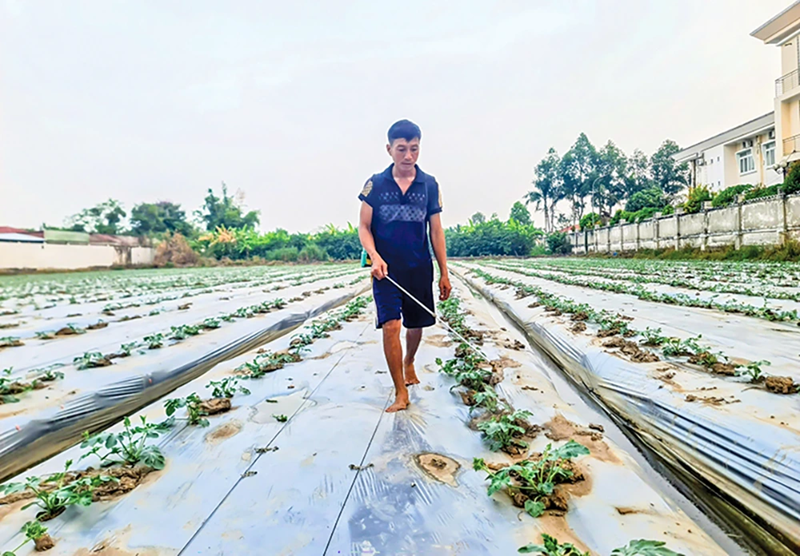
Mr. Nguyen Anh Toan in Vi Tan ward uses plastic mulch to grow watermelons in order to reduce the need for watering during the dry season.
According to the Department of Agriculture and Environment of Can Tho City, in recent years, drought, saltwater intrusion, and freshwater shortages during the dry season have occurred frequently, especially in coastal and estuary areas. The city has been implementing many comprehensive solutions to ensure water resources for daily life and production for its people, such as developing freshwater reservoirs to serve the dry season.
Efficient water use
According to the Department of Water Resources Management (Ministry of Agriculture and Environment), the average annual water volume in the Mekong River basin is approximately 488 billion m3, of which surface water accounts for 97% and groundwater for 3%. The average water volume per person during the dry season is about 2,200 m3/person. In recent years, the flow from the upstream into the Mekong River basin through the Tan Chau and Chau Doc hydrological stations has decreased compared to the multi-year average. Salinity intrusion tends to occur earlier and more intensely than before.
The total water extracted in the entire Mekong Delta region is approximately 32.25 billion m3/year (of which, agriculture and fisheries account for 31.54 billion m3/year, and the remainder is for domestic and industrial use). The Mekong Delta's water resources depend on water from the upper Mekong River, which accounts for 95% of the total water volume in the Mekong Delta.
The Department of Water Resources Management believes that water resource planning should be a national-level overall orientation to ensure water security, including in the Mekong Delta. It is necessary to optimize the benefits provided by the Mekong River. Regarding surface water resources, it is necessary to effectively exploit and utilize freshwater from the Tien River, Hau River, Co Chien River, and Ham Luong River to serve inter-regional and inter-provincial water supply for areas frequently affected by drought and salinity, such as coastal areas and the Ca Mau Peninsula. The capacity for freshwater retention should be strengthened on an appropriate scale in the Long Xuyen Quadrangle and Dong Thap Muoi region. Appropriately sized reservoirs should be constructed; irrigation systems should be operated efficiently; and groundwater resources should be exploited rationally to ensure that water levels do not exceed limits. Strict control over groundwater extraction for irrigation and aquaculture, especially in the coastal areas of Ca Mau province and Can Tho city, is required.
Ms. Nguyen Thi Giang, Deputy Director of the Department of Agriculture and Environment of Can Tho City, said that to minimize the impact of drought and saltwater intrusion on production, the Department of Agriculture and Environment of the city requested localities in the city to strengthen monitoring, forecasting, and timely information on water sources and saltwater intrusion developments. They also urged the operation of sluice gates and active freshwater storage. Furthermore, they requested surveys of irrigation systems to maintain and repair damaged or degraded structures; and to accelerate the construction of ongoing drought and saltwater intrusion prevention projects to ensure timely operation and exploitation, preventing saltwater intrusion and storing freshwater to serve production and daily life during the 2026 dry season. The city's agricultural sector advised people to check water salinity before pumping for irrigation, use mulch and straw to retain soil moisture, and apply water-saving irrigation technologies. They also advised people not to plant crops in staggered seasons or new plantings during drought periods when freshwater supply is insufficient for crops.
Text and photos: HOAI THANH - Bao Can Tho (tnxmai)