DCCI Summit 2026: AI is reshaping digital infrastructure
Given the unprecedented pace of artificial intelligence (AI) development, businesses must not only learn to adapt to new trends but also focus on solving the core problem: How to build the capacity to operate digital infrastructure that keeps pace with technological innovation? The DCCI Summit 2026 offers practical insights and a specific implementation roadmap, helping businesses bridge the gap between the speed of technological development and the capacity of their infrastructure to respond in the AI era.
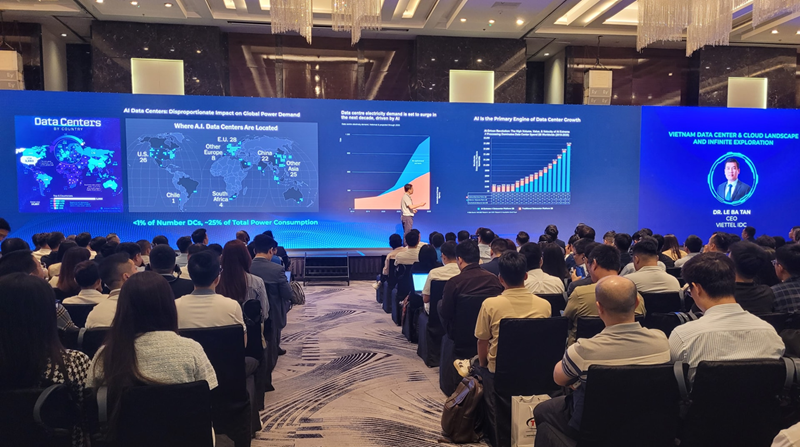
Overview of the event.
With the theme “Sustainable Infrastructure For Global Digital Growth”, the DCCI Summit 2026, a prestigious technology conference organized by Viettel IDC, officially took place on the morning of April 20th in Hanoi, bringing together nearly 2,000 guests and more than 30 domestic and international technology partners.
The event not only provided an overview of the market but also created a space for networking and exchanging solutions, helping businesses optimize operations and achieve sustainable growth in the AI era.
The digital infrastructure landscape and trends
2026 is considered a pivotal year for the data center and cloud computing industries. The rapid development of AI, big data, and multi-cloud architectures is placing entirely new demands on digital infrastructure.
Next-generation AI models require massive computing power, high-speed storage systems, high-bandwidth networks, and near-real-time infrastructure scalability. This brings unprecedented challenges in terms of power, cooling, system architecture, and operational management.
According to the International Energy Agency (IEA), global data center electricity consumption is projected to reach approximately 415 TWh in 2024 and could nearly double by 2030. This figure demonstrates that the AI boom is not just a technological development, but also a strategic challenge regarding energy and infrastructure development.
In his opening speech at the event, Viettel IDC CEO Le Ba Tan presented a noteworthy perspective: in the period 2026-2030, AI will no longer be a standalone technology, but will systematically impact and shape digital infrastructure.
According to a Gartner report, by 2026, total global spending on AI applications and infrastructure will reach $2.5 trillion, a 44% increase compared to 2025, and is projected to continue at that growth rate to approximately $3.3 trillion by 2027. AI is rapidly shifting from the experimental and technological development phase to the scaling-up of services. Investment in AI infrastructure is becoming the largest investment and is impacting the entire AI development process worldwide.
According to Mr. Le Ba Tan, by 2028, there will be 1.3 billion AI agents serving human life, performing tasks such as automated responses and displaying advertisements. To achieve this, leading technology companies worldwide have developed standardized technology systems to allow AI agents to communicate and work with each other synchronously, or to interact with external AI components such as databases, websites, and other platforms.
As automation models become increasingly complex, demanding higher computing power, data processing capabilities, and scalability, digital infrastructure becomes a core factor determining long-term competitiveness. However, the reality is that many organizations still face a significant gap: infrastructure hasn't kept pace while technology advances. To avoid losing their competitive edge, businesses must change their approach: from simply scaling up to optimizing computing power; from spreading investments thinly to focusing on data, energy, and system architecture.
The pressure from AI is driving a new growth cycle for the global digital infrastructure market . According to data released at the DCCI Summit 2026, this market is projected to reach $627.4 billion by 2030, with the Asia-Pacific region alone accounting for $174.8 billion during the same period, indicating a strong shift in the focus of digital infrastructure towards the East.
In the regional landscape, Vietnam holds a position with a tourism market growth rate of approximately 14.2%, nearly equivalent to the overall growth rate of the entire Southeast Asian region.
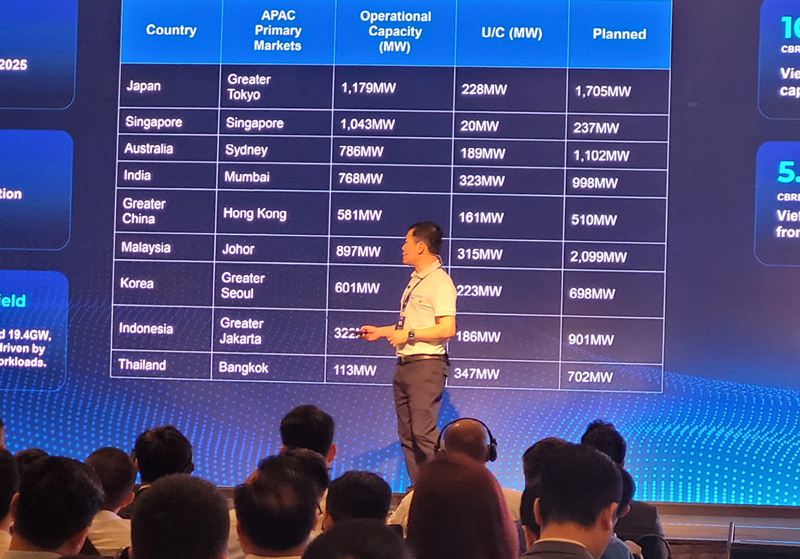
Mr. Le Ba Tan presented the content at the conference.
Looking at the broader AI capabilities, Vietnam ranks 45th globally in the AI Readiness Index, a position that still shows a gap compared to leading countries in the region. However, the WIN World AI Index 2025 recognizes Vietnam as ranking 6th globally in terms of trust and acceptance of AI in society, a significant advantage.
According to the CEO of Viettel IDC, many new data centers will be started in Ho Chi Minh City in the coming period to meet the explosive growth of AI.
"Viettel not only builds data centers but also collaborates with other units to create infrastructure for the digital economy and the AI economy," Mr. Le Ba Tan emphasized.
Meanwhile, the cloud market is also undergoing a profound shift. For years, the cloud was primarily seen as a tool to help businesses scale resources more flexibly. As AI becomes a reality, businesses are beginning to ask additional questions about data location, system control, security levels, legal compliance requirements, and long-term operating costs. As a result, 69% of businesses are considering moving from public cloud to private cloud.
Furthermore, the sovereign cloud (IaaS) market is projected to reach $80 billion in 2026, reflecting a trend where organizations and businesses want to maintain control over their data within their own governance rather than relying entirely on external infrastructure to ensure privacy, security, and sovereignty.
In addition, another issue raised by Mr. Le Ba Tan was information security. In the AI era, as business data is being moved to the cloud, the crucial question is how to protect customer information as attack techniques become increasingly sophisticated. Furthermore, there is the emergence of new generation attack methods using AI, such as installing malware as a service, and proactive, automated attacks that require no human intervention.
Strategic insights revealed from 3 thematic sessions.
The DCCI Summit 2026 comprises three parallel thematic sessions with a wealth of updated information. Experts will provide practical perspectives, implementation experiences, and operational thinking on infrastructure in the AI era, helping businesses better define a roadmap for developing digital infrastructure suitable for this new growth phase.
The DC Room session, themed "AI-Ready Infrastructure Architecture," focused on designing, building, and operating data centersthatmeethigh-performance standards for AI tasks, aiming for sustainable growth (ESG) with the following content.
The Cloud Room session, themed "Redefining theCloud Computing Era," focused onAI-driven infrastructure and how businesses can optimize cloud operations to both manage systems and drive innovation.
The AI Room session , themed "AI for Business- From Trends to Implementation," focused on clarifyinghow AI is reshaping businesses through multimodal AI, AI Agents, and multi-agent systems, while delving into practical challenges related to costs, security, and governance when deploying AI on a large scale.
The entire trend outlined at the DCCI Summit 2026 raises a very practical question for Vietnamese businesses, and that question no longer revolves around whether or not to apply AI infrastructure, but rather how to prepare the foundation so that AI can operate effectively on a real-world scale, ensuring data security while optimizing operating costs in the long term, instead of just solving immediate problems.