New strategic technologies and missions for Vietnamese universities
In the context of increasingly fierce global technological competition, the development of strategic technologies has become an urgent requirement for every nation. For Vietnam, the challenge is not just to access but to master core technologies. In this process, universities are identified as the core force, playing a crucial role in creating knowledge, training human resources, and promoting innovation.
Strategic technology - a national problem-based approach

Semiconductor chip technology has been identified by Vietnam as one of its strategic technologies. Photo: ST.
In the 21st century, technology has become a core factor determining the competitiveness and position of each nation. Successful nations not only access technology but also proactively create and master key technologies. For Vietnam, in the context of transforming its development model, building and implementing a key technology program is of vital importance, not only economically but also in terms of security, self-reliance, and sustainable development.
A particularly important aspect of current thinking on the development of the National Key Industry is the shift from a technology-based approach to a national problem-based approach. This represents a significant step forward in understanding: technology is not the starting point, but a tool for solving major national problems. Accordingly, the logical development chain needs to be designed in the following direction: from national problems, to strategic products, to core technologies, and finally to the market. This approach helps avoid fragmented, undirected research that is disconnected from practice – a long-standing limitation.
In that structure, core technology plays a central role, serving as a measure of national self-reliance. And it is at this point that the role of universities becomes particularly important. While businesses focus on products and markets, research institutes and universities are the places that generate foundational knowledge and develop core technologies. This is a strategic division of labor, accurately reflecting the nature of the modern innovation ecosystem.
The role of universities
Core technologies cannot be developed in the short term or under immediate commercial pressure. They require long-term research, deep knowledge accumulation, and a free and creative academic environment. Universities, with their mission of research, knowledge creation, and education, are the only institutions that can sustainably fulfill this role. Key fields such as artificial intelligence, advanced materials, computational mechanics, biotechnology, aerospace technology, and semiconductors, etc., all originate from fundamental research in university settings before being transformed into industrial applications.
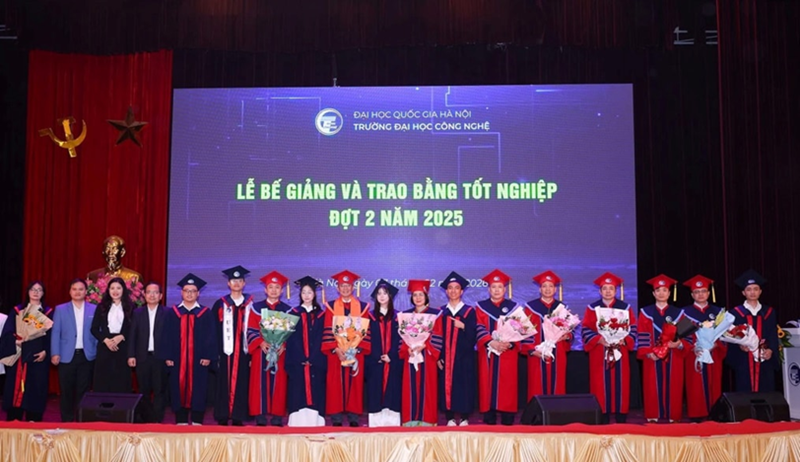
Universities play a crucial role in developing strategic technologies. Photo: VNU Media.
Furthermore, universities are also places that train high-quality, highly skilled human resources – a decisive factor in the success of all core technology and high-tech programs. In the new context, university education cannot stop at simply transmitting knowledge, but must aim to develop research and creative capabilities, systems thinking, and the ability to solve practical problems. This requires a redesign of the training program. First and foremost, a solid foundation of modern basic scientific knowledge needs to be built. Without a sufficiently deep foundation, it will be difficult to master core technologies. At the same time, university education needs to be closely linked to major national problems and high-tech projects.
Another breakthrough in the policy for developing applied research is the role of the state in market creation. Instead of just funding research, the state also acts as the first buyer, or creates sufficient market demand for strategic products. This is a powerful tool that has been successfully applied by many countries such as the US, China, and South Korea. This approach helps address a crucial bottleneck: the output of research. For universities, this opens up great opportunities to participate more deeply in the innovation value chain. Building strong research groups allows them to research and develop new products, transfer technology, or establish spin-off businesses to commercialize research results. When the market is guaranteed by public policies, the risks of commercialization are significantly reduced, thereby creating a strong incentive for applied research.
Simultaneously, the mechanism of commissioning research based on large-scale problems also helps to guide scientific and technological activities more effectively. Instead of small, scattered projects, universities need to shift to participating in large, interdisciplinary programs with clear objectives. This requires a change in both research organization and the mindset of scientists, from individual research to strong group research, and from scientific publication to creating practical value.
Another crucial factor is the role of standards in the development of the CNCL (Computer Numerical Control and Technology) sector. Unlike traditional thinking, standards are no longer the final step, but must precede other steps to guide technology development and create markets. The development of standards, even in pre-standard form, will help shape development direction, facilitate bidding, procurement, and mass production. In this context, universities need to actively participate in the standard-setting process through research, evaluation, and international comparisons. This is not only a technical task, but also part of a strategy for integration and enhancing the nation's scientific standing.
From a institutional standpoint, innovation in science and technology finance and governance is also a necessary condition. Shifting to a budget allocation mechanism where the State provides a large sum of money in a package, and units independently decide how to allocate it to research activities (block funding) significantly reduces administrative procedures, increases flexibility, and grants greater autonomy to research units. However, this autonomy comes with accountability, demonstrated through a four-tiered evaluation system: input, output, results, and impact. This is a modern approach that allows for a comprehensive assessment of the effectiveness of science and technology activities, from research to application and social impact.
In this context, universities need to undergo a comprehensive transformation. First, they need to build strong research universities, focusing on key areas of science and technology and capable of international competitiveness. Next, they need to improve curricula to provide students with a solid foundation in basic science and strongly innovate the organizational and management forms of training linked to businesses, develop an innovation ecosystem within universities, including research centers, technology incubators, and university-based startups, and effectively implement the four-party cooperation model: the State - businesses - scientists and universities.
It is necessary to train engineers and chief engineers at several key technology and engineering universities. The State also needs to invest in training programs for talented bachelors and engineers in cutting-edge science and technology fields. For skilled experts and scientists, there is a need for a change in mindset, utilizing and assigning tasks according to the principle of "work according to needs, receive according to ability, and a reward mechanism based on the effectiveness of their contribution."
Vietnam also urgently needs to establish special testing zones (sandboxes) with flexible mechanisms, allowing universities to test new technologies without requiring permission. This is a necessary condition for universities and scientists to boldly venture into developing high-tech fields related to security and defense, such as unmanned aerial vehicles (UAVs), artificial intelligence (AI) cameras, or fields related to AI, new energy, smart cities, etc.
Finally, it is necessary to strengthen international cooperation, not only to access new knowledge and technologies, but also to participate in global value chains and enhance university autonomy, so that universities can best and most quickly utilize all resources for innovation and development.
In summary, developing the high-tech industry is not just a task for the science and technology sector, but a comprehensive national strategy. Within this strategy, the state plays a facilitating and coordinating role, businesses play the role of implementation and commercialization, universities serve as the foundation – the place where knowledge, core technologies, and human resources are formed, and scientists play a key role in the ecosystem of knowledge and technology innovation.
Without strong universities, talented scientists, and a team of engineers and chief engineers, core technologies are impossible. Without core technologies, strategic products are impossible. And without strategic products, the nation cannot achieve self-reliance, prosperity, strength, and sustainable development.
Vietnam is facing a great opportunity for breakthrough. The key is to act in a coordinated, steadfast, and long-term manner. In this journey, universities also have a golden opportunity to develop. Universities need to be placed in their rightful position – not just as centers of education, but also as centers of cutting-edge research, generating knowledge and core technologies, and serving as pillars of the national high-tech ecosystem.