Not good at math - is it difficult to master AI?
Could a lack of math skills become a barrier to accessing and mastering artificial intelligence (AI)? At a recent national scientific conference in Hai Phong, experts pointed out the core connection between mathematics and information technology, and proposed several solutions for developing digital human resources in the era of digital transformation.
The 2026 National Scientific Conference, themed “Mathematics and Information Technology in the Digital Age: Challenges and Opportunities,” recently organized by Hai Duong University at the Eastern Cultural Center, attracted a large number of scientists, lecturers, and businesses from across the country.
Beyond being an academic forum, the conference also opens up strategic directions for developing digital human resources, promoting innovation, and enhancing national competitiveness in the context of the ongoing digital transformation.
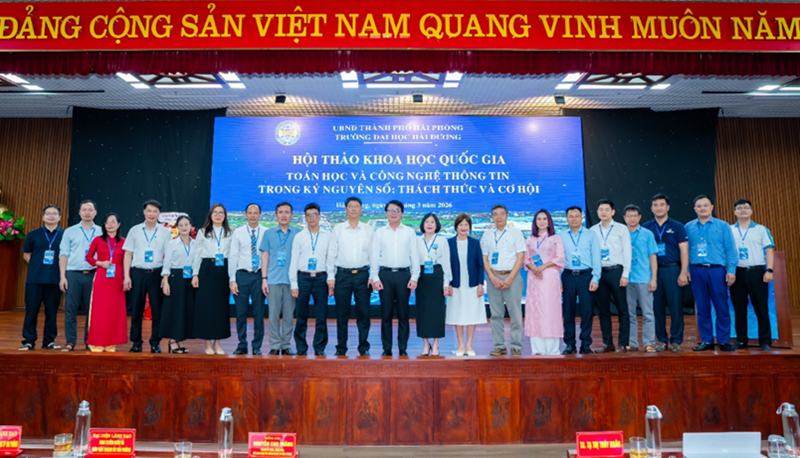
Overview of the Conference.
Mathematics and Information Technology: Two Pillars of the Digital Age
In the context of a rapidly developing knowledge-based economy and digital society, the roles of mathematics and information technology are increasingly affirmed as two inseparable pillars. In fact, the combination of mathematical thinking and technological foundations has created remarkable advances in many fields, from AI and data science to system optimization.
Mathematics is not only the theoretical foundation but also the "common language" of modern science and technology. Meanwhile, Information Technology plays the role of a tool for realizing mathematical models, helping to transform abstract ideas into concrete applications in life.
Currently, most core technologies such as AI, machine learning, blockchain, and big data analytics are built on mathematical algorithms and models. This creates an urgent need to improve the quality of training and research in these two fields, especially in the context of Vietnam's comprehensive digital transformation.
This year's conference received over 60 scientific papers from more than 10 prestigious universities and research institutes nationwide. The papers focused on several key topics, including: Trends in digital transformation in education and training; Developing digital skills for learners; Applications of mathematics and information technology in practice; In-depth research directions such as AI and blockchain; and Models of collaboration between universities and businesses.
Beyond theory, many presentations offered concrete solutions to connect research with practical needs, particularly in the fields of digital economy, smart cities, and data governance.
A notable point is the involvement of technology companies, indicating a growing trend of linkages between academia and the market. This is considered a key factor in enhancing the applicability of scientific research results.
Hai Phong aims to become a center for innovation.
In his keynote address at the workshop, Mr. Nguyen Cao Thang, Director of the Hai Phong Department of Science and Technology, emphasized the importance of Mathematics and Information Technology in the city's development strategy.
Accordingly, Hai Phong aims to become one of the leading localities nationwide in innovation by 2030, with the digital economy contributing approximately 35% to its GRDP. To realize this goal, high-quality human resources in the fields of Mathematics and Information Technology are identified as key factors.
Mr. Thang affirmed: "Mathematics and Information Technology are not two separate fields, but have an organic relationship, complementing each other. Mathematics is the theoretical foundation, while IT is the environment to realize and develop those models in practice."
At the same time, he also pointed out that the rapid development of technology, especially computing power and big data, is opening up new spaces for mathematics, from fundamental research to applications.
One of the topics hotly debated at the conference was curriculum reform. According to experts, the traditional training model, with its separation of disciplines, is no longer suitable in the current context.
Instead, interdisciplinary programs should be developed, where Mathematics serves as the foundation and Information Technology as the application tool. Students should not only be equipped with specialized knowledge but also possess the ability to think logically, analyze data, and solve practical problems.
The University of Oceanography has been urged to focus on areas such as: modernizing its training programs; promoting applied research; strengthening cooperation with businesses; and developing a startup ecosystem. These are considered necessary steps to train human resources that meet the demands of the labor market in the digital age.
Many experts at the conference emphasized the irreplaceable role of mathematics in the development of modern technology. A lecturer from Hanoi shared: “Without mathematics, there would be no AI. All machine learning models are based on probability, statistics, and linear algebra.”
According to experts, Vietnam has an advantage in terms of its young workforce, but still faces limitations in specialized training and basic research. Therefore, a long-term strategy is needed to develop mathematics as a foundation for innovation.
In addition, investing in technological infrastructure, especially data centers and high-performance computing systems, is also crucial for promoting research and application.
A representative from a technology company attending the conference stated that the demand for personnel with a background in Mathematics and Information Technology is increasing sharply, especially in fields such as data analysis, AI, and cybersecurity.
However, the gap between training and practice remains quite large. Many students lack practical skills and work experience, forcing businesses to spend time retraining them.
Therefore, businesses are looking to strengthen cooperation with universities through internship programs and customized training. This is seen as an effective solution to bridge the gap between universities and the market.
Not only professionals, but also the general public have high expectations for the development of Mathematics and Information Technology, especially in improving the quality of life.
Ms. Lan Anh from Le Chan ward, Hai Phong, shared: “I see technology increasingly present in every field, from healthcare and education to transportation. If applied well, it will certainly make life much more convenient.” Meanwhile, Mr. Minh Tuan, a young engineer, said: “The important thing is to train high-quality human resources, not only good at theory but also capable of practical application. Only then can Vietnam compete with other countries in the region.”
The role of policy: Creating "leverage" for development
Representatives from the Hai Phong Department of Science and Technology stated that they will continue to refine mechanisms and policies to promote the development of science, technology, and innovation. These policies will focus on: supporting scientific research; encouraging businesses to innovate technologically; developing a startup ecosystem; and accelerating digital transformation in various fields.
At the same time, the Department is committed to working alongside educational institutions and businesses in training, research, and application, with the aim of developing a high-quality digital workforce.
The workshop not only focused on academic exchange but also aimed at concrete solutions that could be implemented in practice. The opinions and suggestions presented at the workshop will serve as an important basis for developing policies and strategies for future growth.
In the context of increasingly fierce global competition, investing in Mathematics and Information Technology is not just an option but a necessity. This is the key to Vietnam's breakthrough, enhancing its competitiveness and integrating into the international community.
It is clear that mathematics and information technology are playing a central role in the digital age. However, the decisive factor remains people – those with the knowledge, skills, and mindset to master technology.
The workshop once again affirmed the importance of developing high-quality human resources, while also opening up new directions for education, research, and application.
In the digital transformation journey, the combination of Mathematics and Information Technology not only creates economic value but also contributes to building a smarter, more sustainable, and more humane society.