Developing smart cities is an essential requirement for Can Tho to fulfill its role as a regional center
On the morning of April 22nd, the Can Tho City Smart City Development Coordination Council held its first meeting of 2026. Mr. Truong Canh Tuyen, Chairman of the City People's Committee and Chairman of the Coordination Council, along with Vice Chairmen of the City People's Committee Nguyen Van Hoa and Vuong Quoc Nam, presided over the meeting.
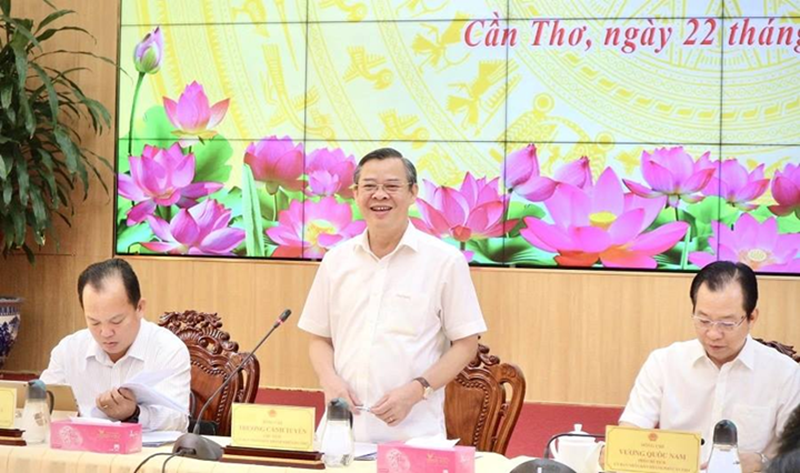
Chairman of the People's Committee of Can Tho City, Truong Canh Tuyen, delivered a directive speech at the meeting.
Also in attendance were members of the Coordinating Council, representatives from departments, agencies, and localities, as well as technology and telecommunications corporations such as Viettel and MobiFone.
The Can Tho City Smart City Development Coordination Council, established under Decision No. 3253/QD-UBND dated December 23, 2025, is an important step in concretizing the central government's policy on building and developing sustainable smart cities.
According to a report by the Department of Construction - the standing agency of the Council - Can Tho is one of the four centrally-governed cities that have issued a Smart City Development Plan, and is also one of the first two localities (along with Hanoi) to establish a Coordinating Council in accordance with Government Decree No. 269/2025/ND-CP.
To date, the city has completed 3 out of 16 Level 1 criteria according to the Sustainable Smart City Criteria Set (version 1.0), and is currently implementing 8 more criteria. To achieve Level 1, the city needs to complete at least one more criterion, aiming to reach Level 2 or higher by 2030.
For the period 2026-2030, the plan identifies 59 tasks and projects; of which the 2026-2027 period focuses on 21 key tasks, prioritizing the construction of a shared data platform, completing the ICT architecture framework, developing innovation infrastructure, and promoting the application of artificial intelligence (AI) in urban management.
In the first quarter of 2026, the Department of Construction simultaneously implemented several tasks, including publishing the Project on electronic information portals, advising the City People's Committee on directing its implementation; coordinating with telecommunications companies Viettel, VNPT, and MobiFone to advise on implementation solutions; and developing an activity plan for 2026.
To date, five units have issued implementation plans, including: the Department of Science and Technology, the Department of Agriculture and Environment, the Department of Education and Training, the Department of Construction, and the Department of Justice; three units are currently developing their plans. The remaining units are requested to urgently complete their plans as soon as possible to ensure the overall progress.
Regarding human resource capacity building, the city focuses on training and developing existing officials and civil servants to enhance their ability to operate digital infrastructure systems, artificial intelligence (AI) platforms, big data, the Internet of Things (IoT), and digital twin technology; while also developing appropriate mechanisms and policies to attract experts and high-quality personnel to serve smart city development.
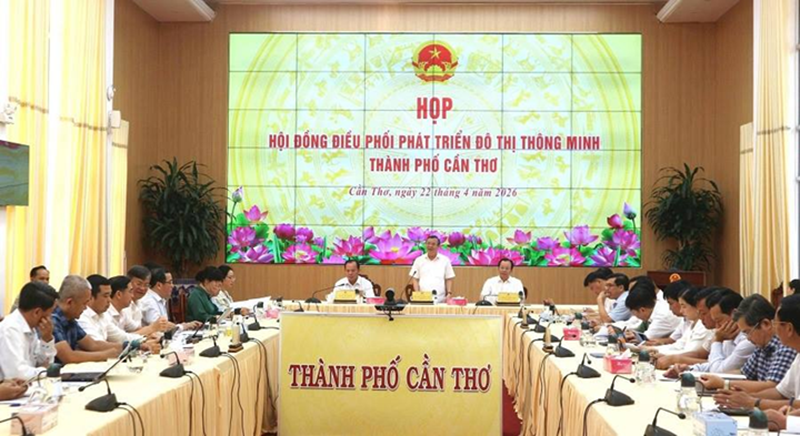
The scene at the meeting.
At the meeting, delegates focused on discussing solutions to overcome institutional, data infrastructure, and resource challenges, emphasizing the need to improve data sharing mechanisms, strengthen linkages between industries and sectors, and promote cooperation with technology companies.
Speaking at the meeting, Chairman of the People's Committee of Can Tho City, Truong Canh Tuyen, emphasized that developing a smart city is not only an important political task according to Resolution No. 57-NQ/TW of the Politburo, but also an essential requirement for Can Tho to play its role as the central hub of the Mekong Delta region.
The Chairman of the City People's Committee requested that departments, agencies, and localities raise awareness and proactively develop specific action plans; and at the same time, promptly finalize the inter-agency coordination mechanism, issue the data architecture framework and regulations for building and sharing the city's common database.
Emphasizing the implementation principles, the Chairman of the City People's Committee requested that "investment should not be scattered, duplication and waste should be avoided; each project must have clear responsibilities, tasks, timelines, and expected results."
The Department of Construction - the standing agency of the Council - is tasked with urgently compiling a list of priority projects for capital allocation in 2026 from various departments and agencies, submitting it to the Department of Finance for appraisal, and presenting it to the City People's Committee for approval in accordance with regulations, ensuring the progress of the Project implementation in the coming period.
Author: Phuong Thao