Promoting cooperation in developing high-tech agricultural value chains, aiming for sustainable exports
On the morning of April 20th, the Chairman of the People's Committee of Can Tho City, Truong Canh Tuyen, along with the Vice Chairman of the People's Committee, Tran Chi Hung, and leaders of various departments and agencies, held a working session with Hung Nhon Group and De Heus Royal Group (Netherlands) to discuss opportunities for cooperation in developing a high-tech agricultural value chain, aiming for sustainable export.
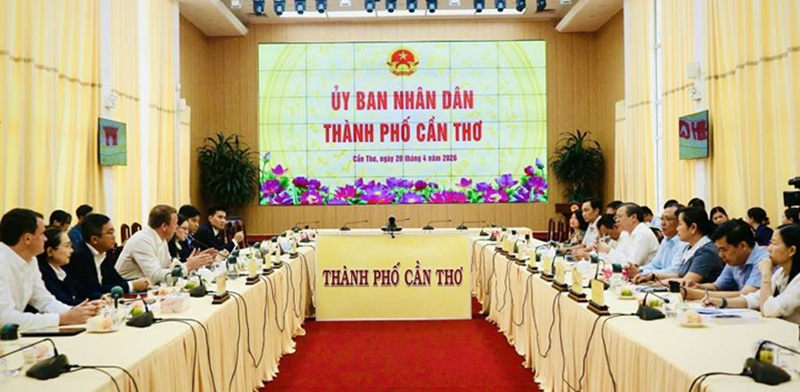
Scenes from the working session.
Attending the meeting, on the business side were Mr. Vu Manh Hung - Chairman of the Board of Directors of Hung Nhon Group; Mr. Johan Van Den Ban - General Director of De Heus Vietnam and Asia, and other members of the delegation.
According to the agricultural sector report, in 2025, the GRDP growth of the agriculture, forestry, and fisheries sector of the city will reach 3.79%, exceeding the set target (3.53%); the sector will account for 20.97% of the economy.
The livestock sector continues to shift towards concentrated, biosecure farming, gradually forming production - consumption linkages. The city currently has 1,110 farms and approximately 90,000 livestock households; 35 facilities meet VietGAHP standards and 35 facilities/regions are certified disease-free. The city has developed 4 production-consumption linkages; 30 large-scale livestock farms are linked with businesses such as CP, De Heus, and Japfa Comfeed. The total livestock and poultry population reached over 16.8 million head; meat production reached 168,080 tons, and egg production reached nearly 750 million eggs. In addition, swiftlet farming continues to develop with 1,171 facilities, with an estimated production of over 14 tons per year.
In the fisheries sector, the total aquaculture area reached 97,078 hectares; the production of aquatic and marine products reached 781,853 tons, of which aquaculture production accounted for more than 705,000 tons. The city focuses on managing the aquaculture environment, protecting aquatic resources, and gradually developing in a sustainable direction.
According to the Can Tho City Planning for the period 2021-2030 , with a vision to 2050, the city has oriented the development of high-tech agricultural zones in Thoi Hung, Thanh Phu, Co Do, Truong Xuan, O Mon, Vinh Vien, Thanh Quoi, and Thanh An; high-tech livestock farming zones in Thoi Hung, Dong Binh, and Chau Thanh; and concentrated aquaculture areas.
During the meeting, Mr. Johan Van Den Ban and Mr. Vu Manh Hung presented the investment and development plan for the De Heus - Hung Nhon value chain for the period 2026-2030. The two corporations proposed developing a closed-loop agricultural value chain from breeding stock, feed, farming, processing to export, meeting international standards such as Halal, ISO 22000, and FSSC 22000; targeting markets in the EU, the Middle East, Japan, and South Korea.
According to the plan, by 2030, this supply chain aims to achieve a capacity of approximately 37,500 breeding pigs and commercial sows; 83 million chickens; 5 million tons of feed per year; supplying 52 million processed poultry per year and 132,000 tons of aquatic products.
Currently in Can Tho City, De Heus Group is partnering with livestock farmers, especially in the fields of animal husbandry and aquaculture, by providing feed, breeding stock, nutritional solutions, and technical support. The company operates three feed production plants for aquaculture, livestock, and poultry in Tra Noc Industrial Park I, Tra Noc Industrial Park II, and Tan Phu Thanh Industrial Park (Phase 1). These plants operate stably, supplying the domestic and export markets with over 700,000 tons of products annually, achieving revenue exceeding US$200 million and providing stable employment for over 500 local workers.
Speaking at the meeting, Chairman of the People's Committee of Can Tho City, Truong Canh Tuyen, emphasized that the city has always prioritized agricultural development in the direction of "ecological agriculture, modern rural areas, and civilized farmers," linked to increasing added value, sustainable development, and adaptation to climate change.
The Chairman of the City People's Committee highly appreciated the cooperation proposal from the two corporations, considering it consistent with the orientation of restructuring the agricultural sector towards the development of high-tech agriculture, green agriculture, and a circular economy. If implemented effectively, the projects will contribute to promoting the development of the processing industry, increasing agricultural export turnover, creating stable jobs, raising people's income, and promoting the transformation of production methods from small-scale to chain linkages.
Chairman of the People's Committee of Can Tho City, Truong Canh Tuyen, affirmed that Can Tho City is always committed to accompanying and creating favorable conditions in terms of administrative procedures and investment environment for businesses to implement projects effectively and sustainably.
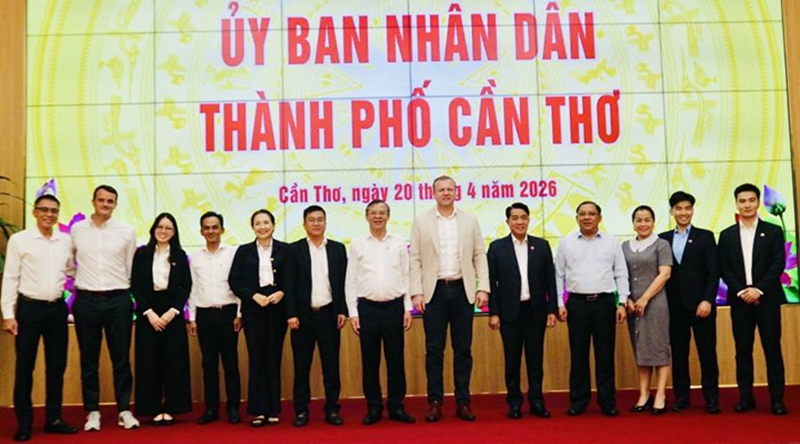
The delegates took a commemorative photo.
To ensure effective cooperation, the Department of Agriculture and Environment requests that investors further clarify their needs, scale, and investment locations; ensure compliance with planning, effectively control environmental factors and disease safety; and develop harmonious linkages between businesses and local people in production organization.
According to the program, in the afternoon of the same day, the working group will conduct a field survey of the planned high-tech livestock farming areas in Thoi Hung, Hoa An, and Long Hung communes, and the high-tech shrimp farming area in Lieu Tu commune and Khanh Hoa ward.