Big success thanks to innovative mudless eel farming.
In Nghe An province, recognizing the potential of eels, Mr. Hoang Kim Luong invested billions of dong to build a large-scale farm for raising eels without mud.
Eels are a specialty of Nghe An province, and due to increasing consumer demand, numerous large-scale, mudless eel farms have sprung up in the province . Among the top examples is the model of Mr. Hoang Kim Luong in Hop Minh commune, with an investment of billions of VND.
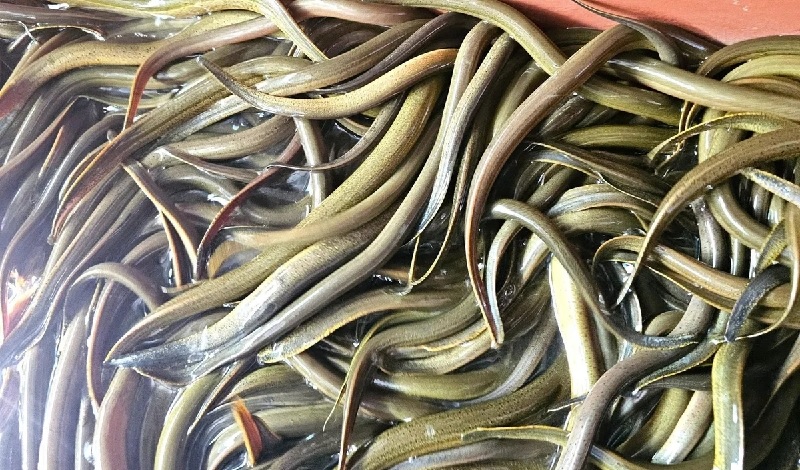
Mr. Hoang Kim Luong's mudless eel farming model yields high economic value. Photo: NT.
Before pursuing this model, Mr. Luong spent many years traveling abroad. Once he had accumulated some capital, in 2018 he decided to return to his hometown to build an eel farm.
“My childhood was spent in the rice fields, setting traps and fishing for eels with my friends. Therefore, I always harbored the dream of starting an eel farming model when the time was right. I diligently researched and visited large eel farms in the southern provinces to learn from their practical experience. Once I had a solid understanding of the basic knowledge and farming process, I mobilized and borrowed additional capital to start,” Mr. Luong confided.
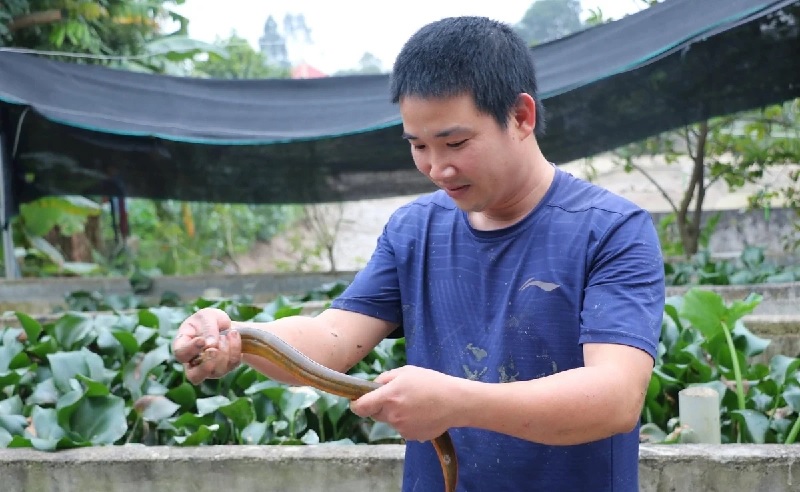
After a difficult start, Mr. Luong has reaped sweet rewards. Photo: Thanh Phuc.
Confident in his knowledge, Mr. Luong ordered eel fry from the South to raise them using traditional methods. However, theory and practice are two different things, and being new to the process, he sometimes encountered large numbers of eels dying.
Undeterred, he tried to adjust environmental and temperature parameters while also seeking advice from experienced farmers. Gradually, the situation improved, and the mortality rate of eels decreased significantly. After some time, realizing that the eels had adapted 100%, Mr. Luong officially switched to mudless farming, with separate areas arranged to suit each stage of the eel's development. In addition to the areas for raising broodstock, hatching eggs, and raising fry, there is also a separate area for commercial eels.
According to Mr. Luong, mudless eel farming requires many improvements, and the cost of building tanks, installing aeration systems, and water filtration is significantly higher. However, if the correct method is applied, the stocking density can be increased fivefold compared to traditional methods, resulting in much higher economic value.
Unlike many common aquatic species, eels are particularly sensitive to their environment, requiring very strict water quality standards. Understanding this crucial factor, Mr. Luong proactively arranged two ponds to store incoming water and installed modern equipment and a filtration system for sedimentation. With suitable living conditions ensured, eels raised in mud-free tanks grow quickly and steadily, and the product quality meets consumer demand.
Currently, with 7 commercial eel farming tanks, each measuring 10m2, Mr. Luong's farm regularly supplies over 1 ton of commercial eels annually to processing facilities, generating approximately 150 million VND in revenue. His brand and reputation have been built over the years, resulting in consistently high demand for his commercial eels.
The farm's revenue also comes from supplying eel fry. Each year, Mr. Luong's farm sells 200,000 to 300,000 fry, consistently earning hundreds of millions of dong. This sweet success is not accidental but the result of boldness in his approach and a mindset that creates differentiation.
Initially, Mr. Luong bought eel fry from the South to raise, but the high price and risks meant low profits. Faced with this difficulty, he tinkered with and invented an eel egg incubator to gradually become self-sufficient in eel fry.
The machine has a heating system that ensures the appropriate temperature is maintained, especially in winter. It is designed with multiple chambers, operating on the principle of circulating water to create oxygen. When the eggs hatch, the baby eels are separated through a conduit to a separate chamber, while the unhatched eggs are retained for further incubation. Through numerous trials and adjustments, Mr. Luong has found the necessary parameters for the egg incubator, thereby maintaining an 80% hatching rate.
Mr. Luong has been crossbreeding parent eels imported from the South with native wild eels to improve the productivity and quality of commercial eels, while also increasing the adaptability of young eels to new environments. This method has proven very practical; each eel tank yields approximately 1 kg of eggs, with a fertilization and hatching rate of 20,000 eels.
https://nongnghiepmoitruong.vn/