Safe shrimp farming - Control must be implemented throughout the entire chain
Risk management must be implemented throughout the entire chain, controlling everything from broodstock and juvenile shrimp to biosecurity, environmental protection, and early detection and timely handling of any abnormalities.
Vietnam is currently one of the world's important shrimp suppliers, exporting to over 100 markets; by 2025, shrimp export revenue is expected to reach approximately US$4.6 billion. However, the Vietnamese shrimp industry is currently facing significant challenges: increased disease outbreaks, more volatile environmental conditions, higher input costs, and increasingly stringent market requirements.
Address the root cause, not just the symptoms.
In the context of Vietnam's shrimp farming industry facing increasingly fierce competition and increasingly complex disease pressures, the necessary direction is not to find a single solution for each problem, but to build a synchronized chain. Only when every link in the chain—from broodstock, fry, farmers, technical enterprises, management agencies to the market—changes towards improving quality, increasing biosecurity, early risk detection, and more effective coordination, can Vietnam's shrimp industry develop in a more stable, efficient, and sustainable direction in the future. This is also the core spirit of this presentation: shrimp farming during disease outbreaks must succeed through a foundation of health, disciplined management, and proactive action throughout the entire chain, not through delayed response.
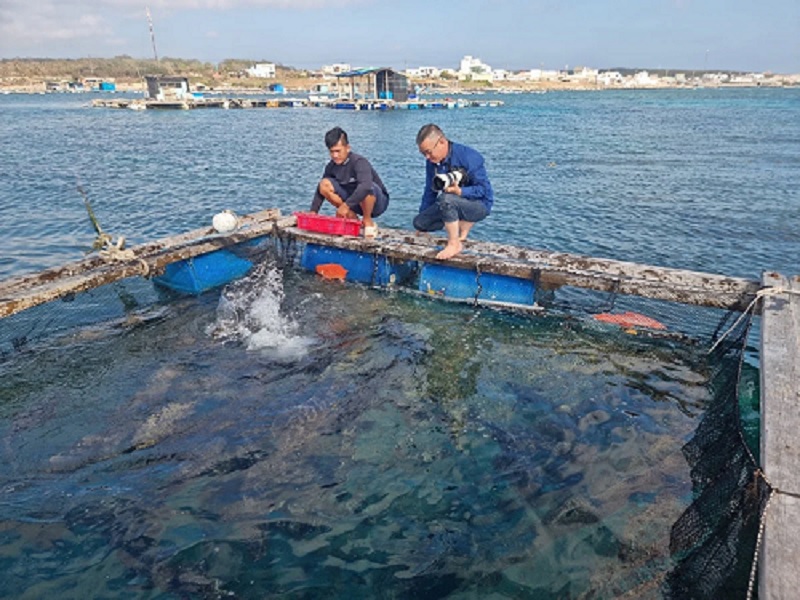
Aquaculture farmers in general, and shrimp farmers in particular, still have a fragmented mindset and have not yet formed a supply chain, thus facing many risks. Photo: Tran Hop.
According to Mr. Trinh Trung Phi, Deputy General Director of Technology at Viet Uc Group, while successful shrimp farming used to focus on keeping shrimp alive and growing, now it also involves ensuring healthy, uniformly sized shrimp at reasonable costs, with traceable origins, and meeting quality and food safety standards. This means that shrimp farming today is no longer just a matter of pond techniques, but a problem of risk management across the entire chain, from broodstock and fry to biosecurity, environmental management, and early detection and timely response to abnormal signs.
“From the perspective of many years of experience in the field of broodstock, juvenile, and commercial shrimp farming, I believe that the question ‘Why is shrimp farming becoming more difficult than before?’ has many answers, many causes, and many factors simultaneously impacting shrimp ponds. These include diseases no longer appearing individually but more frequently; a more sensitive and unpredictable environment; increasing economic pressure; and farmers being forced to do things right from the start if they want to succeed. This means preventing and treating diseases at their source, rather than waiting until the pond is infected before searching for the cause and treatment, which is often too late,” Mr. Phi said.
Mr. Phi analyzed that simply looking at the disease in terms of individual agents such as viruses, bacteria, or parasites is insufficient to explain why, in the same farming area, the same season, and even the same farming model, some ponds are severely affected while others remain unaffected. This is a consequence of the entire chain, from the quality of broodstock and shrimp larvae, the rearing process, transportation, pond preparation, feed management, stocking density, water environment, and the farmer's ability to detect early signs of abnormalities.
Pathogens can exist beforehand or enter the pond at various times; they only erupt strongly when favorable conditions arise, especially when shrimp are weakened, the environment fluctuates, or there are loopholes in management practices. Therefore, many cases of significant losses are not due to just "one highly dangerous disease," but rather to a combination of unfavorable factors that weaken the shrimp population, reduce their appetite, and create conditions for disease outbreaks. In other words, when disease appears at the end of the chain, the underlying causes have often accumulated much earlier in the chain.
Therefore, disease prevention thinking should not begin with the question "What disease is affecting this pond?", but rather with the question "Which link in the chain is increasing the risk to the pond?".
Links across the entire chain
It's a fact that needs to be frankly acknowledged: shrimp farmers cannot single-handedly solve the entire disease problem if other links in the value chain don't change as well. When the quality of broodstock and shrimp larvae is inconsistent; when technical information reaches farmers intermittently; when many commercial solutions are promoted more strongly than scientific evidence; and when warnings about disease and environmental issues don't reach the ponds in a timely manner, the risks continue to fall on commercial farmers.
Therefore, for farmers to change effectively, the entire chain must also change. Broodstock and seed producers need to focus on the health and stability of the offspring, not just the quantity supplied. Feed, supplement, and technical service businesses need to work alongside farmers, providing responsible, transparent, and scientifically-based advice. Management agencies, fisheries extension systems, institutes, universities, and specialized organizations need to strengthen disease surveillance, environmental warning systems, standardize technical information, and bridge the gap between research and production practice.
When accurate information is shared promptly, when inputs are standardized, when biosecurity is strictly implemented, and when each component in the chain understands its responsibilities, then shrimp farmers will have the conditions to organize production in a more stable and sustainable way. This is the foundation for moving from "shrimp farming to solve problems" to "shrimp farming through management and coordination of the entire value chain".
In the context of Vietnam's shrimp industry facing increasingly fierce competition and increasingly complex disease pressures, the necessary direction is not to find a single solution for each problem, but to build a synchronized approach for the entire chain. Only when each link, from broodstock, seed, farmers, technical enterprises, management agencies to the market, changes towards improving quality, increasing biosecurity, early risk detection, and more effective coordination, can the Vietnamese shrimp industry develop in a more stable, efficient, and sustainable direction. This is also the core spirit of this paper: shrimp farming during disease outbreaks must succeed through a foundation of health, disciplined management, and proactive action from the entire chain, not through delayed response.
"Disease prevention doesn't lie in treating shrimp after they've already contracted the disease, but in better input control, which includes selecting broodstock, implementing stricter biosecurity procedures, maintaining a more stable environment, and detecting abnormalities earlier. This mindset also helps avoid a piecemeal approach, where each time a problem arises, only one type of medicine or a temporary solution is sought, while the root cause remains unaddressed," said Mr. Trinh Trung Phi, Deputy General Director of Technology, Viet Uc Group.
https://nongnghiepmoitruong.vn/