Vietnam now has 'green label' fishmeal.
Ho Chi Minh City – For the first time, Vietnam has marine fishmeal that meets MarinTrust 3.0 standards – a 'green ticket' that helps the seafood industry participate more deeply in the global supply chain and overcome IUU barriers.
In the livestock and aquaculture value chain, marine fishmeal is considered a "golden" ingredient. Marine fishmeal has a relatively high protein content (40-80%), is rich in essential amino acids, vitamins, and minerals, which help livestock grow quickly, improve immunity, and optimize feed conversion ratios.
However, climate change, environmental pollution, and overfishing are depleting marine resources, forcing the global fishmeal industry to transform. Major markets no longer accept raw materials of unknown origin, instead demanding traceability, transparency, and accountability. Concepts like "red labels" and "yellow labels" are gradually being replaced by "green labels"—symbols of a sustainable supply chain.
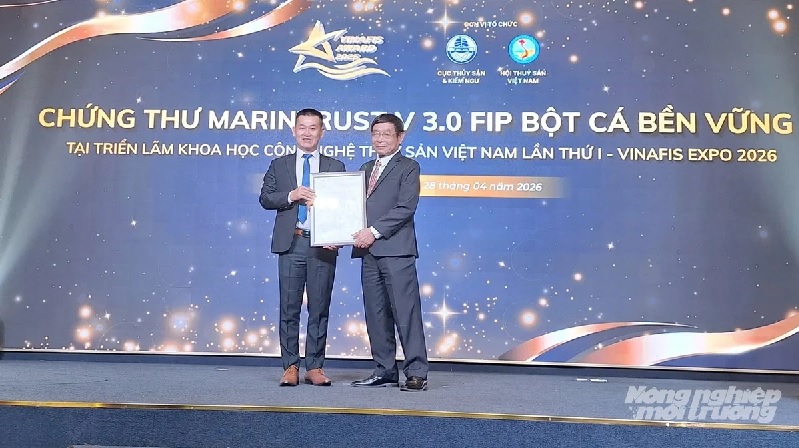
On the evening of April 28th, at the VINAFIS AWARD ceremony within the framework of VinaFIS Expo 2026, representatives from SGS presented the MarinTrust 3.0 certification to Mr. Nguyen Thanh Loc, Director of Phuc Loc Vung Tau Co., Ltd., and Chairman of the Ho Chi Minh City Fisheries Association. Photo: XL .
The introduction of the MarinTrust standard (formerly IFFO RS) in 2012 marked a significant turning point. Beyond controlling raw material inputs, this standard encompasses measures to combat IUU fishing, protect ecosystems, and promote social responsibility throughout the entire production chain. With version 3.0, effective from 2024, the requirements have been raised to the highest level ever.
According to Mr. Dinh Xuan Lap, Deputy Director of the International Cooperation Center for Sustainable Aquaculture and Fisheries (ICAFIS) under the Vietnam Fisheries Association, market trends are creating pressure for businesses to change.
“Major international buyers like Walmart, Aeon, and Metro all set very high standards for sustainability. Standards such as BAP, GlobalGAP, and ASC all require a large percentage of fishmeal to be certified or come from fisheries improvement programs (FIPs). This is no longer an option, but a mandatory condition if we want to participate in the global supply chain,” Mr. Lap emphasized.
These standards extend beyond environmental concerns to encompass social responsibility and fisheries governance. This forces the entire ecosystem, from fishermen and businesses to regulatory agencies, to change. "If we don't move in this direction, it will be very difficult for Vietnamese seafood to maintain its market share, especially in high-value segments," Mr. Lap said.
Recognizing the trend early on, since 2015, the Ba Ria - Vung Tau Fishmeal and Fish Oil Association has initiated a Fisheries Improvement Program (FIP) with the participation of businesses, fishing vessels, and stakeholders. After many years of implementation, in February 2022, the Vung Tau FIP was recognized by MarinTrust as the first multispecies fisheries program in Vietnam to meet the standards.
Not stopping there, the FIP community continues to raise its targets for 2035, adding social responsibility alongside criteria on combating IUU fishing, protecting endangered species, and adhering to the FAO's responsible fisheries rules.
With the determination to "elevate Vietnamese seafood to new heights," in December 2025, Phuc Loc Vung Tau Co., Ltd. officially registered for assessment according to the MarinTrust 3.0 standard. After nearly four months of rigorous evaluation by SGS and MarinTrust, on April 17, 2026, the enterprise was granted certification, meeting all the requirements of the fisheries improvement program.
Mr. Nguyen Thanh Loc, Director of Phuc Loc Vung Tau Co., Ltd. and Chairman of the Ho Chi Minh City Fisheries Association, said that this journey was not easy: “To achieve MarinTrust 3.0, we had to control the entire chain from fishing vessels and raw materials to production processes and traceability. The most difficult thing was not the technology, but changing the fishing habits and awareness of fishermen.”
The fact that marine fishmeal has achieved MarinTrust 3.0 certification helps the Vietnamese fisheries industry in general to expand its market reach. “With the ‘green label,’ Vietnamese fishmeal products can participate in high-end supply chains, which were previously almost closed due to IUU issues and a lack of certification. This is an opportunity to increase value, not just increase production,” Mr. Loc further shared.
Globally, there are currently only about 111 fishmeal mills using whole fish from wild-caught fish that meet the MarinTrust 3.0 standard, mainly concentrated in Peru, Chile, Europe, and the United States. Achieving this certification for a Vietnamese company is a groundbreaking step and the first case in Asia for this segment.
Since 2017, the European Union's "yellow card" warning regarding IUU (Illegal, Unreported, and Unregulated) fishing has created numerous obstacles for Vietnamese seafood exports. This impact not only directly affects harvested products but also extends to the entire supply chain, including the fishmeal and fish oil industries.
In this context, products like fishmeal certified with the "green label" demonstrate that Vietnam is fully capable of building a transparent, responsible supply chain that meets the most stringent international standards.
Mr. Dinh Xuan Lap commented that this is a positive sign, but the model needs to be further promoted and replicated. "It's commendable that one enterprise has achieved this, but to create real change, this model needs to be replicated across the entire industry. Only then can Vietnam shift from a passive to an active role in the global competition," Mr. Lap stated.
https://nongnghiepmoitruong.vn/