Ten years of 'nourishing' civets, earning billions of dong annually
QUANG TRI - With 350 breeding pairs of civets, Mr. Tinh's farm generates an income of approximately 1 billion VND per year.
The farm of Mr. Do Tien Tinh's family (35 years old, Huong Thi village, Truong Phu commune, Quang Tri province) is located on a hillside covering more than 3 hectares. Mr. Tinh said that in previous years he had tried many different economic development models such as raising chickens, raising pigs, growing citrus trees... but each model had different difficulties and risks. Raising chickens and pigs also easily causes environmental pollution and poses difficulties in waste treatment.
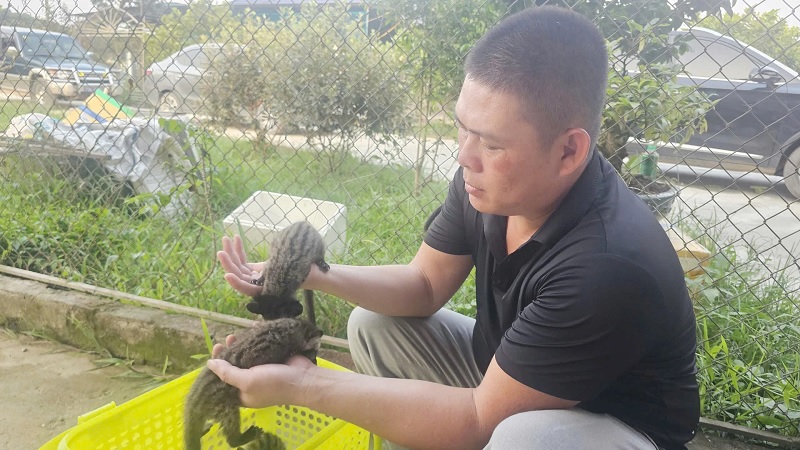
Mr. Do Tien Tinh checks the quality of the "baby" civets before selling them. Photo: T. Duc.
After hearing recommendations from friends and learning about it through newspapers and television, Mr. Tinh became interested in raising civets (also known as musk civets) and packed his bags to travel to the southern provinces to learn from experienced breeders. After nearly a month of learning how to raise civets, Mr. Tinh returned and renovated his farm to start his business with this new animal.
Initially, to learn from experience, he only bought 5 breeding pairs of ferrets to raise. He was worried, and some nights he couldn't sleep when it rained heavily, with thunder and lightning. "Perhaps the land and climate have been favorable to my livestock, so everything has gone smoothly. Since starting my business, nothing has happened," Mr. Tinh said.
When the civets reproduced, Mr. Tinh called to inquire about and seek advice from the initial breeding facility, receiving further guidance with great care. The first litter of "baby" civets grew quickly and soon became a breeding herd, which further encouraged him.
Investing in expanding his enclosures, Mr. Tinh bought more than a dozen breeding pairs to increase his herd. Just two years later, his farm had nearly a hundred breeding civet pairs. "I only focus on breeding civets and supplying good quality breeding stock to the market. The rest of the breeding stock is used to increase the herd and the number of breeding civets," he shared.
On his farm, Mr. Tinh grows citrus trees to supplement his income and keeps dozens of beehives. The honey is mostly used to feed and nourish civets during the rearing period after weaning. The civets are housed in three separate enclosures: one for breeding civets, one for baby civets, and one for breeding civets during the mating and reproduction phase.
Mr. Tinh often feeds his civets with foods like ripe bananas, fish porridge, and meat porridge. In addition, he also feeds the mother civets chicken eggs during the breeding season to ensure that the offspring are of good quality, develop well, are healthy, and are resistant to disease.
According to Mr. Tinh, if properly cared for, civets can reproduce after 15 to 18 months. Two months after birth, the pups are separated from their mothers and moved to a separate care area. After one month, the "baby" civets weigh between 1.2 and 1.5 kg each and can be sold as breeding stock. "The price of breeding stock varies depending on the market, around 8 to 10 million VND per pair," Mr. Tinh said.
After nearly 10 years of developing civet farming , Mr. Tinh's farm now has over 350 breeding pairs. Every year, his farm supplies a considerable number of offspring to the market. "Last year, for example, the farm sold offspring and earned a profit of about 1 billion VND. Whenever a customer comes to buy offspring, I always ask carefully about the land area, the layout of the enclosures, etc., to advise them on the appropriate number of offspring, ensuring they have the capacity to raise and care for them, and how to gradually increase the herd."
"It's also a way to support each other in developing our family's economy. Through this, I also established a farming group to exchange knowledge, market information, and to network and learn from each other," Tinh confided
https://nongnghiepmoitruong.vn/