"Village Numbers" in Bat Xat: An approach based on the real needs of the people.
In mountainous border regions like Bat Xat (Lao Cai), the concept of "digital village" is not understood as a technological slogan, but rather as a way of reorganizing life at the grassroots level based on digital tools – from administration and production to community activities. A noteworthy point is that this model stems from the very specific needs of the people, rather than imposing complex top-down frameworks.
First and foremost, the "digital village" in Bat Xat is built on a foundation of basic infrastructure and applications: online meetings from the commune to the village level, community Zalo groups for quick information sharing, use of online public services, and simple cashless payments. These tools significantly shorten geographical distances, which are a major barrier in mountainous areas. Meetings are no longer entirely dependent on travel; government announcements reach citizens faster; and administrative procedures are gradually shifting from "going to submit documents" to "being guided on-site."
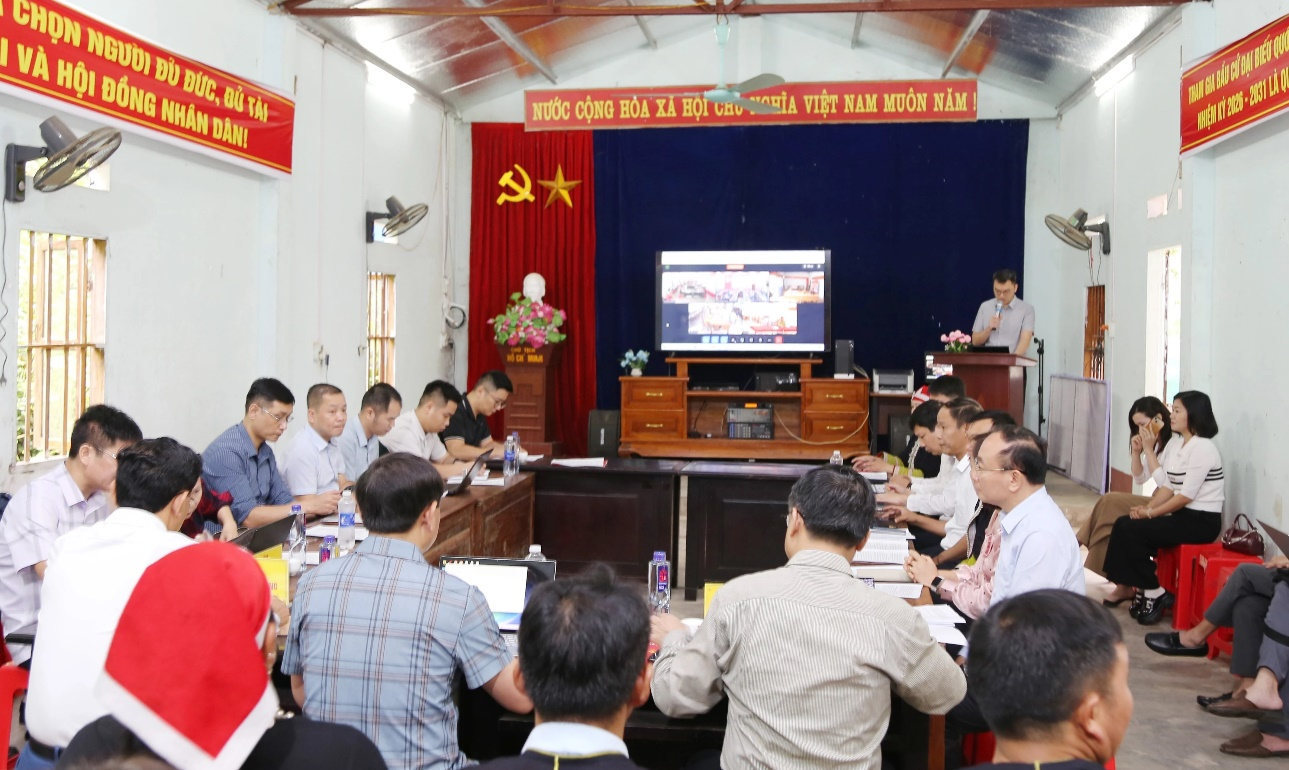
A delegation from the Provincial Party Committee's Propaganda and Mass Mobilization Department and the Department of Science and Technology surveyed the "digital indigenous people" and "digital villages" models in Lao Vang village, Bat Xat commune.
More importantly, "digital villages" are not just about technology, but about a change in how grassroots systems operate. Party branches and mass organizations are beginning to use electronic notebooks and management software, making the management of party members and the implementation of tasks more transparent and convenient. From a governance perspective, this is a shift from experience to data, albeit still in its early stages.
Another pillar of the model is the "digital native" force – local individuals who can provide hands-on guidance to the people. These are often village officials, youth union members, teachers, or tech-savvy young people. In a context where people's digital skills are limited, this intermediary role is crucial. Instead of large-scale training courses that are difficult to sustain, the approach in Bat Xat focuses on direct support, tailored to specific situations: registering for public service accounts, installing electronic identity verification applications, selling goods on e-commerce platforms, etc.
From an economic perspective, "digital villages" are initially opening up new consumption channels for agricultural products and local produce. Some villages have experimented with promoting specialties and OCOP products on digital platforms, combined with the "digital market - digital rural area" model. Although the scale is still small, this approach helps people access a wider market, reduce dependence on traders, and create new transaction habits.
In the social sphere, the model also contributes to changing how people access services. Electronic health records, telemedicine consultations, online learning for students in mountainous areas... are not yet widespread, but have begun to appear as "model services". The common point is reduced travel costs and time savings, factors that are very significant in mountainous regions.
However, the "digital village" model in Bat Xat is still in its initial stages. Telecommunications infrastructure is uneven, equipment is lacking, and people's digital skills are inconsistent. Some applications are deployed in a fragmented and uninterconnected manner. Notably, if not closely linked to actual needs (production, consumption, essential services), the model could easily become merely a formality.
From this experience, the direction of Bat Xat is quite clear: not chasing high technology, but prioritizing "sufficient" solutions that are easily accessible, have direct guidance, and are linked to livelihoods. Therefore, "digital villages" are not the destination, but a way of doing things, where digital transformation is "localized" to suit the conditions of the highlands, gradually changing habits and improving the quality of life for the people.
Center for Science and Technology Communication