Farming in harmony with nature, remaining calm in the face of fuel shortages.
Since its inception, this farm has been oriented towards organic farming practices, enriching the soil, minimizing groundwater extraction, and utilizing rainwater for irrigation.
The farm is well-invested in, scientifically managed, and cultivated according to a philosophy of harmony with nature, utilizing natural water sources, a water-saving drip irrigation system controlled by software (app), automation using solar energy, and minimal use of fossil fuels... as a result, it has remained almost unaffected by the fluctuations in the fuel market in recent times.
That's Queen Farm, a durian farm located in Phuoc Son commune, Dong Nai province (formerly Dang Ha commune, Bu Dang district, Binh Phuoc province). The owner is Mr. Nguyen The Tung, a master's graduate in production management from England.
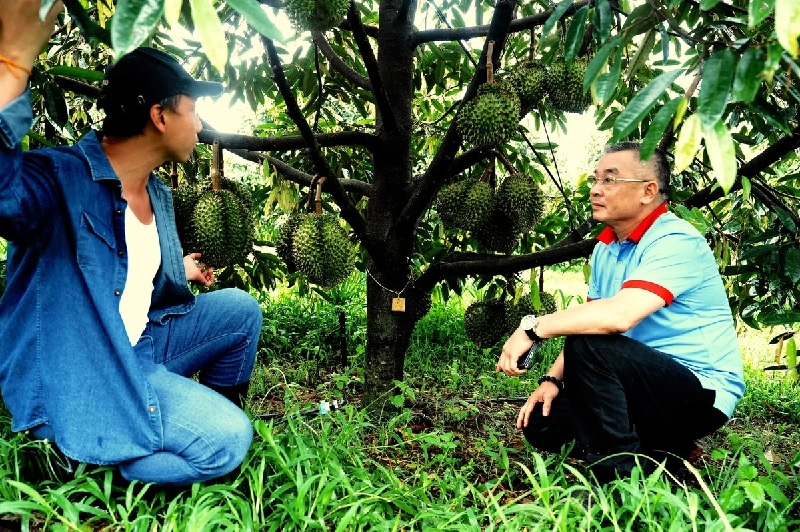
Nguyen The Tung introduces the environmentally friendly farming process at Queen Farm. Photo: Minh Tien.
Thinking "unconventionally"
Recently, the fluctuating price of gasoline and diesel fuel has caused turmoil for businesses and the general public alike. This immediately brought to mind the Queen Farm durian model. It's a well-invested, modern farm with many philosophies focused on harmony with nature. To date, after four years of cultivation, Queen Farm has achieved Global GAP certification, with the total organic nutrient content in its farming process reaching nearly 80%.
It's understandable, because having been educated and trained in a European environment, Tung has enough knowledge to create a "European-standard" agricultural model. In addition, he has a mother who is very passionate about agriculture, so he developed a passion for it himself without even realizing it.
CEO Nguyen The Tung has an unconventional mindset. Instead of drilling industrial wells dozens, even hundreds of meters deep underground, he designed shallow but wide ponds, lined with tarpaulin to collect rainwater. Queen Farm has two ponds, one of which, nearly 1.2 hectares in size, is located at the highest point in the middle of the farm and has a capacity of approximately 100,000 cubic meters, providing enough water for irrigation for six months during the dry season.
"Here, there are 5-6 months of dry season each year, with little rain and water shortages. That's one of the reasons why we've mainly grown drought-resistant crops like cashew and rubber trees here. Durian, on the other hand, is a finicky crop. Without knowledge and careful consideration of all possible scenarios, especially with increasingly unpredictable climate change, it's very easy to fail. In the summer of 2024, this region experienced a severe drought, with not a single drop of rain for 6 months. If it weren't for these two reservoirs, I don't know what would have happened to the crops," Tung confided.
“Why not drill wells? It would save space, time, and money,” I wondered. Tung explained, “I know that groundwater resources are generally depleted severely, the surface land is subsiding, global warming and rising sea levels are becoming increasingly serious, and yet farms, large or small, are drilling industrial wells and using high-capacity pumps. During the dry season, thousands of these wells simultaneously pump up enormous amounts of water to the surface. That’s one of the reasons why the land is subsiding. That’s why I decided not to drill wells and instead invest in these reservoirs.”
After having two ponds, Tung continued to invest in an automatic irrigation system with a pipeline length of up to 75km running around the garden. Each tree is equipped with a sensor to ensure that the amount of water irrigated each time is just right, avoiding waste. Everything is operated automatically with control software on a phone or laptop.
Tung assessed that compared to traditional manual farming methods, Queen Farm requires a relatively large initial investment, but the costs decrease over the long term, and profits and benefits increase.
In particular, despite having "foresight" and planned from the beginning, Tung, like many others, could not have foreseen the current fluctuations in fuel prices. "Recently, many traditional farmers with drilled wells and large-capacity irrigation pumps have been scrambling to find sources of diesel fuel at high prices, but to no avail," Tung said.
Comprehensive green development orientation
One of Queen Farm's initial key priorities was to focus on green farming, creating an ecological environment, aiming for "Net zero," saying no to waste, especially plastic waste, and avoiding the use of chemical fertilizers and pesticides. Therefore, weeds in the garden are almost allowed to grow freely, only being trimmed scientifically according to Tung's intentions.
“I cut the grass and spread it under the trees to retain soil moisture, protect water sources, and provide green manure for the plants. I only ‘borrow’ the land to grow trees, I don’t own it. And if I borrow, I have to return it, both principal and interest. Simply put, the land provides nutrients for me to nourish the plants, and I have to know how to replenish those nutrients for the land, just like a mother giving milk to her child; if it’s not nourished, how can it produce enough milk for the child? The land is the same; if it’s not properly cared for and nurtured, it will quickly become barren and infertile, and the plants cannot thrive. Everything we take from the land must be returned to the land with the utmost gratitude,” CEO Nguyen The Tung explained.
From its inception, Queen Farm has been operated according to the ESG (environment, social, and governance) philosophy, aiming to transform this land into a symbol of civilized agriculture and sustainable values.
Tung explained that, in terms of the environment, he invested in a closed-loop water treatment system, reusing all organic by-products, protecting soil microorganisms, and avoiding the use of chemicals. Regarding nutrition, Queen Farm produces its own products using microbial technology.
Regarding governance, as mentioned above, all processes are digitized, from farming logs and irrigation schedules to product quality management. Data is stored and checked according to international standards.
In terms of social aspects, he creates stable jobs for dozens of workers, most of whom are Khmer and Stiêng people, as well as young graduates. They work, live, and study together like a family, enjoying the same welfare benefits. "True sustainable development is when we bring happiness to the land, to nature, and to everyone, without distinction between employer and employee."
In 2024, Queen Farm harvested its first durian crop, yielding 420 tons. And right from the first harvest, the product achieved GlobalGAP certification, awarded by Bureau Veritas – a 200-year-old French quality assessment group. Furthermore, Queen Farm is the first durian growing region in Southeast Asia to receive this certification.
In 2025, Queen Farm aims to produce nearly 400 tons of high-quality durian, with approximately 80% meeting export standards. However, Queen Farm will not forget the domestic market, readily supplying wholesale and retail orders to domestic partners, hoping that domestic consumers can also enjoy clean and safe products.
https://nongnghiepmoitruong.vn/