According to the flowering season, bees bring their livelihood to the highlands
In Lao Cai, people in the highlands bring bees along with the flowering seasons, traversing mountains and forests to find sweet honey, gradually increasing their income, stabilizing their lives, and opening up avenues for economic development.
Gather the sweet nectar according to the flowering season
When the hillsides of Muong Lo are covered in the creamy white of longan blossoms, it's also the time when beekeepers in Pung Luong commune (Lao Cai) are busy preparing for long journeys. Not only are they devoted to their bee colonies in the mountains and forests of their homeland, but they also take their bees hundreds of kilometers, following the flowering seasons in search of sweet nectar.
Over the years, that job has become a way of life.
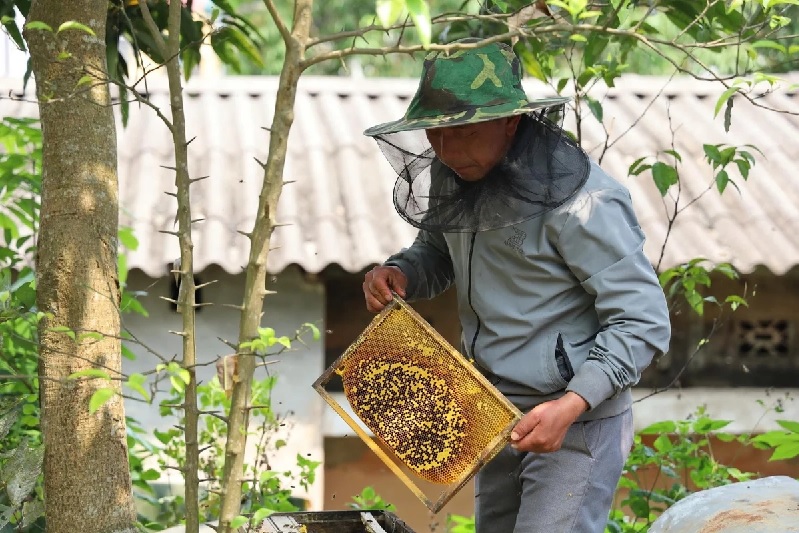
Besides keeping bees locally, many people have taken their bee colonies to find sources of sweet nectar in various places. Photo: Thanh Nga.
Giang A Nha, a Hmong man from Cáng Dông village, Púng Luông commune (Lào Cai province), has been involved in beekeeping for many years . For over six years, he has not only kept bees locally but also traveled with his relatives to various flower-growing regions. His group consists of six people, all sharing the same bloodline and a common desire to make a living. Each flowering season, they set off together, carrying with them the hope of finding fragrant, wholesome honey.
When the longan flowers bloom profusely in the Muong Lo region, the group transports hundreds of beehives to localities such as Van Chan, Trung Tam, Cau Thia, and Nghia Lo. These trips last for months, are far from home, and are arduous, but in return, they offer the opportunity to harvest honey with a higher yield than raising bees locally. Each person is responsible for a specific area to place the bees, depending on the availability of flowers and the terrain conditions.
Approximately once a week, they would gather together to extract honey. From early morning until late afternoon, amidst the tranquil mountain forest, the buzzing of bees blended with the rhythm of their work. Each honeycomb was carefully collected, the honey extracted, and then packed into containers. Sweat soaked their shirts, and sometimes they suffered painful bee stings, but in return, they received containers of golden, thick honey, fragrant with the scent of forest flowers.
This year, Giang A Nha brought about 180 beehives to Mường Lò, divided into three locations. However, unfavorable weather conditions resulted in fewer longan blossoms than in previous years, significantly reducing honey production. While in the past they could harvest honey 5-6 times a season, this year they only managed about 3 harvests. Even so, longan blossom honey remains popular in the market, often selling out immediately after harvesting. This is enough to keep them going in the profession.
To find the ideal location for their beehives, the group conducts extensive surveys before each flowering season. They search for areas with large flowering plants and suitable environments before deciding where to place the bees. Afterward, they hire vehicles to transport the bees and rent temporary accommodation during the honey harvesting period. All of this has become a familiar part of their livelihood.
Increase income, stabilize life
Besides Muong Lo, there were years when they took their bees far away, as far as Moc Chau (Son La), to find new flower sources. When back in their hometown of Pung Luong, they continued beekeeping according to the seasonal flowers of the forest, such as wild apple and cardamom. Each type of flower produced a unique honey flavor, creating a rich variety of products.
If bees are only kept locally, there will be periods without flowers, and honey production will decrease significantly. Therefore, moving the bees to different flowering seasons not only makes better use of time but also significantly improves economic efficiency. This is a flexible approach, suitable for the natural conditions of the highlands.
What is truly valuable is not just their diligence, but also their spirit of solidarity. They don't work alone but always support each other in every step, from transporting the bees and setting up the hives to extracting the honey. This bond helps them overcome difficulties and maintain their craft for a long time.
Thanks to beekeeping, families' incomes have become more stable than before. Life has changed dramatically: children receive a better education, living conditions have improved, houses are more spacious, and meals are more substantial.
Giang A Nha simply shared: "To raise bees, you have to learn from them. If you work diligently, you will have sweet honey." This simple statement encapsulates a journey of hard work and perseverance. Amidst the high mountains, they work quietly, without fanfare, yet create value day by day.
Bee colonies follow in the footsteps of humans throughout the flowering seasons, bringing back sweet honey and opening up a sustainable livelihood for people in the highlands.
https://nongnghiepmoitruong.vn/