Duckweed - a solution for the volatile fertilizer market
Duckweed is a solution that Dr. Pham Gia Minh suggested for Vietnam to adapt to a volatile fertilizer market due to conflicts in the Middle East.
Farmers are most vulnerable when the fertilizer market fluctuates.
Dr. Pham Gia Minh translated the book "The Story of Azolla Water Hyacinth - A Message from the Future" by British scientists Jonathan Bujak and Alexandra Bujak into Vietnamese and played a key role in popularizing and inspiring its use. According to him, in the context of the Middle East conflict causing significant fluctuations in the global fertilizer market, the exploitation of natural nutrient sources like Azolla water hyacinth is being considered by many experts as an ecological solution that helps reduce costs, improve soil, and reduce greenhouse gas emissions.
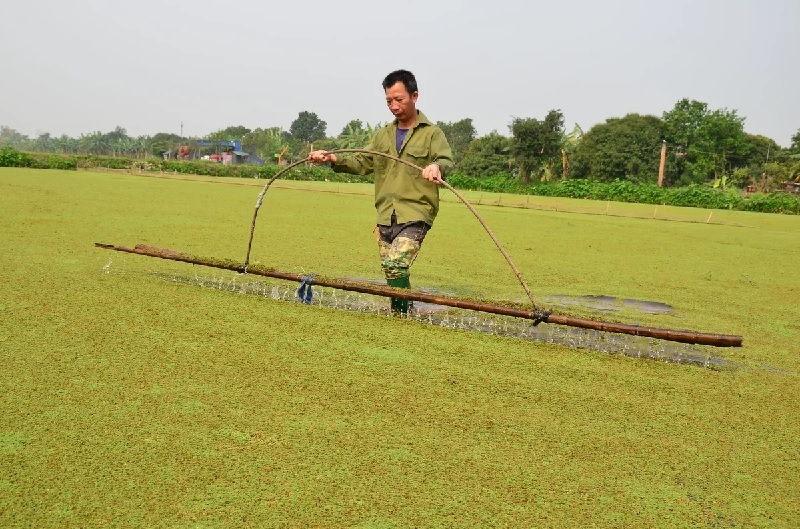
Cultivating duckweed in Hung Yen. Photo: Duong Dinh Tuong.
Meanwhile, rice farming practices in Vietnam still rely heavily on chemical fertilizers, making farmers most vulnerable if the fertilizer market experiences significant fluctuations due to political factors, energy crises, or climate change. This highlights the need to find more sustainable production solutions and reduce reliance on imported inputs.
In the past, duckweed was a familiar component of the rice paddy ecosystem in Northern Vietnam. According to many agricultural documents, this aquatic plant once covered more than 1.5 million hectares of rice fields and contributed to creating fields with yields of 5-7 tons/ha even during periods of chemical fertilizer scarcity.
Duckweed has the ability to form a symbiotic relationship with the cyanobacterium Anabaena azollae, helping to fix nitrogen from the atmosphere and convert it into a nutrient source for rice plants. Therefore, using duckweed in rice cultivation can significantly reduce the amount of chemical nitrogen fertilizer needed.
In the current context, as agriculture moves towards ecological models and reduces greenhouse gas emissions, reassessing the value of traditional farming methods such as duckweed cultivation is essential, especially when combined with modern agricultural technology.
Benefits for the nation and benefits for individual farming households.
According to studies and experiments on rice cultivation in Vietnam and some Asian countries, using duckweed can help reduce urea fertilizer use by about 30% while maintaining stable rice yields. Assuming an average nitrogen fertilizer application rate of about 120 kg N/ha (equivalent to about 260 kg urea/ha) and a urea price of about 10,000 VND/kg, the current urea fertilizer cost would be around 2.6 million VND/ha.
By reducing urea usage by 30% using duckweed, farmers can save approximately 0.78 million VND/hectare/crop. If applied to 1 million hectares of rice, the total fertilizer cost savings could reach around 780 billion VND per crop. This is a significant figure given the ever-increasing input costs in agriculture.
Besides reducing fertilizer costs, the use of duckweed can also contribute to reducing greenhouse gas emissions in rice cultivation. The presence of duckweed on the rice field surface can help reduce methane (CH₄) emissions by about 20-40%. With an average emission level of about 1.2-1.5 tons CO₂e/ha/crop, a reduction of about 30% could result in a reduction of 0.36-0.45 tons CO₂e/ha/crop.
With a voluntary carbon credit price of approximately US$10/ton of CO₂e (equivalent to about VND 250,000), the value obtained could reach approximately VND 100,000/ha/crop. If implemented on 1 million hectares, the potential revenue from carbon credits thanks to duckweed could reach approximately VND 100 billion per crop. Notably, the carbon credit market based on nature-based solutions is showing strong growth. Some forecasts suggest that the price of carbon credits from biological solutions could reach approximately US$45/ton by 2030.
In addition to its direct economic benefits, duckweed also brings many ecological advantages to agricultural land.
Besides some mountainous areas where the ecological environment of rice fields is preserved and duckweed still exists naturally, there are currently some models of cultivating duckweed for medicinal purposes in Thai Binh or as feed for aquaculture in Hanoi.
When decomposed in rice paddies, duckweed provides organic matter, essential nutrients such as N, P, K, and many important trace elements. Under favorable conditions, duckweed can fix approximately 1,100 kg of nitrogen/ha/year. This improves soil fertility, soil structure, and reduces the need for chemical fertilizers in subsequent crops by 10-20%. This not only reduces costs but also lays the foundation for the development of organic and green agriculture – one of the major directions of Vietnam's agricultural sector.
Considering all direct economic factors, if the duckweed model is implemented on 1 million hectares of rice in one crop season, the estimated benefits include saving 780 billion VND in fertilizer costs per crop and generating 100 billion VND in income from selling carbon credits per crop season. If applied to two rice crops per year, the total economic benefits could reach approximately 1,580 billion VND per year.
At the household level, each hectare of rice cultivation using duckweed can yield an additional benefit of approximately 1.5 million VND per year (for two crops) from reduced fertilizer costs, not including a 10-20% reduction in fertilizer use in subsequent rice crops. Given the continuously rising price of urea fertilizer and the immeasurable benefits for soil health, crops, the environment, and the brand value of organic rice, the use of duckweed in rice cultivation is a solution that deserves attention.
Beyond its economic value, the restoration and development of the rice-duck farming system also brings many macro-level benefits: reducing dependence on imported fertilizers, saving foreign currency, contributing to Vietnam's commitment to reducing methane emissions at COP26, improving soil and water quality, and promoting the development of organic agriculture.
However, frankly speaking, for duckweed to be widely applied again, policies are needed to research the mechanization and automation of its cultivation and processing. This includes establishing a gene bank and creating heat-tolerant duckweed varieties suitable for different soil and climate conditions in Vietnam. A carbon credit market should be established for rice cultivation combined with duckweed. Cooperatives and companies specializing in duckweed breeding services should be formed to supply farmers. Universities and agricultural research institutes should be encouraged to vigorously conduct research on the application of duckweed in Vietnam, while also expanding international cooperation in this field.
In the context of global agriculture facing many unpredictable changes, effectively utilizing available biological resources such as duckweed could become an important direction to enhance the self-reliance and sustainability of Vietnam's rice production.
https://nongnghiepmoitruong.vn/