Biopower enhances the efficiency of extensive shrimp-rice farming
AN GIANG: Biological products help treat rice straw directly in the field, stabilize the environment, reduce toxic gases, create a natural food source, and improve the productivity and efficiency of shrimp-rice farming.
Transforming straw into nutrients
U Minh Thuong is a key area in An Giang province for the rotational farming of shrimp and rice (one crop per year), with shrimp and rice cultivation. In particular, Vinh Hoa commune, with over 4,600 hectares of shrimp-rice fields, has become the main source of livelihood for thousands of households. However, farmers often face difficulties in collecting and processing rice straw after the harvest to prepare for the next shrimp farming season.
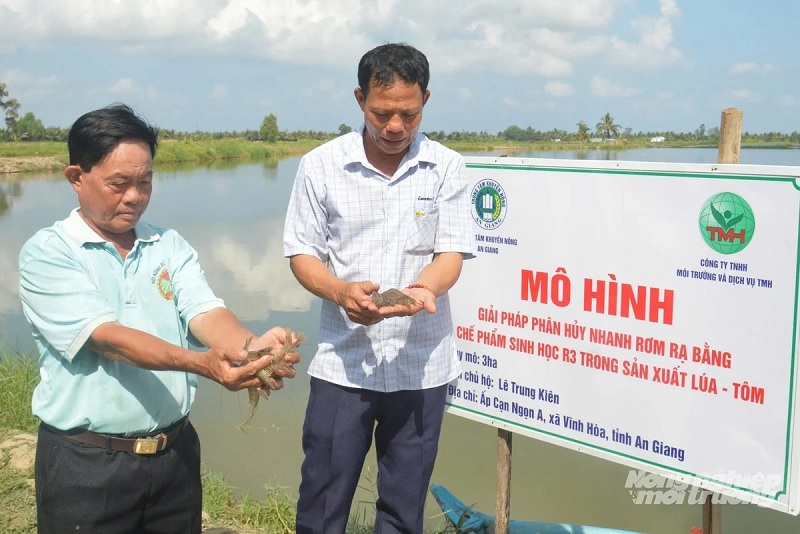
Biological solutions not only help farmers effectively manage straw but also retain nutrients in the soil, creating a favorable ecological foundation for shrimp and crab development. Photo: Trung Chánh.
Traditionally, rice straw is often burned directly in the fields or soaked in water and then discharged into the environment. While this method is quick, it has many negative consequences. The water used to soak the straw in anaerobic conditions turns black and emits a foul odor due to the accumulation of organic compounds and toxic gases. When discharged into canals and ditches, this water reduces dissolved oxygen, shocks the environment, and can cause mass deaths of aquatic life.
Based on this reality, the An Giang Agricultural Extension Center, in collaboration with TMH Environmental and Service Company Limited, implemented a model using the R3 biological product to treat rice straw directly in the field. This solution does not eliminate organic matter but utilizes a controlled decomposition process, retaining nutrients while limiting the generation of toxic gases.
The model was implemented in Can Ngon A hamlet, Vinh Hoa commune, on an area of 3 hectares belonging to Mr. Le Trung Kien's household. Mr. Tran Ha Quang Du, a technical officer from the Fisheries Extension Department - An Giang Agricultural Extension Center, who monitored the model, said that after harvesting the rice, farmers pump water into the fields, supplement with R3 biological products, and combine this with applying lime and dolomite to stabilize pH and monitor environmental indicators.
After only about 2-3 weeks, the water in the ponds turns tea-colored, the foul odor disappears, and the pH and alkalinity levels are all within safe limits for shrimp development. More importantly, this process eliminates the need for farmers to repeatedly soak and rinse the ponds as before, thereby reducing pumping costs, saving labor, and minimizing negative impacts on the surrounding environment.
Increasing ecological value
Besides improving the environment, the application of biological products also creates an abundant source of natural food for farmed shrimp. As straw decomposes, microorganisms thrive, forming organic matter, algae, and plankton, which are natural nutrients that help shrimp grow better.
Mr. Le Trung Kien, a household directly participating in the model, said that thanks to microbial treatment, shrimp fry can be released into the ponds right from the first water intake, significantly shortening the preparation time. During the farming process, the shrimp develop uniformly, the survival rate is high, and the feed conversion ratio is low, showing a clear improvement in feed efficiency compared to traditional methods.
The model was implemented using a multi-cropping approach, combining brackish water shrimp farming with sea crab farming in the same area. After 55 days of stocking, Mr. Kien harvested 920 kg of shrimp, with an average size of 92 shrimp per kg, selling them at 96,000 VND/kg, for a total revenue of over 88 million VND. After deducting expenses, the initial profit reached over 26 million VND.
However, this is only the initial economic benefit of the farming season. For the remaining approximately three months, farmers will continue to harvest in multiple batches, while also exploiting the additional value from the mixed-farming crabs, promising significantly higher income.
Ms. Nguyen Thi Minh, Director of TMH Environmental and Services Co., Ltd., said that the R3 product contains beneficial microbial strains that help decompose rice straw quickly right in the field. Compared to traditional methods, this biological solution not only reduces labor but also retains nutrients in the soil, creating a favorable ecological foundation for shrimp and crab development.
In the context of increasingly complex climate change, utilizing agricultural by-products in a biological way is becoming an inevitable direction. This solution not only addresses environmental issues but also contributes to increasing value per unit area, helping the shrimp-rice farming model in U Minh Thuong develop in a green, sustainable direction and better adapt to natural conditions.
https://nongnghiepmoitruong.vn/