Positioning Ca Mau’s Rice–Shrimp “Pearl”: A Strategic Agricultural Transformation Toward Ecological Branding, Carbon Value, and Sustainable Regional Leadership
Ca Mau Province is redefining its agricultural future by transforming its distinctive rice–shrimp farming system from a localized ecological practice into a strategic model for premium branding, green economic growth, and climate-adaptive agriculture. Rather than competing primarily on production volume, Ca Mau is increasingly positioning itself around quality, sustainability, and differentiated ecological value—an approach that could reshape not only its own agricultural identity, but also contribute to a broader reorientation of Mekong Delta farming toward higher-value, lower-emission development.
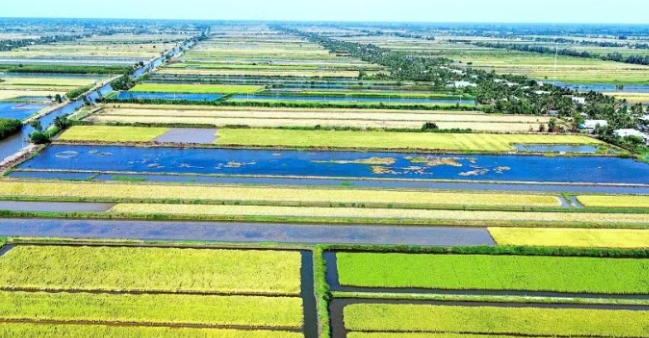
At the center of this strategic shift is Ca Mau’s rice–shrimp system, a uniquely integrated farming model in which rice cultivation and shrimp aquaculture coexist in seasonal ecological balance. This system is particularly important because it aligns with multiple global agricultural priorities simultaneously: reduced chemical input, biodiversity preservation, climate adaptation, and lower carbon intensity. In a world increasingly focused on food traceability, environmental sustainability, and premium health-conscious consumption, this gives Ca Mau a potentially powerful competitive advantage.
Provincial leadership, as articulated by Vice Chairman Le Van Su, is making a deliberate move to position Ca Mau’s rice not simply as another commodity, but as an “ecological pearl” associated with environmental integrity and human health. Hosting the first Mekong Delta Delicious Rice Competition is therefore not merely a promotional event—it serves as a strategic launchpad for redefining market perception and elevating Ca Mau’s rice into premium and selectively export-oriented segments.
This approach reflects a fundamental agricultural philosophy change: from maximizing yield to maximizing value.
Ca Mau’s strategy rests on three major pillars.
First is product standardization. This includes improving quality benchmarks, production protocols, and traceability systems to ensure that ecological claims translate into verifiable market trust.
Second is branding and geographical identity. By building labels, regional reputation, and potentially geographical indications, Ca Mau aims to distinguish its rice in increasingly segmented domestic and international markets.
Third is green economic integration, particularly through low-emission agriculture and carbon markets. The province’s ambition to develop over 50,000 hectares of high-quality, low-emission rice production by 2030 demonstrates an effort to align local agricultural systems with emerging carbon-credit opportunities and Vietnam’s national climate commitments.
This carbon dimension may prove especially transformative. If ecological rice–shrimp farming can be measured and monetized through emissions reduction frameworks, farmers may gain not only from crop sales, but also from environmental value creation—effectively turning sustainability into an income stream.
Regional cooperation is equally central. Ca Mau recognizes that long-term competitiveness cannot be achieved through isolated provincial efforts. By linking raw material zones, enterprise–cooperative partnerships, logistics systems, and joint Mekong branding, the province is advocating for a more integrated agricultural ecosystem across the Delta.
This is particularly significant because fragmented production and inconsistent branding have often limited Vietnamese agricultural exports despite strong production capacity.
Ultimately, Ca Mau’s strategy represents more than rice sector reform—it is an attempt to reposition agriculture as an ecosystem of culture, sustainability, and strategic value.
Its rice–shrimp fields symbolize not only food production, but also resilience in the face of salinity, climate change, and shifting global consumer expectations.
If successful, Ca Mau could emerge as a model for how regions with environmental constraints can convert ecological uniqueness into strategic advantage.
In that vision, the “rice–shrimp pearl” is not just a product—it becomes a symbol of how sustainable agriculture can create prosperity by working with nature rather than against it.