Building a Synchronized Logistics Ecosystem at Vietnam’s Northern Border Gates: Lạng Sơn’s Digital Transformation Imperative
As trade flows through Vietnam’s northern border gates continue to accelerate, particularly in Lạng Sơn Province, logistics is emerging as both a strategic opportunity and a structural challenge. Positioned as one of Vietnam’s most critical cross-border trade corridors, Lạng Sơn has experienced substantial import-export growth, reinforcing its role as a gateway for regional and international commerce. Yet this rapid expansion has also exposed a crucial limitation: logistics capacity and operational organization have not fully kept pace with trade velocity. Increasingly, the core bottleneck is not simply infrastructure, but the absence of a synchronized, data-connected logistics ecosystem capable of supporting scale, efficiency, and competitiveness in a digital era.
Recent figures underscore the magnitude of this transformation. With import-export turnover through Lạng Sơn reaching over $29 billion by mid-April 2026—up approximately 40% year-on-year—the province faces mounting pressure to improve cargo coordination, reduce congestion, and lower logistics costs. This is especially urgent as transport infrastructure connecting key economic corridors is expected to improve further, amplifying cargo volume and operational complexity.
In response, digital transformation has become the central strategic solution. At major gateways such as Hữu Nghị International Border Gate, businesses are increasingly deploying online registration systems, cashless payments, real-time vehicle dispatch, and digital monitoring tools. These innovations are already improving operational efficiency by shortening wait times, increasing vehicle turnover, and enhancing transparency across customs and warehouse processes.
Private sector pioneers have played a particularly important role. Companies like Hữu Nghị Xuân Cương have embraced phased digital transformation strategies, beginning with internal process digitization and progressing toward integrated digital ecosystems powered by AI and Big Data. Their international collaborations, such as partnerships with Chinese logistics giant SF Express, signal a recognition that future competitiveness depends not only on domestic optimization but also on technological integration with broader cross-border logistics standards. Equally noteworthy is the emergence of green logistics objectives, including gradual electrification of cranes, forklifts, and transport vehicles—an important step toward meeting future sustainability demands within global supply chains.
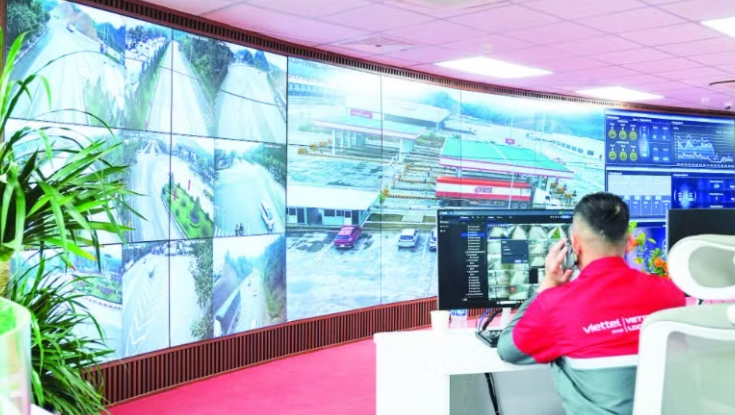
Viettel’s large-scale logistics park in Lạng Sơn further demonstrates the transformative potential of advanced technologies. By integrating IoT, digital twin models, and AI-enabled surveillance systems, Viettel’s logistics ecosystem provides real-time visibility into cargo and vehicle movement. Such systems allow predictive traffic management, more efficient customs coordination, and improved operational decision-making. For example, AI-powered route surveillance now replaces traditional physical sealing processes, reducing manual intervention while strengthening cargo security and procedural transparency.
At the governance level, customs authorities are also moving aggressively. The regional customs division’s prioritization of digital transformation, including administrative simplification and AI-enabled operations, reflects a larger institutional commitment to modernization. Reduced paperwork, streamlined procedures, and partial workforce optimization suggest that digital customs reform can produce both productivity gains and governance efficiency.
However, despite these advancements, the most significant structural weakness remains incomplete data interoperability. This is the defining barrier preventing Lạng Sơn from evolving into a truly synchronized logistics ecosystem. While the province’s digital border gate platform has been operational since 2022 and connects various local stakeholders, it remains insufficiently integrated with national-level systems. Businesses still face duplicated data entry requirements across separate governmental platforms, increasing inefficiency and undermining automation. In practice, this fragmentation forces many processes to remain semi-manual, limiting the full benefits of digitalization.
This challenge highlights a broader truth: digital logistics transformation cannot succeed through isolated innovation alone. Even advanced technologies lose efficiency when systems remain fragmented. Effective logistics modernization requires a unified architecture in which customs, transport, warehousing, inspection, enterprise software, and national databases operate through interoperable standards.
Additional barriers also persist, including uneven digital infrastructure in geographically complex border areas, shortages of highly skilled technology personnel, high capital costs for advanced systems, and organizational resistance to abandoning traditional operational habits. These issues demonstrate that logistics modernization is not solely a technical challenge—it is equally a governance, workforce, and institutional adaptation challenge.
Encouragingly, recent efforts by customs authorities to reduce procedural steps, integrate AI cameras, deploy automated barriers, and expand QR-based payment systems indicate progress toward operational simplification. Yet long-term success will depend on treating logistics not as separate facilities or software tools, but as an integrated ecosystem built around real-time data, institutional coordination, and scalable standards.
Looking ahead to 2026–2030, Lạng Sơn’s logistics future will likely be defined by its ability to evolve from fragmented operational upgrades into a comprehensive digital-border ecosystem. In this model, enterprises function as innovators and implementers, government agencies serve as regulatory architects and data integrators, digital infrastructure ensures continuous real-time operation, and green technologies support sustainability objectives.
Ultimately, the transformation of Lạng Sơn’s logistics sector is not just about improving border efficiency—it is about redefining Vietnam’s northern trade gateways as intelligent, sustainable, and globally competitive logistics platforms. If data connectivity challenges are successfully resolved, Lạng Sơn could become a model for next-generation border logistics, where digital integration transforms trade corridors into strategic engines of national economic growth.