Ensuring water supply for production and daily life during the dry season
An Giang province proactively operates its irrigation system, controls salinity, stores freshwater, and regulates water resources to serve production and people's needs during the dry season.
Proactively regulate water resources
As the dry season peaks, An Giang province is implementing a comprehensive range of irrigation solutions to ensure water supply for agricultural production, especially for the 2026 summer-autumn crop. With its vast territory after mergers, An Giang now encompasses all three ecological zones: freshwater, freshwater-brackish, and saltwater-brackish, requiring flexible water resource management tailored to each area.
According to Mr. Doan Quoc Hung, Deputy Head of the An Giang Irrigation Sub-Department, the entire province is divided into many production sub-regions such as North Vam Nao, South Vam Nao, Long Xuyen Quadrangle, the area along the Cai Lon - Cai Be river, the U Minh Thuong buffer zone, the coastal area, the Bay Nui highlands, and the islands. Each area has its own hydrological conditions, so water supply solutions also need to be scientifically calculated and closely aligned with reality to be effective.
Over the past period, the key infrastructure management units have closely coordinated to effectively operate the system of sluices, dams, and canals. In the upstream areas, An Giang Irrigation Exploitation Company Limited has proactively taken and stored water to the maximum extent in the inland fields, serving both the 2025-2026 winter-spring rice crop and creating a water source for the following summer-autumn crop. The domestic water supply for the people is also ensured to be stable.
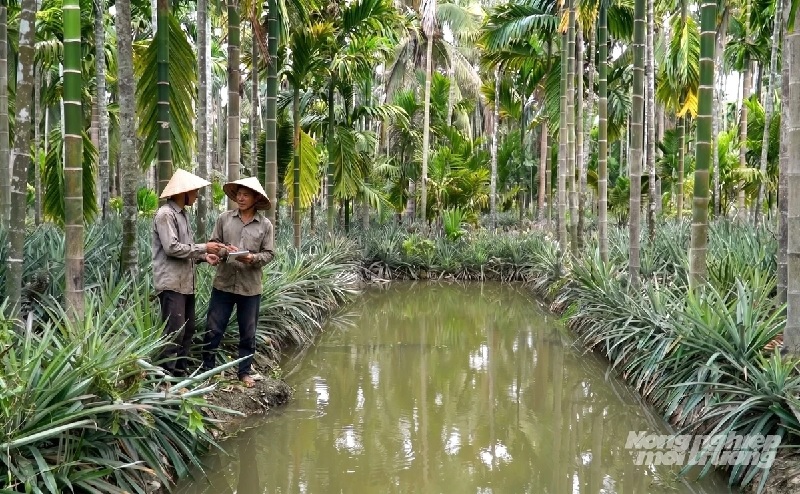
Farmers in Binh An commune store freshwater in the irrigation system to serve agricultural production. Photo: Trung Chanh.
In coastal areas and the western part of the Hau River, the An Giang Irrigation Sub-Department, in coordination with the Mekong Delta Branch of the Southern Irrigation Exploitation Company Limited, the unit managing the Cai Lon - Cai Be irrigation system, operates the Cai Lon, Cai Be, and Xeo Ro sluice gates to control salinity and maintain freshwater levels appropriately at different times. As a result, many rice and fruit-growing areas have overcome the peak of saline intrusion without significant damage.
Notably, the Vam Ba Lich sluice gate in Binh An commune is operated flexibly to cut off high tides during periods of high tides. This structure plays a crucial role in protecting freshwater resources for production and daily life of people in the area, especially Rach Gia and Phi Thong wards and neighboring communes.
Ready for the summer-autumn crop season
According to the An Giang Provincial Meteorological and Hydrological Station's forecast, from now until the end of April, water levels on major rivers and inland areas will continue to gradually decrease, while salinity may remain high until the end of April before rapidly decreasing from May. This is a sensitive period for summer-autumn crop production, especially in the planting and early irrigation stages.
In light of this situation, the An Giang Irrigation Department has requested that units continue to operate the North Vam Nao, South Vam Nao systems and main sluice gates effectively to take advantage of water extraction and maximize water storage in inland canals. Water regulation will closely follow the seasonal schedule, the needs of each region, and the actual water resource situation.
In the Long Xuyen Quadrangle region, the basic sluice gate system is now complete, and the water supply for production and daily life is considered quite stable. The western part of the Hau River region now has the Vam Ba Lich sluice gate, which provides proactive regulation when there is a risk of saltwater intrusion. Meanwhile, the U Minh Thuong region is in the brackish water shrimp farming season, so the water supply basically meets the specific production requirements of the area.
However, ensuring water supply in An Giang province still faces some difficulties that require investment to overcome. The irrigation system in many areas is not yet synchronized, and the ability to regulate water locally is limited. Some canals and ditches have been polluted for a long time, resulting in the closure of sluice gates to retain freshwater. Further improvements are needed in the downstream areas of the Cai Lon sluice gate to enhance the overall system's efficiency.
To effectively respond to the dry season, the authorities of communes, wards, and special zones are required to closely monitor weather developments, salinity levels, and water levels, and promptly inform people to check water quality before pumping for irrigation. At the same time, they should encourage people to use water sparingly, store water scientifically, and avoid using saline water in fields or ponds.
With proactive measures taken early on and coordinated efforts across various sectors, An Giang is creating a proactive approach to agricultural production during this year's dry season. Maintaining a stable water supply not only allows farmers to confidently plant new crops but also provides a foundation for the locality to continue developing climate-adaptive agriculture, aiming for green and sustainable growth.
https://nongnghiepmoitruong.vn/