Shifting from pollution control to river ecosystem restoration
Instead of just controlling pollution, we need to approach it from the perspective of assessing the "health" of the water system in order to find fundamental, long-term solutions for rivers.
The Department of Water Resources Management (Ministry of Agriculture and Environment) recently collaborated with the Asian Development Bank (ADB), the Vietnam Institute of Water Resources Science, and other relevant agencies and organizations to hold a seminar on "Solutions for Water Resource Restoration". The forum attracted a large number of delegates from ministries, localities, research institutes, universities, businesses, and international organizations.
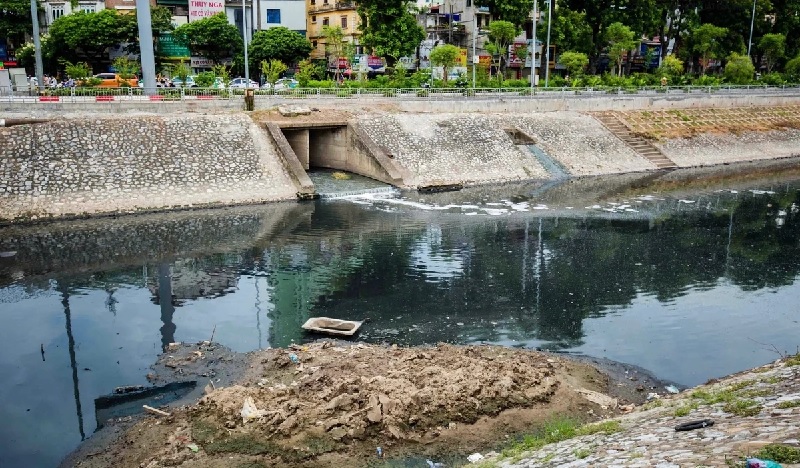
Under pressure from urbanization and industrialization, many rivers are severely polluted. Photo: Viet Anh.
Water resources are deteriorating, adding pressure upon pressure.
Deputy Director of the Department of Water Resources Management, Nguyen Hong Hieu, frankly acknowledged that the reality presents many serious challenges. Under the impact of climate change, along with increased water exploitation and use, and pressure from urbanization and industrialization, many water resources in Vietnam are rapidly degrading.
Many rivers, canals, and streams have become heavily polluted, even turning into "dead rivers" that are no longer able to self-cleanse. The consequences extend beyond the environment, directly impacting water supply for domestic use and production, public health, and the ecological balance.
In light of this situation, the Party and Government have identified water resource restoration as an urgent task with strategic significance in ensuring national water security. To provide a specific legal framework, the 2023 Water Resources Law has added many regulations and policies related to river restoration, such as regulations on financial mechanisms and policies for water resource restoration activities, to provide a basis for mobilizing and allocating resources to restore degraded, depleted, and polluted water sources.
Specifically, the Prime Minister assigned the Ministry of Agriculture and Environment to develop a project titled "Investigation, assessment, and proposal of pilot plans for restoring degraded, depleted, and polluted water sources in the Bac Hung Hai, Nhue-Day, and Ngu Huyen Khe rivers." This project aims to regulate, distribute, restore, and develop surface water resources; strictly manage and control sources of surface water pollution in the rivers; and pilot the application of mechanisms and policies to maximize the mobilization of social resources...
According to Mr. Nguyen Hong Hieu, this is not only an urgent task in the short term but also a long-term one, requiring the synchronized involvement of the entire system, from management agencies and scientists to businesses and the community.
Restoring water sources to rivers
Analyzing the root causes of water resource degradation in more detail, Associate Professor Dr. Trinh Quang Toan (Vietnam Institute of Water Resources Science) argues that when the natural water supply is no longer maintained, the river's self-purification capacity is almost completely eliminated. This leads to the accumulation of pollutants, causing a rapid increase in pollution indicators. In other words, the decline in water quality is essentially a consequence of a shortage in quantity.
Therefore, Associate Professor Dr. Trinh Quang Toan proposed a holistic approach to the restoration problem, combining both structural and non-structural solutions. In particular, technical solutions such as groundwater replenishment , construction of regulation systems, and maintaining river flow play a crucial role in restoring the "water source" for rivers.
Besides technical solutions, Associate Professor Dr. Trinh Quang Toan believes that strategic and managerial factors play a decisive role. "Identifying the right goals, building a clear system of criteria, and organizing regular monitoring will help accurately identify areas of decline. By answering the questions of where, when, and to what extent recovery is possible, investment resources will be effective and avoid waste," Associate Professor Toan stated.
Digitalization and basin-based management
Based on the experiences of key river basins such as Bac Hung Hai, Nhue-Day, and Ngu Huyen Khe, experts believe that water resource restoration needs to be implemented using an interdisciplinary and inter-regional approach.
One of the solutions emphasized is establishing a system for regular monitoring linked to the annual updating of the water resource catalog. This provides a foundation for tracking changes, identifying risks early, and promptly adjusting management policies.
Therefore, modernizing the water resource monitoring system towards automation and continuous operation is considered a crucial step in improving monitoring quality. Collected data will be connected and integrated into the national database and developed in real time. When standardized and interconnected, this system will allow management agencies to proactively regulate water resources, selecting appropriate solutions for each river basin and at each time, instead of reacting passively as before.
A key point agreed upon by many experts is the need to shift management thinking from administrative boundary-based management to river basin-based management, in line with the natural laws of water flow. Simultaneously, instead of simply controlling pollution, the approach should focus on assessing the "health" of the water system to develop fundamental, long-term solutions.
In parallel, it is necessary to strictly control sources of pollution, invest in wastewater collection and treatment systems, and supplement clean water sources to improve water quality.
Experts also emphasized the need to restructure development spaces by integrating water management with urban planning, creating ecological corridors and green spaces along rivers. This is not only an environmental solution but also contributes to improving the quality of life and creating momentum for economic development.
In terms of resources, the private sector is expected to play a crucial role. The government will focus on investing in foundational infrastructure, while encouraging businesses to participate in water treatment projects, river rehabilitation, and the development of related services.
From an engineering perspective, three options were proposed: operating the reservoir to maintain water levels; constructing an underground dam; and constructing a diversion dam. Of these, the diversion dam option was considered more advantageous as it ensured water level maintenance during the dry season while not hindering flood drainage during the rainy season.
Professor Tran Dinh Hoa, Director of the Vietnam Institute of Water Resources Science, believes that applying technology and building a system for regular monitoring is fundamental to improving investment efficiency and reducing waste.
"Looking at it more broadly, this is not just an effort to 'save' degraded rivers, but also a strategic step to preserve the 'lifeline' for future generations. If we don't act decisively now, the price we pay will be the loss of the entire process of national development," emphasized Professor Tran Dinh Hoa.
With the support of international organizations such as the ADB in assessing water security according to global standards, Vietnam is hoping to create significant changes, not only restoring rivers but also ensuring a sustainable water supply for domestic use and production in the future.
https://nongnghiepmoitruong.vn/