40 mineral mines will not be auctioned off to 'quench the thirst' for material supply
Da Nang has just decided not to auction off mining rights in 40 mineral areas, in order to promptly supplement the supply of construction materials for projects.
Urgent solution
Surveys show that construction material prices in Da Nang City are at their highest level in many years. In particular, sand and stone – two essential materials – have seen sharp price increases due to prolonged shortages. Furthermore, land and leveling materials are also in short supply, directly impacting the disbursement of public investment funds, one of the city's key tasks at present.
According to the Da Nang Department of Agriculture and Environment, there are currently 72 valid mineral exploitation licenses in the city , including 7 issued by the Ministry of Agriculture and Environment and 65 by the City People's Committee. In 2025, businesses carried out exploitation according to plan and supplied a significant amount of materials to the market, including construction stone, white sand, gravel, limestone, and fill soil. However, this output is still insufficient to meet the rapidly increasing demand and investment progress.
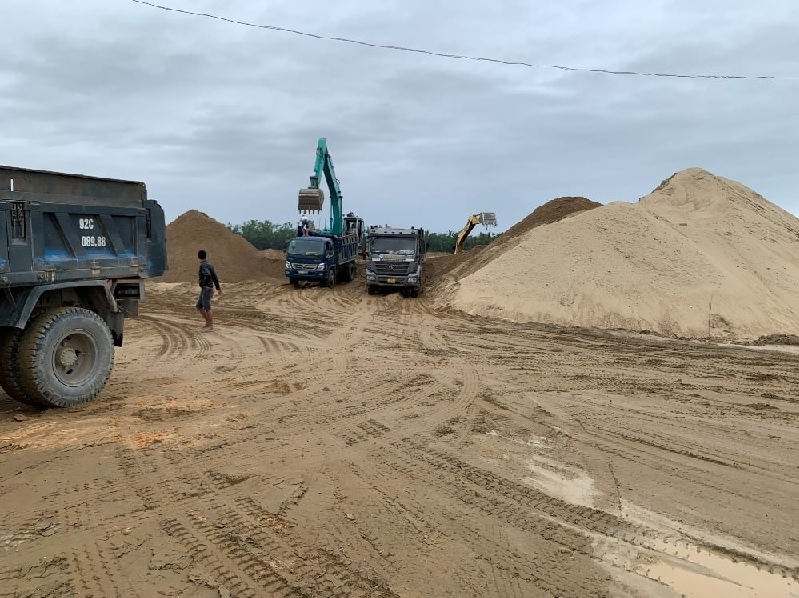
The scarcity of construction materials, especially sand, has led to very high prices. Photo: LA
Even if operating quarries and those slated for licensing operate at full capacity, the supply of construction stone will only meet about 70% of the demand.
The pressure of shortages will become even more apparent as we enter 2026. Forecasts indicate that the city's demand for construction sand alone will reach over 5.4 million cubic meters, far exceeding current supply capacity; while the projected shortage of earth and sand for leveling is over 3.2 million cubic meters. This widening supply-demand gap necessitates an urgent need for flexible and timely management solutions.
In response to this situation, the Da Nang City People's Committee issued Decision No. 990/QD-UBND dated March 20, 2026, approving the list of areas where mineral exploitation rights will not be auctioned, in order to supply common construction materials for projects in the city. This is considered a temporary but necessary solution to shorten procedures and quickly bring resources into exploitation to serve urgent needs.
According to this decision, 40 mining areas have been included in the list, comprising 6 landfill mines with an estimated reserve of approximately 21.6 million m³; 11 sand and gravel mines with approximately 9.7 million m³; and 23 stone quarries with a total reserve of approximately 25.7 million m³, along with about 1.3 million m³ of overburden. Notably, among the stone quarries, many areas have expired mining licenses but still have reserves, and are now designated for continued exploitation under a special mechanism to quickly replenish market supply.
In addition, some sand and gravel mines whose mining licenses have expired or are in potential areas are also being included in the list for re-exploitation. Utilizing existing mines helps reduce the time spent on surveying, exploration, and completing procedures, thereby significantly shortening the time to bring materials to market. This is a crucial factor in the context of rapidly increasing demand and increasingly stringent project timelines.
Businesses are still facing difficulties
To ensure effective implementation, the Da Nang City People's Committee has assigned the Department of Agriculture and Environment to take the lead and coordinate with relevant units to advise on granting mining licenses in accordance with regulations for approved mining areas. At the same time, the department will continue to review and propose the addition of areas not subject to auction, in line with planning and actual needs, to ensure the supply of construction materials for key projects.
The Department of Agriculture and Environment requests that departments, agencies, and localities proactively review projects based on Resolution 66.4/2025/NQ-CP, linking them to specific mineral mines (surveying, selecting suitable mines, and assessing material quality). Based on this, they should propose investment or project adjustments to ensure timely implementation and prevent shortages of construction materials for key projects.
The designation of 40 mining areas where mining rights will not be auctioned demonstrates the city's flexibility in the face of construction material shortages. However, according to feedback from businesses, the implementation process still has shortcomings and requires greater flexibility and coordination.
A representative of a company whose mine is included in the list stated that, although it is not subject to auction, its exploitation depends on the project investor's choice. This leaves the company in a passive position, unable to proactively plan production, mining timing, or product consumption. Meanwhile, many companies have the necessary machinery and personnel but cannot operate them, leading to increased costs, equipment degradation, and resource waste.
Businesses are also concerned that if the investor chooses a contractor, the new contractor may not be familiar with the geological characteristics and operating procedures at the mine, leading to additional risks and costs.
Based on this reality, business representatives suggest that regulatory agencies could tighten control by requiring the public disclosure of selling prices, and simultaneously mandate the supply of materials for projects using state budget funds, instead of relying entirely on the investor's specifications.
It is evident that the flexible approach to demarcation and the non-auctioning of mineral exploitation rights have contributed to resolving the "bottleneck" in the supply of construction materials for Da Nang during the current period of supply scarcity. However, for the policy to be truly effective, it is necessary to further improve the implementation mechanism to harmonize the interests of the State, businesses, and investors, while ensuring transparency and proactiveness in exploitation. When obstacles are promptly removed, the supply of materials will not only be unlocked but will also create a foundation for sustainable resource and mineral management.
The People's Committee of Da Nang City has just issued a decision to establish a working group to conduct auctions for mineral exploitation rights in the city, aiming to improve the efficiency of resource management and utilization. This group is tasked with selecting auction organizations; reviewing and evaluating applications for mineral exploitation rights auctions; and inspecting and supervising the entire auction process and procedures to ensure compliance with current laws and regulations.
https://nongnghiepmoitruong.vn/