France partners with Vietnam in managing the mining industry's environmental impact
France is one of Vietnam's active partners through technical cooperation, sharing of environmental management experience, and transfer of mining technology.
Strategic cooperation in the field of minerals
In the context of Vietnam promoting the exploitation and development of strategic minerals to serve energy transition and industrial growth, the issue of sustainable development is becoming an increasingly urgent requirement for the mining industry. France is currently one of Vietnam's active partners in this field, through technical cooperation, sharing of environmental management experience, and technology transfer.
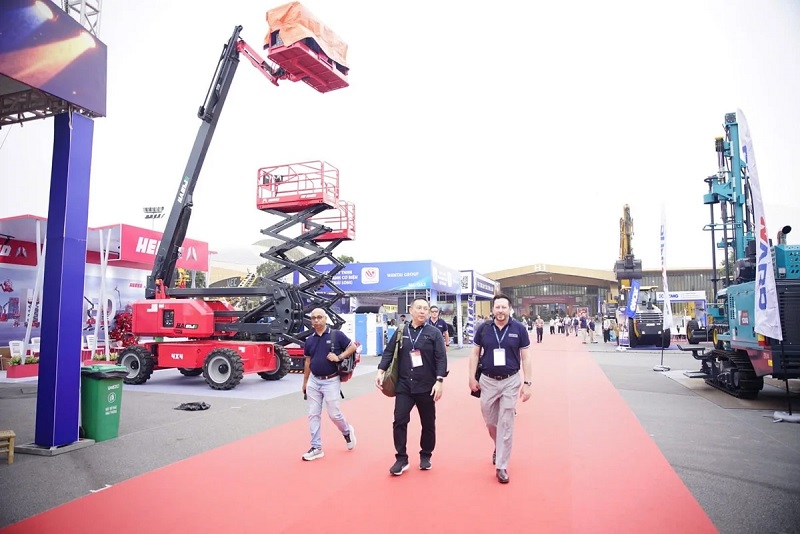
Many technologies and machinery were showcased at the International Mining & Construction Vietnam 2026 Exhibition, organized by the French Agency for Geosciences and Minerals Research (BRGM) in collaboration with the Vietnam Department of Geology and Minerals. Photo: Linh Linh.
Ambassador Olivier Brochet of France to Vietnam stated that strengthening French-Vietnamese cooperation in the fields of strategic minerals, innovation, and new technologies is part of the commitments under the Comprehensive Strategic Partnership framework between the two countries, established on October 7, 2024.
According to the French Ambassador, this cooperation is concretized through a technical assistance program implemented by the French Agency for Geosciences and Minerals Research (BRGM) to support the Vietnam Department of Geology and Minerals (DGMV) in enhancing its capacity in various fields such as developing regulations for mining operations, managing the mining industry, minimizing environmental impacts, and promoting the circular economy.
In October 2026, Business France plans to organize "French Sustainable Mining Days," bringing French businesses to Vietnam and Australia to promote cooperation on sustainable mining management.
Through specialized workshops, BRGM shared with Vietnam many experiences and technologies currently applied in France, including solutions for managing and processing geological data, managing mineral resources, and protecting the environment.
“France was once a major mining nation, possessing high and long-standing expertise in the management and exploitation of geological and mineral resources, both in the private and public sectors. And France is ready to share this expertise with Vietnam,” said Olivier Brochet.
The French ambassador also stated that cooperation in this field has significant potential for expansion in the future, particularly with the participation of the private sector.
Lessons learned from post-mining environmental management experience.
Speaking to the press on the sidelines of the "Environment in the Mine's Cycle of Life" workshop on April 22nd at the International Mining & Construction Vietnam 2026 Exhibition, Dr. Gael Bellenfant, an expert from the French Agency for Geological and Mineral Research (BRGM), said that current cooperation between the two countries focuses on many topics such as mining regulations, mining industry management, and especially minimizing environmental impact in the context of a circular economy.
The event is part of the technical cooperation program between BRGM and Vietnam, funded by the FEXTE instrument of the French Ministry of Economy, Finance and Foreign Affairs, officially launched in September 2025.
According to Bellenfant, experience in France shows that many serious environmental risks often arise after mine closure, particularly related to wastewater, tailings, and residential planning around the mining area.
"The approach we use emphasizes preventing risks from the outset rather than intervening when incidents occur, managing the environment throughout the entire lifecycle of the mine, rather than focusing only on the extraction phase," he said.
He argued that the top priority for environmental management in the mining industry is to integrate environmental factors right from the exploration and planning stages. At the same time, urban planning and land use need to be closely coordinated with mining maps to avoid developing residential areas in regions with potential pollution or subsidence risks.
According to BRGM experts, the two biggest environmental challenges currently facing the mining industry are wastewater management and waste disposal from mining operations.
BRGM is sharing various mining waste treatment technologies with Vietnam, including a process for separating water from waste to increase the dryness of sludge. This solution helps reduce the risk of pollution and facilitates long-term storage. The separated water is then further treated to remove pollutants before being discharged into the environment.
Furthermore, Mr. Gael Bellenfant assessed Vietnam's promotion of circular economy development as a positive direction. According to him, reusing or repurposing mining waste not only helps reduce environmental pressure but also creates additional economic value.
Regarding the issue of mine closure, he argued that environmental restoration plans should be developed from the moment mining permits are granted and must be accompanied by stricter monitoring mechanisms.
The need to enhance monitoring and adaptation to climate change.
According to BRGM, recent discussions with Vietnamese authorities have highlighted the need to strengthen environmental auditing, inspection, and monitoring capacity in the mining sector.
Currently, environmental audits in Vietnam mainly focus on projects with foreign investors, while domestic experts need further training to more effectively monitor mining operations. Vietnam is currently undergoing a transition regarding the mechanism of deposit guarantees for environmental restoration work by mining companies.
This is an important financial tool to ensure sufficient resources are available to address the environmental impacts after the mine closes.
Previously operating mines are not subject to this mechanism. Therefore, Vietnam is in a transitional phase and must continue to refine this system. It is also necessary to better integrate the impacts of climate change – heavy rainfall, storms, and extreme weather events – into mining and post-closure management processes.
According to Mr. Bellenfant, Vietnam also needs to better integrate the impacts of climate change, such as heavy rainfall, storms, and extreme weather, into the entire mining and post-mining management process.
AFD supports Vietnam in developing sustainable mining.
Mr. Pierrel Hugo, Deputy Director of the French Development Agency (AFD), said that cooperation in the mining sector is within the framework of the enhanced comprehensive strategic partnership between France and Vietnam.
AFD has been present in Vietnam since 1994 and has funded numerous projects related to infrastructure, climate change adaptation, water resource management, energy transition, and sustainable transport.
In the mining sector, AFD prioritizes technical support, sharing of experience, and dissemination of environmental management standards in accordance with European standards.
“Vietnam has significant potential in strategic mineral resources. If developed effectively and sustainably, this sector could make a substantial contribution to economic growth and the energy transition,” said Pierrel Hugo.
According to the AFD representative, the French side's goal is to support Vietnam in integrating environmental standards right from the exploration phase to minimize future remediation costs.
AFD is also exploring the possibility of technical cooperation with large state-owned mining enterprises such as Vinacomin, particularly in projects related to improving energy efficiency and reducing carbon emissions.
"Mining is a major energy consumer; improving energy efficiency and reducing emissions will contribute to Vietnam achieving its carbon neutrality goals," said Hugo.
https://nongnghiepmoitruong.vn/