Improve water storage solutions and proactively adapt to drought and salinity
Dong Thap province is proactively improving water storage solutions, responding to drought and salinity intrusion, ensuring freshwater resources for production and daily life, and aiming for sustainable agricultural development.
Proactively stockpile water as a "shield" against saltwater intrusion.
Climate change is having an increasingly evident impact on the Mekong Delta region , with Dong Thap province being one of the localities directly affected. In recent years, natural patterns have changed significantly: the flood season is no longer stable, while droughts and saltwater intrusion are becoming more complex and unpredictable.
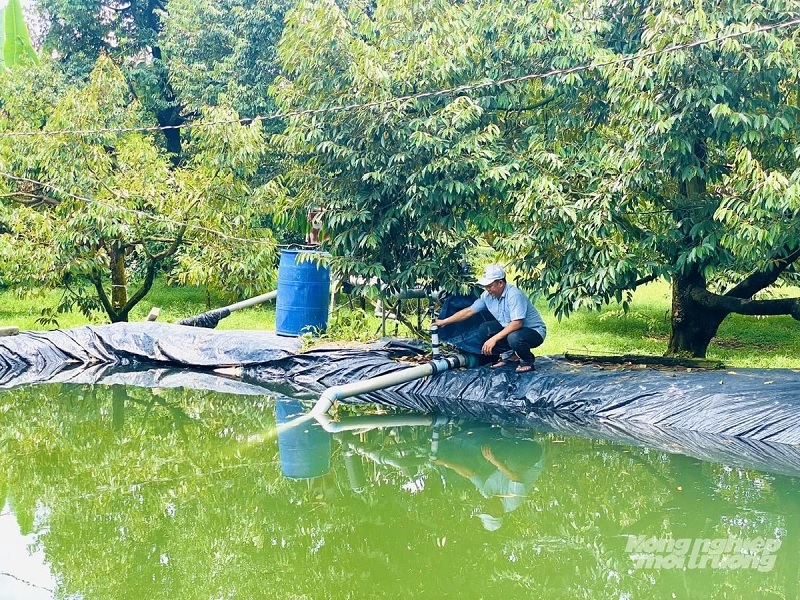
Dong Thap province is proactively improving water storage solutions, responding to drought and salinity intrusion, ensuring freshwater resources for production and daily life, and aiming for sustainable agricultural development. Photo: Le Hoang Vu.
According to Mr. Le Ha Luan, Director of the Department of Agriculture and Environment of Dong Thap province, the province's irrigation system currently serves approximately 320,000 hectares of agricultural land. However, reality shows a disparity between two extremes: in years of heavy floods, there is a risk of overflow and dike breaches in upstream areas bordering Cambodia. Meanwhile, in years of historical droughts and salinity intrusion like 2016 and 2020, many areas bordering the sea suffered severe freshwater shortages.
Typically, the Go Cong irrigation system area, covering approximately 54,400 hectares, is cut off from water due to the Cho Gao canal, preventing the Xuan Hoa sluice gate from drawing freshwater during droughts. Similarly, the delta areas, covering over 43,600 hectares, also face tidal surges and saltwater intrusion due to an incomplete irrigation system.
Given this situation, proactively storing water is considered a fundamental and long-term solution. Not only is this being done through large-scale projects, but the province is also encouraging people to adopt decentralized water storage models such as digging small ponds and lakes in their gardens, and utilizing irrigation ditches to store water for irrigation.
Mr. Nguyen Van Tam, a mango farmer in Cao Lanh commune, shared: “Previously, during the dry season, I was completely dependent on canal water. But in recent years, I have proactively dug ponds to store water, combined with a water-saving irrigation system, so my orchards still maintain productivity even during the long dry season.”
Not only individual households, but many cooperatives are also pioneering in investing in water storage systems. Mr. Tran Huu Toan, Director of Huu Hiep Durian Cooperative in Huu Hiep commune, Dong Thap province, said that for many years, members of the cooperative have proactively built freshwater storage tanks in their orchards and combined them with drip irrigation systems, saving irrigation water while improving fruit quality and meeting export requirements.
Simultaneously, public awareness campaigns have been intensified to educate people about the safe and economical use of water. Local authorities regularly update weather and hydrological forecasts so that people can proactively plan their production accordingly.
Investing in irrigation is the foundation for sustainable development
Besides immediate solutions, the long-term challenge remains improving the irrigation system to ensure efficient water regulation, storage, and distribution.
During this year's dry season, Dong Thap province has implemented many strategic solutions, such as strengthening the operation of existing irrigation works to maximize water utilization during the rainy season, while proactively storing water for the dry season. Measures to supply domestic water, such as transporting fresh water and providing water storage equipment, have also been implemented vigorously.
Notably, the province is building a comprehensive database on irrigation systems, water resources, and saltwater intrusion, aiming for technology-based management and improved operational efficiency.
Mr. Nguyen Phuoc Thien, Vice Chairman of the People's Committee of Dong Thap province, emphasized that improving water storage capacity is not only a technical solution but also an urgent requirement in the province's sustainable agricultural development strategy.
In particular, over the past period, the province has also received contributions from experts and scientists to support the locality on solutions for storing freshwater and proactively adapting to drought and salinity intrusion. In addition, it has promoted regional linkages in agricultural production, especially in supplying raw water for domestic use and production in water-scarce areas.
"We must carefully review key areas affected by saltwater intrusion to develop realistic response scenarios. At the same time, we need to focus on providing water storage equipment to the people, especially in island areas and remote regions, ensuring that no household lacks access to clean water during the dry season," Mr. Thien instructed.
According to the leaders of Dong Thap province, investing in irrigation systems should be considered a top priority, not only to cope with natural disasters but also to create a foundation for agricultural restructuring. The projects need to be designed with multiple purposes: preventing saltwater intrusion , storing freshwater, and serving transportation and economic development.
Furthermore, mobilizing social resources is also being considered to reduce pressure on the state budget. Businesses and cooperatives are encouraged to participate in investing in, exploiting, and managing irrigation works in an efficient and sustainable manner.
https://nongnghiepmoitruong.vn/