Digital transformation paves the way for modern geology
Digital transformation is creating a new impetus for the geological industry, from data digitization to the application of AI in resource forecasting and mineral exploration.
Digital data is changing the way geology is studied
Amidst the strong digital transformation taking place across many sectors, the geological industry also faces the need to innovate research methods, data management, and resource forecasting. From geological and geophysical surveys to the construction of mineral databases, the application of digital technology and artificial intelligence (AI) is opening up new approaches, contributing to improved research efficiency and serving socio-economic development.
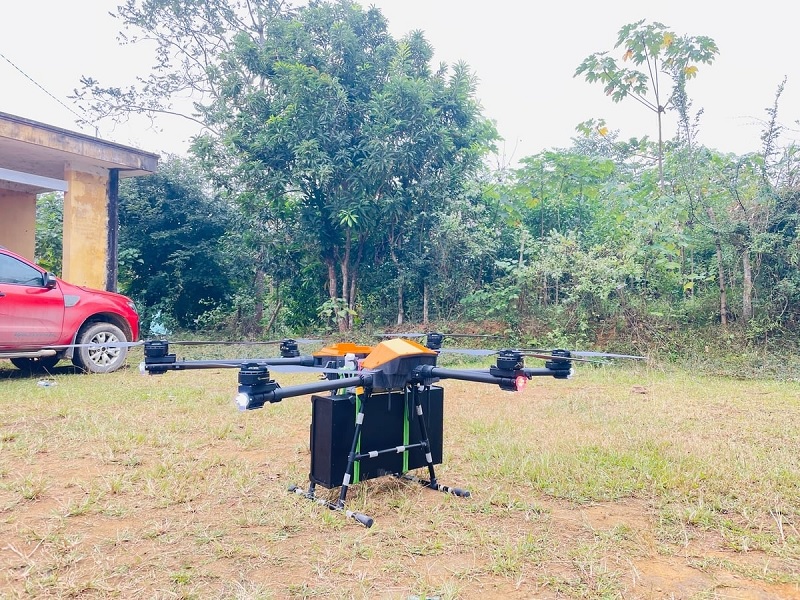
The Federation of Geophysics integrates gamma-ray spectrometers onto UAVs. Photo: Linh Nguyen.
Unlike in the past, when most geological data was stored in a fragmented manner as paper files, traditional maps, or distributed across individual units, the current trend is to digitize all information to form an integrated data system. This is considered a crucial foundation for the geological sector to move towards centralized data management, increasing the ability to share and utilize information among specialized units.
The gamma-ray spectroscopy flight projects at scales of 1:25,000 and 1:50,000 over an area of more than 95,000 km2 collected data to create field maps (magnetic field, gamma radiation field, radioactive elemental concentration field of K, U, Th).
Sharing his views on this trend, Mr. Lai Ngoc Dung, Deputy Head of the Marine Geophysics Team, Federation of Geophysics (Vietnam Geological and Mineral Resources Department), stated that digital transformation is creating a fundamental change in geophysical research activities . According to him, digitizing geophysical data and integrating information sources such as geology, drilling, and remote sensing on specialized software platforms will help improve the efficiency of managing, processing, and interpreting documents.
In practice, geological surveys are often conducted in remote areas with complex terrain and harsh weather conditions. When data is digitized and managed on modern systems, sharing and analyzing information between specialized units becomes easier, thereby improving research efficiency and shortening document processing time.
According to Mr. Dung, a notable trend today is the emergence of artificial intelligence in the field of geophysics. AI algorithms can assist in the automatic analysis and identification of magnetic, gravitational, or electro-electromagnetic anomalies, helping scientists to more quickly detect geological structures with potential mineral resources.
Beyond data analysis, AI is capable of processing large volumes of information from various sources, including geophysical, geological, drilling, and remote sensing data. When these data sources are integrated into digital systems, the construction of 2D and 3D geological models and mineral prospect forecasting can be done faster and more accurately.
New technology targets hidden resources
Along with digital transformation, modernizing geological survey technology is also considered a key task in the coming period, especially in the context of many exposed and shallow mineral resources gradually being depleted.
According to Mr. Pham Van Hung, Deputy Head of the Technical Department of the Federation of Geophysics, while many exposed and shallow mineral resources are gradually declining, mineral exploration work needs to focus strongly on discovering ore bodies located deep underground.
Following this direction, the processing and interpretation of aerial geophysical anomalies will be strengthened to identify deep structures favorable for mineral accumulation. Several key areas in the geological survey plan for the period 2021-2030, such as Western Nghe An, the Northeast region, and the North Central region, are being prioritized for surveying.
In these areas, aerial geophysics, gamma-ray spectroscopy, and gravity analysis are used to assess the prospects of mineral deposits such as tin, gold, iron, nickel, copper, or platinum at deeper levels. The application of new technologies expands the scope of surveys, instead of focusing only on depths of a few hundred meters as before.
To meet this requirement, geophysical equipment, drilling, and information technology systems are being gradually modernized, aiming to build a highly reliable data collection and processing system, while also mastering digital technologies in mapping and building integrated geological and mineral databases.
Besides technology, human resources are considered key to the digital transformation process. According to Mr. Hung, modern equipment is only effective when used with a highly qualified workforce. Therefore, training and developing young staff, along with strengthening international cooperation to enhance research capabilities and in-depth geophysical data processing , is an urgent requirement.
In the context of increasing demand for minerals for green technologies, the combination of digital technology, artificial intelligence, and high-quality human resources is considered a crucial direction to improve the efficiency of geological surveys.
From data digitization to the gradual application of AI and modern surveying technology, the geological industry is opening up a new, more scientific, faster, and more accurate research method, creating a foundation for the efficient discovery and exploitation of mineral resources to serve national development.
https://nongnghiepmoitruong.vn/