New-generation FDI – No longer about attraction, but about upgrading position
In the context of strong restructuring of global supply chains, the FDI Connect 2026 Forum raises the challenge of strengthening internal capabilities and promoting business linkages, thereby helping Vietnam enhance its position in the global value chain.
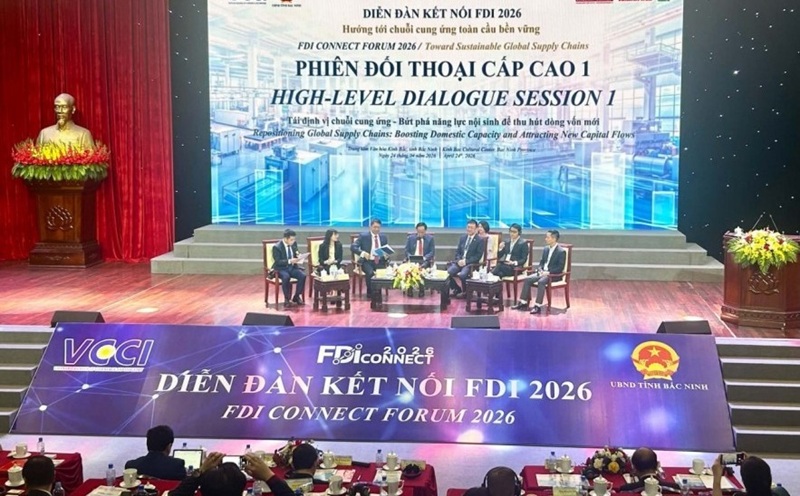
On the afternoon of April 24 in Bac Ninh, the “FDI Connection – FDI Connect 2026” Forum with the theme “Towards Sustainable Global Supply Chains,” organized by the Vietnam Chamber of Commerce and Industry (VCCI) in coordination with the Bac Ninh Provincial People’s Committee, brought together leaders from ministries, sectors, local authorities, FDI enterprises, domestic businesses, and international organizations.
Strengthening internal capacity and enhancing linkages for deeper participation in global supply chains
Not only an investment promotion activity, the forum is defined as a substantive dialogue space among economic stakeholders, setting urgent requirements to enhance endogenous capacity and strengthen linkages for Vietnam to participate more deeply in the global value chain.
Speaking at the forum, Associate Professor Dr. Hồ Sỹ Hùng, Chairman of VCCI, emphasized that in the context of strong restructuring of global supply chains, countries’ competitive advantages no longer lie in low costs but have shifted toward adaptability, transparency, and sustainable development. According to him, the forum serves as a strategic dialogue platform for stakeholders to share visions, connect resources, and shape a new position for Vietnam in the global supply chain.
The VCCI Chairman affirmed that Vietnam is becoming an attractive destination for international investment flows thanks to its strategic geographic position, stable political environment, and ongoing reform efforts. However, to attract new-generation FDI, Vietnam cannot continue relying on low-cost advantages and must instead strengthen its internal economic capacity.
According to Hồ Sỹ Hùng, this requires a clear strategy to develop domestic enterprises, especially supporting industries, so they can meet requirements in technology, quality, and governance. Vietnamese enterprises must shift from a mindset of “participation” to “upgrading their position” in the value chain, gradually mastering technology and engaging in higher value-added stages such as design, research and development, and innovation.
It has also been pointed out that linkages between FDI enterprises and domestic firms remain limited, localization rates are low, and only a small number of Vietnamese companies participate in supply chains as tier-1 suppliers. Therefore, the core objective of the forum is to promote multidimensional connections among businesses, investors, localities, and regulatory agencies, thereby identifying and removing institutional, infrastructure, and procedural barriers.
From a local perspective, Phạm Hoàng Sơn, Chairman of the Bac Ninh Provincial People’s Committee, stated that from a purely agricultural province, Bac Ninh has risen to become a high-tech manufacturing hub, particularly in electronics. In 2025, the province achieved 10.27% growth, import-export turnover of about 182 billion USD, and attracted 18.6 billion USD in investment.
In the coming period, Bac Ninh aims to pursue selective FDI attraction, prioritizing high-tech, environmentally friendly, and spillover-capable projects, while shifting strongly toward an investment model based on quality, innovation, and sustainable development.
From the perspective of international investors, Kim In Woo, Vice Chairman of the Korea Business Association in Vietnam, stated that the investment environment has changed significantly. Businesses are no longer focused solely on cost but are placing greater emphasis on technological capability, workforce quality, connectivity, and policy stability.
According to the data shared, in 2025 Vietnam–Korea trade turnover reached 94.5 billion USD, with a target of 150 billion USD by 2030; cumulative Korean investment in Vietnam exceeded 95 billion USD with more than 10,400 projects.
Experts assess that in an increasingly competitive environment, if Vietnam remains limited to processing and assembly activities, it will struggle to maintain long-term advantages. The requirement is to enhance production capacity, improve quality management, develop high-quality human resources, and build a stable, predictable legal environment, thereby gradually affirming its position in the global supply chain.
https://baochinhphu.vn/fdi-the-he-moi-kkhong-con-la-thu-hut-ma-la-nang-vi-the-10226042419241784.htm