Why Life Feels Worse at Midnight: Study of Nearly One Million Data Points Reveals the Pattern
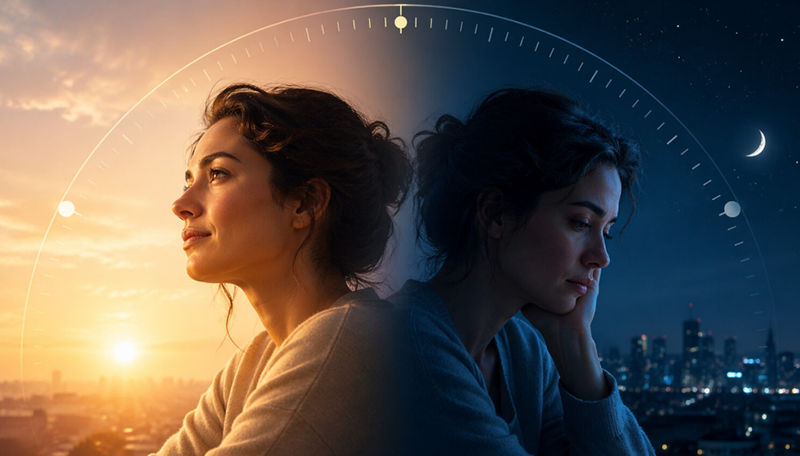
A large-scale study in the UK has uncovered a striking trend: negative emotions peak around midnight, while mornings are when people feel most optimistic and content.
The Study
Researchers at University College London (UCL) analyzed nearly one million survey responses from over 49,000 adults between 2020 and 2022, as part of the UCL COVID-19 Social Study. This is one of the most comprehensive investigations into how mental health fluctuates throughout the day.
Instead of simply categorizing moods as “good” or “bad,” the study broke mental health into six indicators: depression, anxiety, happiness, life satisfaction, sense of meaning, and loneliness. This allowed for a more nuanced picture of psychological rhythms.
Key Findings
- Morning boost: Lower depression and anxiety, higher happiness and life satisfaction.
- Midnight slump: All positive indicators decline, with negative ones peaking.
- Magnitude: Differences between morning and midnight reached up to 10% for negative symptoms and 15% for positive ones.
- Loneliness: Remained relatively stable, suggesting it is more of a persistent state than a daily fluctuation.
Interestingly, happiness and satisfaction were slightly higher at the start and end of the workweek, defying the “Monday blues” stereotype. Weekends showed more emotional volatility, with highs in the morning, dips midday, rebounds in the evening, and sharp declines at midnight.
Seasonal effects also mattered: spring, summer, and autumn saw lower depression and anxiety compared to winter. Yet the “better in the morning, worse at night” pattern held across all seasons.
Biological and Social Drivers
Scientists point to the body’s circadian rhythms. Cortisol, the stress-response hormone, peaks after waking and declines toward evening. Neurochemicals like serotonin and dopamine, body temperature, and fatigue also shape mood cycles.
But social factors play a role too—work schedules, routines, and weekend behaviors influence emotional stability.
Context and Implications
The data was collected during the COVID-19 pandemic, a period of heightened psychological stress. While this may have influenced results, it also provided unique insights into how people adapt under crisis.
Importantly, researchers caution against oversimplifying mental health. Depression, anxiety, or loneliness cannot be “fixed” by waiting until morning. Yet understanding that emotions follow natural rhythms may help people contextualize nighttime struggles.
As the study notes, negative thoughts at midnight may not just be personal—they’re part of a biological cycle. Sometimes, the best remedy is simply to wait for morning, when optimism naturally returns.