Developing a Network of Radiotherapy and Nuclear Medicine Facilities
This is one of the contents of the Strategy for the Development and Application of Atomic Energy for Peaceful Purposes up to 2035, with a vision to 2050 (the Strategy), recently approved by Deputy Prime Minister Nguyen Chi Dung under Decision No. 438/QD-TTg dated March 16, 2026.
The overall objective of the Strategy is to develop and apply atomic energy safely and securely, effectively serving socio-economic development goals, improving people’s quality of life, protecting the environment and national energy security, and contributing to achieving the goal of net-zero emissions by 2050. Put nuclear power plants into operation safely and efficiently, contributing to ensuring energy security for digital transformation and green transformation; complete a number of basic tasks in the nuclear power development program. Expand the application of radiation and radioisotopes in economic and technical sectors. Improve institutions, enhance state management capacity, strengthen nuclear science and technology potential, gradually master strategic technologies, and develop human resources to meet the requirements of atomic energy development and application, ensuring safety and security.
Operating safely the 2 Ninh Thuan Nuclear Power Plants by 2035
Regarding nuclear power development, the Strategy aims that by 2035, the construction and safe operation of the two Ninh Thuan 1 and Ninh Thuan 2 nuclear power plants will be completed; domestic enterprises are expected to participate at a rate of 30% of the total investment in construction and installation items of auxiliary components of nuclear power projects; at least 01 nuclear power plant project using small modular reactor (SMR) technology is expected to be implemented.
Complete the development of nuclear power infrastructure; complete the orientation for developing subsequent nuclear power projects in a safe, sustainable, and efficient manner, contributing to ensuring national energy security and achieving the net-zero emissions goal.
Mastering advanced nuclear techniques and radiation technology in quality management of construction works and products
Regarding the development and application of radiation and radioisotopes, by 2035 the scale and economic efficiency of radiation and radioisotope applications in industries and sectors will be increased, achieving an average growth rate of 10–15% per year.
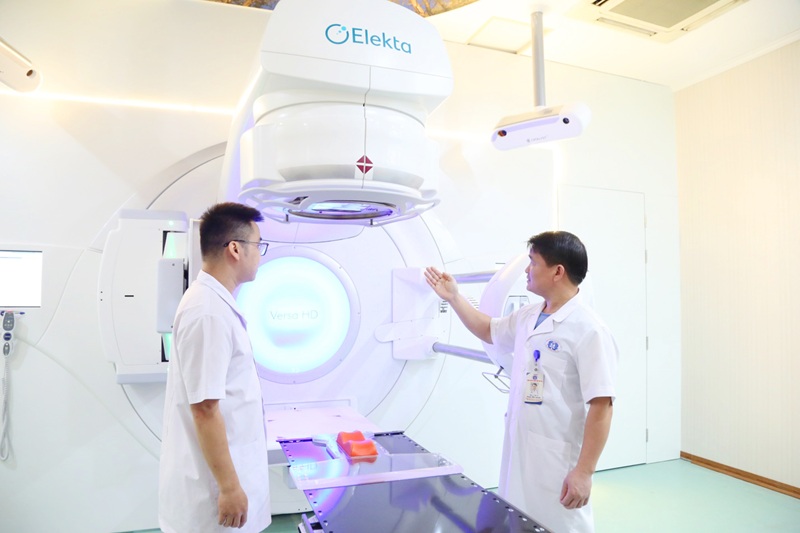
Radiation medicine will reach an advanced level among ASEAN countries, aiming for 20 CT scanners per million people, 10 MRI machines per million people, 1 gamma camera per million people, and 1–2 linear accelerator radiotherapy machines per million people, achieving 100% digital X-ray coverage.
Master advanced nuclear techniques and radiation technology in quality management of construction works and products, optimization of industrial processes, material treatment and modification; manufacture and produce some types of radiation equipment and radiation measurement and recording devices with high demand in socio-economic sectors to replace imports...
Regarding the development of nuclear science and technology capacity, ensuring radiation safety, nuclear safety and nuclear security, and human resource development, by 2035 develop a system of advanced research facilities, focusing on establishing 02 national key laboratories on nuclear power technology, rare earth, uranium, and titanium technology; 03–05 advanced laboratories; aiming to have 04–05 research groups capable of mastering some nuclear technologies supporting nuclear power projects and research reactors. Invest in 03–05 universities specializing in nuclear power education reaching advanced international standards...
By 2050, atomic energy becomes an economic-technical sector
With a vision to 2050, atomic energy will become an economic-technical sector, making an important contribution to energy security, green economy, and sustainable national development.
The share of nuclear power will account for about 6–8% of total national electricity output, with an additional 04 large nuclear reactors and 10–15 small modular reactors. Consider increasing the share of nuclear power and balancing the number of large and small modular reactors when economic and technical conditions are favorable, in line with optimal power system planning. Basically master nuclear technology, develop leading corporations and enterprises capable of construction, design, manufacturing, and production of materials and equipment for nuclear power.
Master advanced radiation and nuclear techniques in healthcare, industry, agriculture, natural resources, and environment, effectively contributing to socio-economic development. Put a large accelerator center into operation.
Vietnam’s nuclear science and technology capacity and level will reach the average level of developed countries, with modern facilities and high-quality human resources, ensuring a foundation for the development of radiation, radioisotope, and nuclear power applications; becoming a nuclear training, research, and application hub in Southeast Asia.
According to the Strategy, the orientation for nuclear power development is to build and implement a nuclear power development program with flexible scales and appropriate roadmaps, harmoniously combining large-scale nuclear power plants and small modular reactor plants. The program is concretized into synchronized mechanisms, policies, plans, projects, and schemes.
Developing, producing, and applying some radiopharmaceuticals and radioisotopes for disease diagnosis and treatment
The orientation for the development and application of radiation and radioisotopes is to develop and apply them in a synchronized, efficient, and sustainable manner, meeting socio-economic development needs, improving public healthcare quality, and protecting the environment.
In the healthcare sector, develop a balanced, synchronized, and efficient network of radiotherapy, nuclear medicine, and radiology facilities to meet the basic needs of people in all regions nationwide; strengthen research, development, production, and application of some radiopharmaceuticals and radioisotopes for diagnosis and treatment based on investment and effective utilization of existing cyclotron systems and nuclear reactors. Train and supplement radiation medicine human resources to a level equivalent to upper-middle-income countries in the world.
In the industrial sector, develop and master advanced and new technologies in the application of radiation and radioisotopes; gradually manufacture radiation equipment and radiation measurement devices, material processing and modification equipment; link scientific research and technological development with practical production needs, improving competitiveness and economic efficiency of domestic industries.
In the agricultural sector, research, access, and master advanced techniques in the application of radiation and radioisotopes for crop breeding, prioritizing research and development of some valuable radiation-induced mutant crop varieties to increase productivity, quality, and agricultural value; promote the application of radiation technology and nuclear techniques in plant protection, soil science, animal husbandry, veterinary medicine, aquaculture, preservation and processing; strengthen investment and development of irradiation facilities...
Orient the development of nuclear science and technology capacity toward modernity, synchronization, and efficiency, promoting scientific research, technological development, and innovation in the field of atomic energy; simultaneously implement basic research and applied research.
Develop the national radiation and nuclear safety authority in a professional direction, ensuring regulatory functions in accordance with International Atomic Energy Agency recommendations, with sufficient capacity, resources, organization, and staffing, serving as the core of the state management system for radiation safety, nuclear safety, nuclear security, and nuclear safeguards, meeting the requirements of atomic energy development and application, especially nuclear power.
Develop a modern, synchronized national environmental radiation monitoring and warning network based on effective utilization of existing monitoring station locations; ensure high-quality human resources for research, training, development, and application of radiation, radioisotopes, and nuclear power; develop a team of engineers, scientists, and experts in nuclear science and technology.