Digital Aspirations at Vietnam’s Southern Tip: How Ca Mau Is Reimagining Development Through Transformation
At the southernmost point of Vietnam, Cà Mau is demonstrating that geographic remoteness no longer defines economic limitation in the digital age. Guided by Resolution 57 on breakthroughs in science, technology, innovation, and national digital transformation, the province is positioning itself not simply as a peripheral agricultural region, but as an emerging model of how digital infrastructure can unlock new developmental pathways. Cà Mau’s transformation reflects a broader national trend: digitalization is no longer just about modernization—it is becoming a strategic tool for restructuring governance, agriculture, and competitiveness from the ground up.
What makes Cà Mau’s approach particularly compelling is its integration of digital transformation across all three pillars: digital government, digital economy, and digital society. The province’s full fiber-optic and mobile coverage across all communes, alongside cloud-based provincial data infrastructure meeting international ISO standards, provides the foundational architecture for this shift. This infrastructure is not merely symbolic; it directly reduces bureaucratic friction, improves transparency, and enhances investor confidence. By ensuring that 100% of businesses use e-invoices and nearly all enterprises file taxes online, Cà Mau is building a governance ecosystem where efficiency and trust become economic assets.
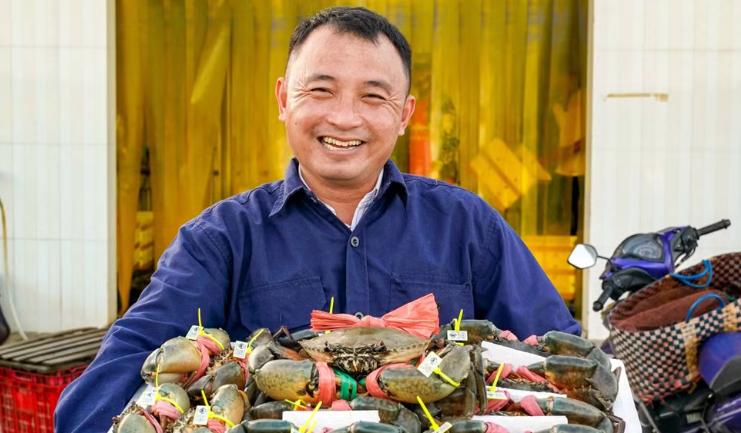
However, the province’s most transformative story lies beyond administrative offices—in its fisheries, shrimp farms, rice fields, and rural cooperatives. As one of Vietnam’s largest aquaculture hubs, Cà Mau historically faced familiar agricultural constraints: fragmented production, inconsistent standards, and weak market connectivity. Digital tools are now helping reverse these limitations. QR traceability systems, electronic production logs, e-commerce platforms, and livestream commerce are not only modernizing supply chains but also redefining value creation. Shrimp, crab, and fermented local specialties such as ba khía are evolving from regional products into traceable, export-ready brands capable of meeting strict standards in markets like the EU, the US, and Japan.
This transition signals a crucial shift from quantity-based production to data-enabled value chains. Digital transformation in Cà Mau is effectively converting agricultural identity into competitive intelligence. Farmers and cooperatives gain better demand forecasting, direct consumer access, and reduced intermediary costs, while consumers gain transparency and trust. In this sense, technology becomes not just a productivity enhancer, but a branding mechanism.
Equally important is the province’s emphasis on inclusion. By supporting cooperatives with livestreaming on trusted public platforms and digital skill-building, Cà Mau is helping smaller producers participate in the digital economy rather than be displaced by it. This democratization of digital access may prove essential for sustainable regional development.
Ultimately, Cà Mau’s “digital aspiration” is about more than adopting technology—it is about reshaping the narrative of a traditionally rural economy. By combining digital governance with agricultural innovation, the province is building a model in which even the nation’s farthest frontier can become a center of smart, sustainable growth.