Vietnam–South Korea Tech Alliance: From Manufacturing Partnership to Innovation Co-Development
The newly signed cooperation agreements between Vietnam’s Ministry of Science and Technology and South Korean partners mark a significant strategic shift in bilateral relations: Vietnam and South Korea are moving beyond traditional trade and manufacturing cooperation toward a deeper innovation-centered alliance. This evolution is especially important as Vietnam seeks to reposition itself from a technology-consuming economy into one increasingly capable of co-developing advanced technologies, digital infrastructure, and intellectual assets.
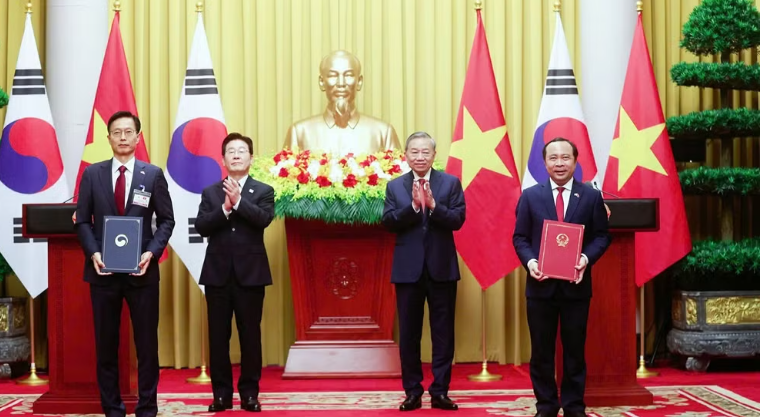
For years, South Korea has been one of Vietnam’s most influential economic partners, largely through foreign direct investment in manufacturing, electronics, and industrial supply chains. However, these new agreements suggest a broader and more ambitious framework—one focused on research and development (R&D), digital transformation, strategic technologies, and intellectual property systems. This transition matters because it aligns closely with Vietnam’s long-term development priorities under its innovation and digital transformation agenda.
The cooperation framework in science, technology, and innovation creates opportunities for Vietnam to access not just capital, but also institutional knowledge, advanced R&D ecosystems, and collaborative innovation platforms. South Korea’s success in transforming from a manufacturing-driven economy into a global innovation powerhouse offers valuable lessons for Vietnam, particularly in semiconductors, AI, telecommunications, and industrial modernization. By encouraging joint research groups, talent exchange, and shared innovation infrastructure, Vietnam gains a pathway to strengthen domestic technological capability rather than remaining dependent on imported systems.
The digital cooperation agreement is equally strategic. Collaboration in AI, 5G/6G, digital infrastructure, and telecommunications standards positions Vietnam closer to the frontier of next-generation connectivity. In a world where digital infrastructure increasingly determines economic competitiveness, this partnership could help Vietnam accelerate modernization while improving regulatory sophistication in spectrum management, service quality, and digital governance.
Perhaps most transformative is the intellectual property (IP) dimension. Historically, developing economies often prioritize production while underinvesting in IP systems, limiting their ability to capture higher-value innovation returns. Strengthening IP cooperation with South Korea can help Vietnam build stronger legal frameworks, improve enforcement, digitize administration, and—most importantly—commercialize intellectual assets more effectively. This is crucial because innovation only becomes sustainable when protected and monetized.
Still, the long-term impact of these agreements will depend on implementation quality. Vietnam must ensure that cooperation translates into domestic capability-building rather than one-sided technology transfer. Institutional readiness, talent development, and policy consistency will determine whether these agreements become transformational or merely symbolic.
Ultimately, this partnership signals Vietnam’s strategic ambition to move up the global value chain—not only as a manufacturing destination, but as an emerging innovation partner. If effectively executed, Vietnam–South Korea cooperation could become a blueprint for how middle-income economies accelerate technological sovereignty through strategic international alliances.