Ho Chi Minh City connects with the Mekong Delta to elevate the status of riverine agricultural products
"On the riverbanks, under the boats" will connect the consumption of agricultural products from the Mekong Delta in Ho Chi Minh City, promote riverine culture, and foster the development of a sustainable and professional OCOP value chain.
Tell the story of Western Vietnam's culture.
Tell the story of Western Vietnam's culture.
On the morning of May 8th, in Tan Hanh ward, Vinh Long province, the People's Committee of Phu Dinh ward (Ho Chi Minh City) collaborated with the Mekong Delta Regional Agricultural Extension Center to organize a trade and tourism promotion conference within the framework of the 2026 "On the Wharf, Under the Boat" Fruit Week.
According to the plan, the week-long event will take place from June 12 to 19, 2026, on Binh Dong, Mac Van, and Bui Huy Bich streets in Ho Chi Minh City . The opening ceremony, themed "Colors of the River - Connecting Trade," is scheduled to be held on the evening of June 12 in the Mac Van street area.
The highlight of the event is approximately 230 booths showcasing specialty fruits, OCOP products, folk cuisine, green agriculture, along with many cultural experience spaces such as making sticky rice dumplings wrapped in bamboo leaves, recreating riverine trading scenes, photo exhibitions, a book street, and displays of Vinh Long red pottery and Bat Trang pottery.
Mr. Bui Trung Truc, Chairman of the Phu Dinh Ward People's Committee, said that following the success of the 2026 Spring Flower Market, the locality continues to cooperate with provinces and cities in the Mekong Delta to build a trading space with a distinct Western Vietnam identity right in the heart of the city. According to Mr. Truc, maintaining supply-demand connection activities not only helps stabilize output for cooperatives and gardeners but also contributes to promoting the image of modern agriculture associated with the region's characteristic river tourism.
According to Mr. Van Huu Hue, Deputy Director of the Department of Agriculture and Environment of Vinh Long province, after the merger, the locality currently has nearly 481,000 hectares of agricultural land, continuing to play a key role in the economy. Of this, the area of fruit trees and coconuts reaches over 223,000 hectares, with a production of approximately 3.7 million tons per year. Coconut cultivation alone accounts for over 120,000 hectares, representing over 50% of the total coconut area nationwide.
According to Mr. Hue, the province currently has hundreds of registered growing areas that meet the requirements for export to many major markets such as China, the United States, the EU, South Korea, and New Zealand; and more than 1,100 OCOP products have achieved 3 stars or higher. This is an important foundation for Vinh Long to promote consumption linkages and expand markets for key products such as coconuts, pomelos, durians, seafood, and specialty fruits.
"This event is an opportunity for the province's agricultural products to get closer to consumers in Ho Chi Minh City through a convenient trading space rich in cultural identity," Mr. Hue said.
Initiating a strategy for deep integration of the agricultural value chain.
Mr. Doan Van Chien, Deputy Director of the Mekong Delta Agricultural Extension Center, stated that 2026 marks the beginning of a strategy for deeper linkages between cooperatives, businesses, and localities to form a sustainable agricultural product consumption chain for the entire Mekong Delta region. According to Mr. Chien, linking agricultural product promotion with distinctive cultural spaces such as the "On the Wharf, Under the Boat" model will help products create a unique identity, enhance commercial value, and improve competitiveness in the market.
“The ‘ On the Wharf, Under the Boat ’ space is not only a place for buying and selling agricultural products, but also a place to tell the story of the culture of the Mekong Delta, the value of the products, and the image of the farmers of the Mekong Delta to urban consumers. When products are associated with cultural identity, the brand value will also be enhanced,” Mr. Chien shared.
According to Mr. Chien, if agricultural products from the Mekong Delta are limited to short-term markets, it will be difficult to create a sustainable distribution system. The key is to establish stable supply-demand connection points, support cooperatives in participating in modern retail chains, reduce dependence on intermediaries, and build transparent regional raw material brands.
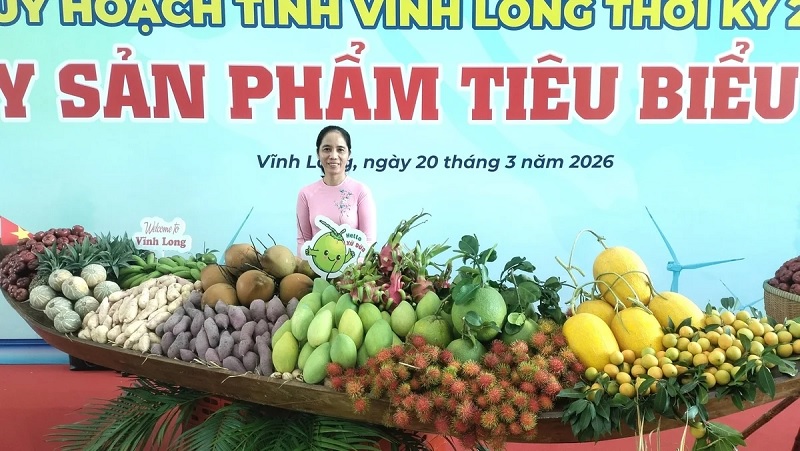
Some of the key agricultural products of Vinh Long province. Photo: Minh Dam.
Cooperative societies, businesses, and farmers also need to focus on production according to VietGAP, GlobalGAP, and OCOP standards; while strengthening traceability and ensuring food safety to build trust with consumers in large cities like Ho Chi Minh City.
Meanwhile, Mr. Lam Hoang Chi, representative of Thanh Duc Cooperative (Vinh Long), stated that, despite initial positive results, the mixing of low-quality goods and the misrepresentation of local specialties is affecting consumer trust. The cooperative representative suggested shifting from seasonal market models to establishing fixed display points and an "OCOP Supermarket" model to protect the brand of over 1,000 OCOP products in the province.
From fruit boats docking at Binh Dong to OCOP (One Commune One Product) stalls in the heart of the city, the "On the Wharf, Under the Boat" initiative is expected to become a model connecting the consumption of distinctive agricultural products of the Mekong Delta with the Ho Chi Minh City market in a professional, sustainable, and culturally rich manner.
https://nongnghiepmoitruong.vn/