Linking watermelon growers to solve the problem of bumper harvests leading to price drops
DA NANG: Production linkages and guaranteed output sales are helping many watermelon farmers in Da Nang solve the problem of bumper harvests leading to price drops.
The joy is incomplete.
These days, the watermelon fields in Chien Dan and Tay Ho communes, Da Nang city, are bustling with harvesting activity. Trucks line up to buy watermelons from the fields, and farmers are busy cutting, sorting, and loading them onto the trucks. After months of care, this year's watermelon crop is considered quite favorable, with stable weather, fewer pests and diseases, and much higher yields than in previous years.
However, the joy of a bountiful harvest is not entirely complete for the farmers, as the price of watermelons at the farm gate currently only ranges from 3,000 to 4,000 VND/kg. This price is much lower than in previous bumper harvests, when watermelons sometimes reached 8,000 to 10,000 VND/kg.
In the melon fields of Tay Ho commune, Mr. Nguyen Lam and his relatives are harvesting the last rows of melons of the season. The plump, glossy green melons are being bought by traders right in the field.
Mr. Lam said that this year his family planted 5 sao (approximately 0.5 hectares) of watermelons. Thanks to favorable weather, the plants grew well, had few pests and diseases, and the yield reached more than 2 tons per sao.
"Traders come directly to the fields to buy the produce, so farmers save a lot on transportation costs and labor for loading and unloading. At the current price, after deducting the costs of fertilizer, seeds, and labor, families still make a small profit," Mr. Lam said.
Not only Mr. Lam's family, but many households in the area also consider this year's melon crop to be favorable for cultivation. According to Mr. Truong Luc, a farmer in Tay Ho commune, melons are easier to grow this year due to stable weather, and the fruits are uniform and beautiful. However, increasing production costs are narrowing farmers' profits.
"The prices of fertilizers and pesticides have increased while the price of melons remains low, so farmers aren't making much profit. Fortunately, traders are buying directly from the fields, which eases their worries about finding buyers," Mr. Luc shared.
Encouraging production linkages
In Thanh My village (Tay Ho commune), the watermelon production linkage model of the Tay Ho Agricultural and Forestry Cooperative is beginning to show clear effectiveness. Mr. Le Van Khanh is one of the households participating in the linkage model, growing watermelons on an area of about 5 sao (approximately 0.5 hectares).
According to Mr. Khanh, when participating in the model, households are guided on clean production processes, trained in safe farming techniques, and have their product quality controlled right from the beginning of the season. More importantly, the entire harvested melon yield is purchased by the enterprise at a guaranteed stable price of 6,000 VND/kg.
"Compared to selling on the free market, this price may not always be the highest, but in return, people can rest assured because they don't have to worry about price manipulation or oversupply. Working through a supply chain ensures a much more stable output," Mr. Khanh said.
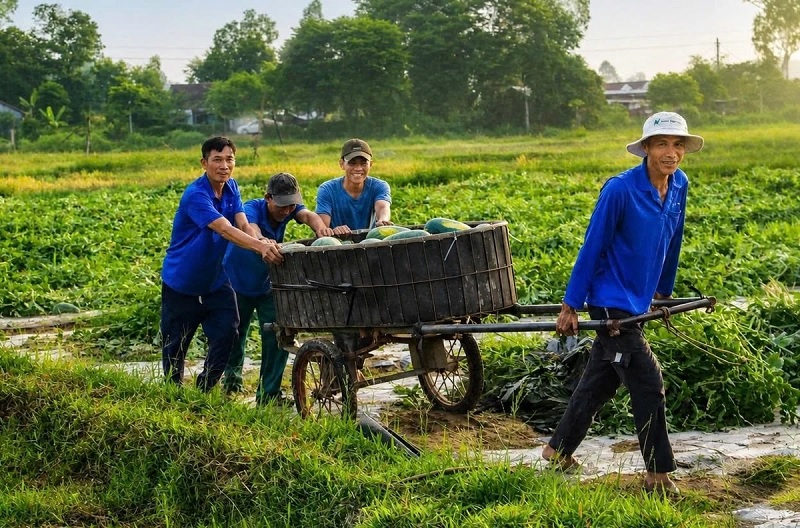
In this production linkage program, the harvested watermelons are purchased by businesses at a guaranteed stable price of 6,000 VND/kg. Photo: Lan Anh.
According to many farmers, the biggest advantage of the cooperative model lies not only in the purchase price but also in its stability. In the context of frequently fluctuating agricultural product prices, having a business guaranteeing the purchase of their produce significantly reduces market risks and allows farmers to be more proactive in their production planning.
According to Mr. Tran Quoc Danh, Chairman of the Tay Ho Commune People's Committee, the commune currently has over 270 hectares of watermelon cultivation . The majority of this is still traditional varieties grown by local farmers and sold through traders. Currently, several businesses are collaborating with farmers to produce traditional watermelons using organic farming methods. In addition, the Tay Ho Agricultural and Forestry Cooperative is also partnering with businesses to implement a model of growing round, striped watermelons under a product buyback agreement.
According to Mr. Danh, striped melon is a new variety, not a traditional one in the area. Currently, the newly established cooperative farming area is about 5 hectares, which is still quite small compared to the total area of over 270 hectares of melons in the entire region. However, the model initially shows many positive signs as the enterprise maintains stable purchasing. The locality is encouraging people to participate in the cooperative production model, but scaling it up still faces difficulties because many households are still waiting for market prices.
"Traditional watermelons have sometimes reached 10,000 VND/kg, so farmers are still considering whether to sell freely or participate in fixed-term contracts. However, market prices often fluctuate sharply, sometimes dropping very low and making it difficult to sell, so production through a supply chain is still considered a more sustainable direction," Mr. Danh said.
According to Mr. Danh, the locality is currently awaiting the City People's Council to approve a resolution on policies to support farmers, replacing Resolutions No. 17/2019/NQ-HĐND and No. 35/2021/NQ-HĐND of Quang Nam province, in order to continue supporting farmers participating in production linkages.
The formation of specialized melon-growing areas based on linkages not only helps stabilize output but also facilitates investment in infrastructure, ensures a reliable water supply for irrigation, enables the application of advanced techniques, and gradually increases the value of agricultural products.
In the context of increasingly competitive agricultural products and heavy market dependence, the shift from small-scale production to integrated supply chains is becoming an inevitable direction. With businesses partnering from production to consumption, farmers not only secure stable output but also gradually change their farming mindset, moving towards safer, more sustainable, and higher-value agriculture.
https://nongnghiepmoitruong.vn/