Multi-tiered cultivation of pineapple, betel nut, and coconut reduces pest and disease pressure
AN GIANG: The pineapple-areca-coconut farming model is proving effective thanks to good pest control, improved soil, and diversified income sources.
Multi-tiered farming reduces pest and disease pressure.
In Binh An commune (An Giang province), the pineapple-areca-coconut farming model is proving effective, not only from an economic perspective but also in terms of plant protection, helping to control pests, improve soil, and adapt to climate change.
According to the An Giang Department of Crop Production and Plant Protection, the province currently has over 9,100 hectares of pineapple, with Binh An commune alone accounting for approximately 1,764 hectares, forming a concentrated production area. A notable feature is that 100% of the pineapple area is intercropped with betel nut and coconut trees, creating a multi-layered farming ecosystem.
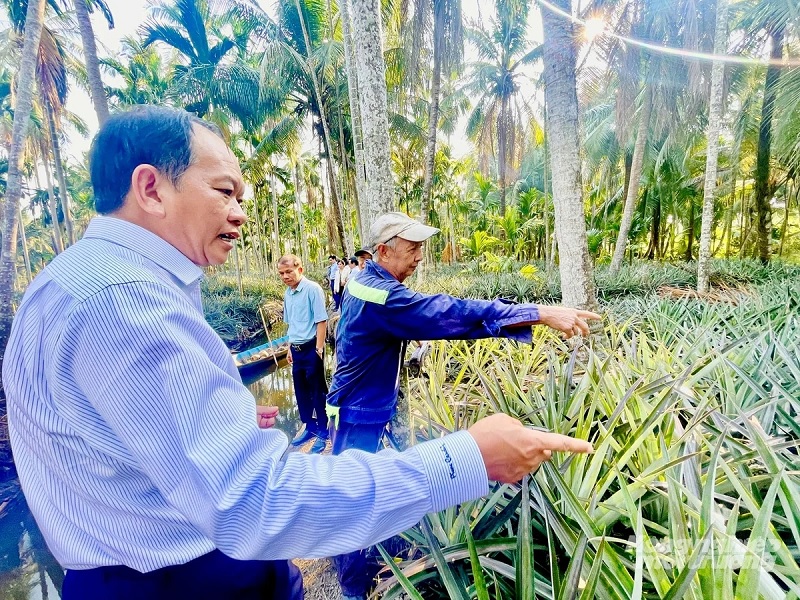
Mr. Tran Thanh Hiep, Deputy Director of the Department of Agriculture and Environment of An Giang province, inspects the pineapple-areca-coconut model in Binh An. Photo: Le Hoang Vu.
This model helps utilize light, moisture, and nutrients at each plant level, while limiting the spread of pests and diseases. The tall coconut trees provide shade to retain soil moisture, the middle-level betel nut trees regulate the microclimate, and the low-level clumps develop stably, reducing physiological stress.
However, in practice, many farmers still plant pineapples at high densities (about 3.5 plants/m²), leading to nutrient competition and increasing the risk of pest outbreaks such as mealybugs and leaf tip blight – a dangerous disease related to viruses.
Notably, the current pineapple seed sources are mainly propagated by farmers themselves using axillary buds, without any quality control, leading to signs of degeneration and disease accumulation, directly affecting yield and fruit quality.
Faced with pest and disease pressures, many farmers in Binh An have proactively changed their farming methods towards safer and more cost-effective practices.
Mr. Huynh Nam Phat, a farmer cultivating 2 hectares of pineapple, betel nut, and coconut trees, shared: “My family has been doing this model for many years, and after deducting expenses, we earn about 150 million VND in profit each year. The important thing is knowing how to care for the plants, manage the soil, and prevent diseases early so that they grow well and require less pesticides.”
According to Mr. Phat, at the beginning of the planting season, people need to improve the soil by creating raised beds, adding mud, and applying organic fertilizer to increase fertility. During cultivation, priority should be given to using manual and biological methods to control mealybugs, and diseased plants should be pruned to prevent spread.
Because of intercropping, pest and disease problems are significantly reduced compared to monoculture farming. Farmers who follow proper techniques can keep costs low while maintaining stable yields.
In reality, the cost of pesticides in this model is only about 2.85 million VND/ha, lower than many other crops. However, the effectiveness is still not optimal due to unbalanced fertilization, especially a lack of potassium - a crucial factor determining fruit quality.
Aiming for safe production and consumption linkages.
Mr. Dang Thanh Phong, Deputy Head of the An Giang Department of Crop Production and Plant Protection, emphasized that to improve the effectiveness of the pineapple-areca-coconut model, it is necessary to start with seed control and the synchronized application of technical procedures.
It is necessary to establish a system for supplying disease-free pineapple seedlings, while simultaneously guiding farmers to apply processes such as VietGAP and IPM to effectively manage pests, reduce costs, and improve product quality.
In addition, agricultural experts recommend adjusting pineapple planting density appropriately, applying balanced fertilizers, and ceasing nitrogen fertilization before harvest to ensure fruit quality meets domestic and export standards.
One problem is that pineapple output still heavily depends on traders (accounting for 68%), while the rate of linkages and guaranteed purchase agreements remains low. This leads to unstable prices, affecting farmers' income.
Mr. Tran Thanh Hiep, Deputy Director of the Department of Agriculture and Environment of An Giang province, said that the department is focusing on promoting linkages between businesses, cooperatives, and farmers.
An Giang's agricultural sector will review raw material areas, establish planting area codes, ensure food safety, and build trust with businesses. At the same time, it will strengthen the transfer of science and technology and improve seed quality to meet market demands.
In the coming period, An Giang's agricultural sector aims to develop a pineapple-areca-coconut model in an ecological and sustainable manner, linked to the value chain. The focus will be on applying a comprehensive set of solutions such as perfecting the system of disease-free seeds, promoting cultivation according to VietGAP standards, strengthening integrated pest management, reorganizing production towards cooperation, and expanding consumption linkages with businesses.
Simultaneously, investing in irrigation infrastructure, rural transportation, and providing capital and technical support to farmers are also considered key factors.
With favorable ecological conditions, production experience, and clear guidance from relevant authorities, the pineapple-areca-coconut model in An Giang is expected to become a major commodity production area, meeting domestic standards and gradually aiming for the export market.
https://nongnghiepmoitruong.vn/