The carbon bottleneck in the sugar industry lies in the raw material supply area
The sugar industry is entering a period of profound transformation where reducing emissions is no longer an option but a condition for maintaining competitiveness and accessing markets.
Pressure to reduce emissions and bottlenecks in the sugar industry.
At the workshop "Reducing Carbon Emissions in Vietnam's Sugar Industry - From Field Pilots to Scaling Up," recently organized by the Agricultural and Forestry Policy Research Network, Dr. Cao Anh Duong, Director of the Sugar Research Institute, stated that pressure from global climate commitments, domestic regulations, and the trend towards greening trade is forcing the sugar industry to restructure.
According to Mr. Duong, major markets are increasingly linking environmental criteria to trade. Mechanisms such as the EU's Carbon Border Adjustment Mechanism (CBAM) put high-emission businesses at risk of difficulty accessing markets, raising capital, and gradually being excluded from global supply chains. "For an economy with a high degree of openness like Vietnam, staying outside this trend is almost impossible," he said.
Domestically, following the COP26 commitment to net-zero emissions by 2050, along with regulations on greenhouse gas inventories and emission reduction roadmaps, businesses must gradually comply. Reducing emissions is not only a compliance cost but also an investment that increases business value, enhances brand standing, and opens access to green capital.
However, the reality of the sugar industry shows that the transformation process is not easy. Mr. Duong described it as still being a small-scale, fragmented production sector. The links between businesses and farmers are weak. Most sugar factories do not own land but sign contracts with farmers, providing capital, seeds, fertilizers, and supplies, and then guaranteeing the purchase of raw materials. But this link lacks stability, mainly following the sugarcane growing cycle, lacking long-term viability, and almost without a clear legal mechanism for sharing benefits between the parties.
"If farmers no longer make a profit and abandon sugarcane cultivation, sugar factories will lose their foundation for survival," Dr. Duong warned.
Regarding emissions, Dr. Duong pointed out that in the entire supply chain, sugarcane cultivation is the largest source, potentially accounting for up to 80%, mainly due to the use of fertilizers, especially nitrogen fertilizers, fossil fuels, and the practice of burning sugarcane leaves before or after harvest.
Based on reference emission factors from several international studies on the sugar industry in countries with similar conditions, Mr. Duong estimated that with a production of approximately 1.3 million tons of sugar in the 2024-2025 crop year, the total emissions of the industry could reach 700,000 tons of CO2e. "The focus of emission reduction in the industry should not be at the factory level but at the farm level and in the raw material areas," Mr. Duong analyzed.
In many sugarcane-growing regions, farming practices increase emissions. For example, burning sugarcane leaves after harvest is still common because farmers worry that if they don't burn them, root regeneration will be poor and pests and diseases will be difficult to control. However, burning leaves not only increases emissions but also depletes a significant amount of organic matter that could be returned to the soil. With current yields, the sugarcane tops and leaves left in the field can yield 15-25 tons/ha.
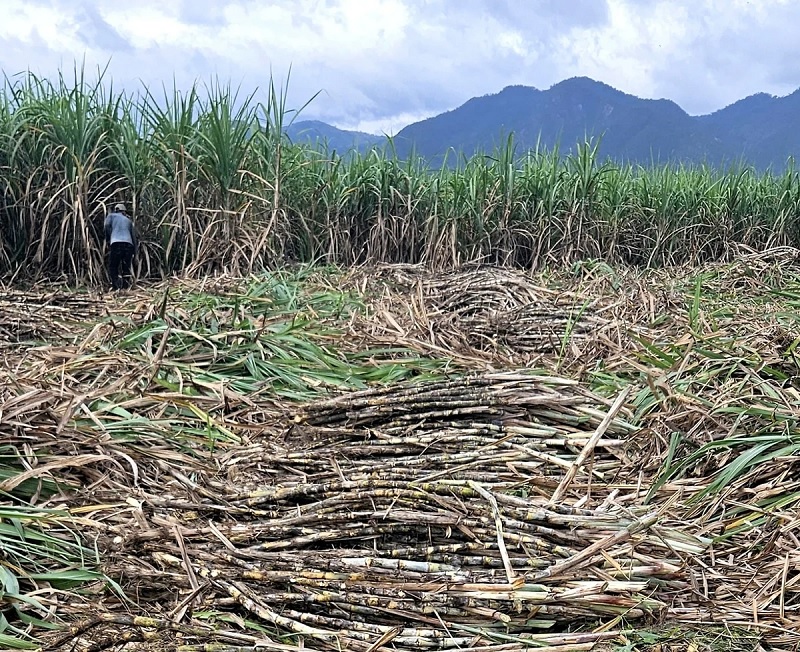
Sugarcane has a large biomass and a high proportion of by-products. Photo: NNMT.
Sugarcane possesses advantages that few other commodities have, such as large biomass, high carbon sequestration capacity, a large proportion of by-products, and potential for developing a circular economy. Mr. Duong pointed out that the stalks used for sugar pressing only account for a portion, while the rest consists of the tops, leaves, bagasse, molasses, and filter sludge. Bagasse can be used for biomass power generation, molasses is a raw material for ethanol production, animal feed, or the food industry, and filter sludge can be mixed to produce organic fertilizer.
The world is increasingly viewing sugarcane as an "energy crop." In Thailand, biomass power from the sugar industry has reached several thousand megawatts, ten times larger than in Vietnam. Currently, only a few factories belonging to the Quang Ngai and Son Duong Sugar Companies in Vietnam have separate biomass power lines, while most are used internally.
From carbon credits to restructuring the sugar industry.
One of the outstanding initiatives currently underway is the sugarcane cultivation project with reduced emissions, implemented by Lam Son Sugar Company in cooperation with Japan. The pilot project covers an area of over 500 hectares, with the long-term goal of expanding to approximately 8,000 hectares of Lam Son's raw material area, and even aiming for a larger scale if its effectiveness is proven.
This model focuses on changing farming practices to reduce emissions and increase carbon sequestration in the soil. Specifically, it involves reducing nitrogen fertilization, increasing organic fertilization, limiting the burning of sugarcane residues after harvest, and reducing the number of tillage and plowing cycles. Importantly, satellite data, soil analysis, and digital technology are used to monitor emissions and support the Measure-Report-Valuation (MRV) system.
The project also expected to generate carbon credits, with an initial estimate of around 3 credits/ha, but preliminary results showed the actual figure to be around 1.5 credits, half of the projected amount. This also complicates the carbon problem in the sugar industry. "The direct economic value from carbon credits is not attractive enough for businesses to consider it the main driving force," Mr. Duong assessed. If the area is small, the raw material region is scattered, the data is inconsistent, and the costs are higher, the scalability becomes more difficult.
However, Dr. Duong believes that carbon should not be viewed as the sole objective, but rather as a tool and a value-added component in the restructuring of the industry. The greater value lies in optimizing farming systems, reducing chemical fertilizers, lowering input costs, improving soil, limiting pollution from biomass burning, standardizing production data, and improving corporate governance capabilities. In other words, the benefits of the transformation lie in the overall efficiency of a more sustainable production model.
This view is supported by Mr. To Xuan Phuc, an expert at Forest Trends. He argues that the problems of the sugar industry have many similarities with those of coffee, rubber, cashew nuts, and some other industrial crops. These include weak farmer-business linkages, a lack of mechanisms for sharing benefits, overuse of input materials, prolonged monoculture farming, and the risk of land degradation.
Mr. Phuc also noted that the domestic carbon market could be a noteworthy direction. As large domestic emitters comply with emission reduction obligations, the demand for domestic carbon credits could increase, creating more opportunities for the agricultural sector, including sugar cane. However, for this to become a reality, a clear legal framework remains essential, particularly regarding emission measurement and verification, credit ownership, and benefit-sharing mechanisms.
According to Mr. To Xuan Phuc, viewing carbon as a single economic benefit is insufficient to create significant change. Carbon needs to be placed within a broader "basket of benefits," encompassing land sustainability, ecosystem health, long-term resilience of production areas, and fairness in the distribution of benefits between farmers and businesses.
https://nongnghiepmoitruong.vn/