Golden millet plants in the heritage area
QUANG TRI - Each millet harvest season along the Son River not only brings high income to local people but is also opening up new opportunities for this region.
In Central Vietnam this season, the sun shines like golden honey on the millet (also known as the "kien" plant), which is laden with grain.
Mr. Ngo Van Nam (Khuong Ha 2 village, Bo Trach commune, Quang Tri province ), quickly harvesting the ripe yellow millet ears and gathering them into sacks to take home, said: “This rice field area along the Son River has the largest millet cultivation area in the province. With one harvest per year, millet brings high income to the farmers.”
It's been almost ten years since we settled here.
The Son River originates from Phong Nha Cave – located within the Phong Nha-Ke Bang National Park, a World Natural Heritage site. The river is over 35 km long, with tributaries flowing through pristine forests, passing through the Phong Nha Cave area, then winding through lush green countryside before joining the Gianh River and flowing out to sea.
The section of the Son River flowing through the former Hung Trach commune (now Bo Trach commune) is quite flat, with large and small alluvial plains on both banks. Every year, after a few floods, water from upstream flows down, depositing silt on the plains, creating fields for the locals to cultivate various vegetables and short-term food crops.
Many locals in the area say that they just wait for the flood season to pass, for the mud to clear up, and then the entire alluvial plain will be ready for cultivation.
Mr. Ngo Van Nam said that his family was allocated more than 2 sao (equivalent to over 1,000 m²) of land in the alluvial plain. For generations, people in the area have been rotating crops like corn, peanuts, and mung beans on this land. "No matter what you plant, it takes root and grows well because the alluvial soil is fertile," Mr. Nam shared.
About 7-8 years ago, someone brought yellow millet (foxtail millet) seeds to try planting on the alluvial plains. The results showed that the millet grew well, with long ears, plump grains, high yields, and was easy to cultivate. Since then, people in this area have gradually switched to growing millet. "Now, in the high alluvial plains or areas with small field boundaries, people grow corn to feed livestock, while the rest is all millet. Thus, the strip of land along the Son River has become the largest millet farming area in the province."
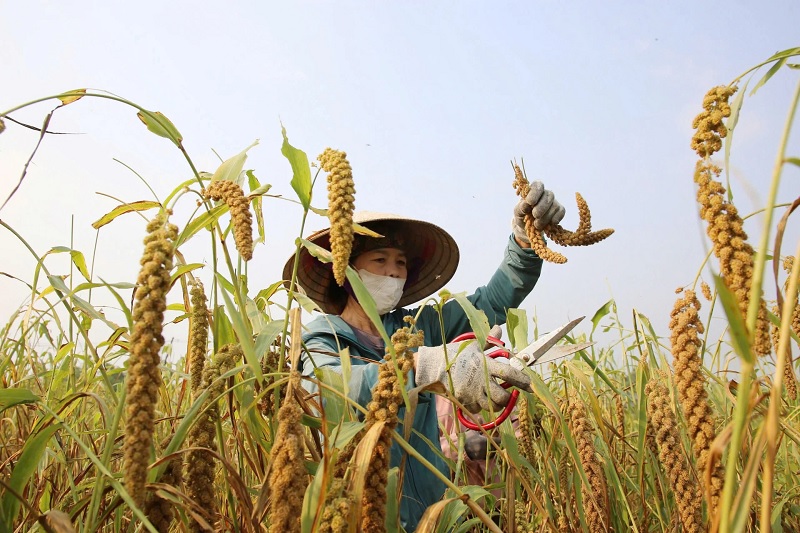
Joyful moments in the millet fields bring high income to local farmers. Photo: T. Duc.
Khuong Ha 2 village has been identified as a heritage buffer zone, therefore it has great potential for developing rural tourism. According to Ms. Vo Thi Mai, Head of Khuong Ha 2 village, many households currently cultivate millet on an area of more than 10 hectares.
Millet cultivation also takes three months, similar to short-season rice. Typically, farmers sow the seeds in the fields around January. After three months, the millet fields ripen to a golden yellow, ready for harvest. The plants grow almost as tall as a person's head, with the ears of grain hanging down in short clusters. The ears are a shimmering golden yellow, curving downwards like a fox's tail; the leaves, stems, and ripe ears all have a soft yellow hue. The ripe millet fields resemble a giant, vibrant, golden carpet.
Joy with the golden seasons
According to residents of Khuong Ha, millet is easy to grow, resistant to pests and diseases, requires low investment costs, and yields high economic returns. However, growing millet demands a lot of care, especially in thinning and weeding. Furthermore, millet can only be harvested manually, making the work quite laborious.
Ms. Nguyen Thi Xuan (Khuong Ha 2 village) said that harvesting millet is quite laborious. When the millet ripens, people use knives and sickles to cut each ear. Then the millet ears are threshed and crushed (similar to threshing rice) to separate the grains. Next, people use winnowing trays, baskets, sieves, and rakes to separate the grains from each bunch. After drying in the sun for 2-3 days (depending on the weather), the product can be stored or sold to traders.
"With a selling price of around 30,000 VND/kg and a yield of over 200 kg/acre like this year, each acre of millet brings farmers 5-6 million VND/crop. Compared to other traditional crops like corn and peanuts, millet yields twice the economic efficiency, not to mention it's easier to cultivate," Ms. Xuan said.
Ms. Vo Thi Mai, Head of Khuong Ha 2 village, said that the area planted with millet along the riverbanks of Khuong Ha 1, 2, 3, 4… villages has a total area of about 27 hectares. Of that, Khuong Ha 2 village has the largest area. “Each hectare of millet cultivation yields an income of 100-120 million VND. This is a stable source of income for many households along the river. In recent years, market demand has increased, so the area planted with millet in Hung Trach area, Bo Trach commune, has gradually expanded,” Ms. Mai said.
According to Ms. Mai, for the next millet crop, the village will encourage villagers to consolidate adjacent plots of land to plant millet in separate lots and create convenient access roads for harvesting.
“Not only do we recognize this as a key crop in agricultural production for the riverside communities, but we have also discovered new potential that this crop brings to local tourism. During harvest season, the golden fields of millet ripen under the early summer sun, becoming a popular destination for sightseeing, taking photos, and creating souvenirs, attracting many tourists on their journey through the Phong Nha - Ke Bang heritage area,” Ms. Mai said excitedly.
Millet, scientifically known as Setaria italica, is an ancient, highly nutritious food crop. Millet grains are commonly used to prepare dishes such as sweet soups, porridges, sticky rice, regular rice, milk, and rice cakes. Millet is also used to make nutritious cereal for children.
https://nongnghiepmoitruong.vn/